Thank you for visiting SNEWPapers!
Sign up free
Story
May 19, 1881
The Bolivar Bulletin
Bolivar, Hardeman County, Tennessee
What is this article about?
Article advises readers and writers on preventing eye strain through proper lighting, avoiding glare, using tinted paper, and protesting poor printing practices like fine type and solid matter in newspapers and periodicals.
Clipping
OCR Quality
98%
Excellent
Full Text
Care of the Eyes.
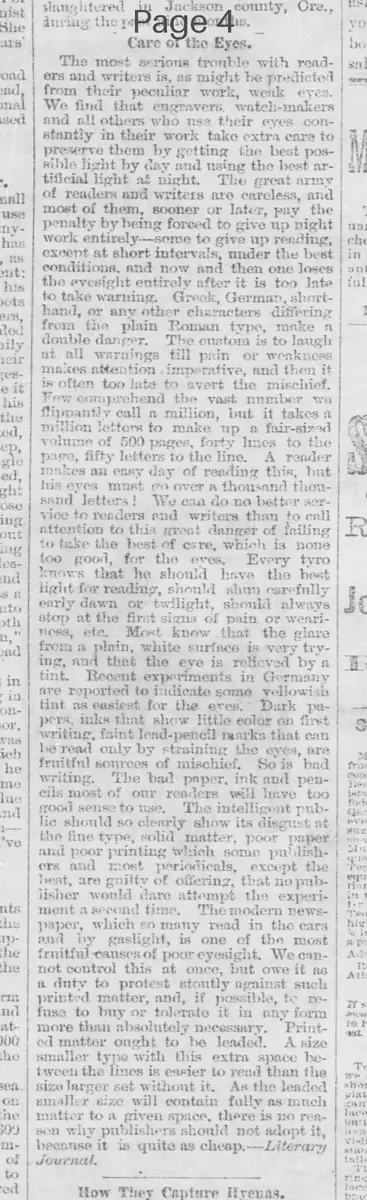
The most serious trouble with readers and writers is, as might be predicted from their peculiar work, weak eyes. We find that engravers, watch-makers and all others who use their eyes constantly in their work take extra care to preserve them by getting the best possible light by day and using the best artificial light at night. The great army of readers and writers are careless, and most of them, sooner or later, pay the penalty by being forced to give up night work entirely—some to give up reading, except at short intervals, under the best conditions, and now and then one loses the eyesight entirely after it is too late to take warning. Greek, German, short-hand, or any other characters differing from the plain Roman type, make a double danger. The custom is to laugh at all warnings till pain or weakness makes attention imperative, and then it is often too late to avert the mischief.
Few comprehend the vast number we flippantly call a million, but it takes a million letters to make up a fair-sized volume of 500 pages, forty lines to the page, fifty letters to the line. A reader makes an easy day of reading this, but his eyes must go over a thousand thousand letters! We can do no better service to readers and writers than to call attention to this great danger of failing to take the best of care, which is none too good, for the eyes. Every tyro knows that he should have the best light for reading, should shun carefully early dawn or twilight, should always stop at the first signs of pain or weariness, etc. Most know that the glare from a plain, white surface is very trying, and that the eye is relieved by a tint. Recent experiments in Germany are reported to indicate some yellowish tint as easiest for the eyes. Dark papers, inks that show little color on first writing, faint lead-pencil marks that can be read only by straining the eyes, are fruitful sources of mischief. So is bad writing. The bad paper, ink and pencils most of our readers will have too good sense to use. The intelligent public should so clearly show its disgust at the fine type, solid matter, poor paper and poor printing which some publishers and most periodicals, except the best, are guilty of offering, that no publisher would dare attempt the experiment a second time. The modern newspaper, which so many read in the cars and by gaslight, is one of the most fruitful causes of poor eyesight. We cannot control this at once, but owe it as a duty to protest stoutly against such printed matter, and, if possible, to refuse to buy or tolerate it in any form more than absolutely necessary. Printed matter ought to be leaded. A size smaller type with this extra space between the lines is easier to read than the size larger set without it. As the leaded smaller size will contain fully as much matter to a given space, there is no reason why publishers should not adopt it, because it is quite as cheap.—Literary Journal.
The most serious trouble with readers and writers is, as might be predicted from their peculiar work, weak eyes. We find that engravers, watch-makers and all others who use their eyes constantly in their work take extra care to preserve them by getting the best possible light by day and using the best artificial light at night. The great army of readers and writers are careless, and most of them, sooner or later, pay the penalty by being forced to give up night work entirely—some to give up reading, except at short intervals, under the best conditions, and now and then one loses the eyesight entirely after it is too late to take warning. Greek, German, short-hand, or any other characters differing from the plain Roman type, make a double danger. The custom is to laugh at all warnings till pain or weakness makes attention imperative, and then it is often too late to avert the mischief.
Few comprehend the vast number we flippantly call a million, but it takes a million letters to make up a fair-sized volume of 500 pages, forty lines to the page, fifty letters to the line. A reader makes an easy day of reading this, but his eyes must go over a thousand thousand letters! We can do no better service to readers and writers than to call attention to this great danger of failing to take the best of care, which is none too good, for the eyes. Every tyro knows that he should have the best light for reading, should shun carefully early dawn or twilight, should always stop at the first signs of pain or weariness, etc. Most know that the glare from a plain, white surface is very trying, and that the eye is relieved by a tint. Recent experiments in Germany are reported to indicate some yellowish tint as easiest for the eyes. Dark papers, inks that show little color on first writing, faint lead-pencil marks that can be read only by straining the eyes, are fruitful sources of mischief. So is bad writing. The bad paper, ink and pencils most of our readers will have too good sense to use. The intelligent public should so clearly show its disgust at the fine type, solid matter, poor paper and poor printing which some publishers and most periodicals, except the best, are guilty of offering, that no publisher would dare attempt the experiment a second time. The modern newspaper, which so many read in the cars and by gaslight, is one of the most fruitful causes of poor eyesight. We cannot control this at once, but owe it as a duty to protest stoutly against such printed matter, and, if possible, to refuse to buy or tolerate it in any form more than absolutely necessary. Printed matter ought to be leaded. A size smaller type with this extra space between the lines is easier to read than the size larger set without it. As the leaded smaller size will contain fully as much matter to a given space, there is no reason why publishers should not adopt it, because it is quite as cheap.—Literary Journal.
What sub-type of article is it?
Medical Curiosity
Curiosity
What themes does it cover?
Misfortune
Moral Virtue
What keywords are associated?
Eye Care
Reading Dangers
Eye Strain
Printing Practices
Lighting Advice
Publishers Criticism
Story Details
Story Details
Advises readers and writers to prevent eye weakness by using optimal lighting, avoiding glare and poor conditions, preferring tinted paper, and protesting against fine type, solid matter, and poor printing in publications like newspapers.