Thank you for visiting SNEWPapers!
Sign up free
Editorial
June 11, 1847
The Liberator
Boston, Suffolk County, Massachusetts
What is this article about?
This editorial argues that Northern abolitionism has paradoxically strengthened slavery in the South by halting internal anti-slavery discussions in states like Virginia and enabling the expansion of slave territories such as Florida and Texas, while controlling U.S. government policy through the Senate.
Clipping
OCR Quality
98%
Excellent
Full Text
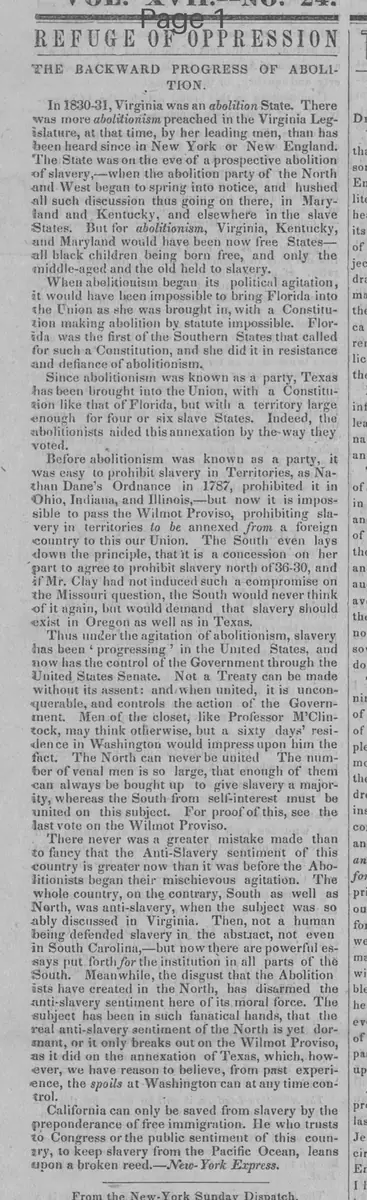
REFUGE OF OPPRESSION
THE BACKWARD PROGRESS OF ABOLITION.
In 1830-31, Virginia was an abolition State. There was more abolitionism preached in the Virginia Legislature, at that time, by her leading men, than has been heard since in New York or New England. The State was on the eve of a prospective abolition of slavery,—when the abolition party of the North and West began to spring into notice, and hushed all such discussion thus going on there, in Maryland and Kentucky, and elsewhere in the slave States. But for abolitionism, Virginia, Kentucky, and Maryland would have been now free States— all black children being born free, and only the middle-aged and the old held to slavery.
When abolitionism began its political agitation, it would have been impossible to bring Florida into the Union as she was brought in, with a Constitution making abolition by statute impossible. Florida was the first of the Southern States that called for such a Constitution, and she did it in resistance and defiance of abolitionism.
Since abolitionism was known as a party, Texas has been brought into the Union, with a Constitution like that of Florida, but with a territory large enough for four or six slave States. Indeed, the abolitionists aided this annexation by the way they voted.
Before abolitionism was known as a party, it was easy to prohibit slavery in Territories, as Nathan Dane's Ordinance in 1787, prohibited it in Ohio, Indiana, and Illinois,—but now it is impossible to pass the Wilmot Proviso, prohibiting slavery in territories to be annexed from a foreign country to this our Union. The South even lays down the principle, that it is a concession on her part to agree to prohibit slavery north of 36°30', and if Mr. Clay had not induced such a compromise on the Missouri question, the South would never think of it again, but would demand that slavery should exist in Oregon as well as in Texas.
Thus under the agitation of abolitionism, slavery has been 'progressing' in the United States, and now has the control of the Government through the United States Senate. Not a Treaty can be made without its assent: and when united, it is unconquerable, and controls the action of the Government. Men of the closet, like Professor M'Clintock, may think otherwise, but a sixty days' residence in Washington would impress upon him the fact. The North can never be united. The number of venal men is so large, that enough of them can always be bought up to give slavery a majority, whereas the South from self-interest must be united on this subject. For proof of this, see the last vote on the Wilmot Proviso.
There never was a greater mistake made than to fancy that the Anti-Slavery sentiment of this country is greater now than it was before the Abolitionists began their mischievous agitation. The whole country, on the contrary, South as well as North, was anti-slavery, when the subject was so ably discussed in Virginia. Then, not a human being defended slavery in the abstract, not even in South Carolina,—but now there are powerful essays put forth for the institution in all parts of the South. Meanwhile, the disgust that the Abolitionists have created in the North, has disarmed the anti-slavery sentiment here of its moral force. The subject has been in such fanatical hands, that the real anti-slavery sentiment of the North is yet dormant, or it only breaks out on the Wilmot Proviso, as it did on the annexation of Texas, which, however, we have reason to believe, from past experience, the spoils at Washington can at any time control.
California can only be saved from slavery by the preponderance of free immigration. He who trusts to Congress or the public sentiment of this country, to keep slavery from the Pacific Ocean, leans upon a broken reed.—New-York Express.
THE BACKWARD PROGRESS OF ABOLITION.
In 1830-31, Virginia was an abolition State. There was more abolitionism preached in the Virginia Legislature, at that time, by her leading men, than has been heard since in New York or New England. The State was on the eve of a prospective abolition of slavery,—when the abolition party of the North and West began to spring into notice, and hushed all such discussion thus going on there, in Maryland and Kentucky, and elsewhere in the slave States. But for abolitionism, Virginia, Kentucky, and Maryland would have been now free States— all black children being born free, and only the middle-aged and the old held to slavery.
When abolitionism began its political agitation, it would have been impossible to bring Florida into the Union as she was brought in, with a Constitution making abolition by statute impossible. Florida was the first of the Southern States that called for such a Constitution, and she did it in resistance and defiance of abolitionism.
Since abolitionism was known as a party, Texas has been brought into the Union, with a Constitution like that of Florida, but with a territory large enough for four or six slave States. Indeed, the abolitionists aided this annexation by the way they voted.
Before abolitionism was known as a party, it was easy to prohibit slavery in Territories, as Nathan Dane's Ordinance in 1787, prohibited it in Ohio, Indiana, and Illinois,—but now it is impossible to pass the Wilmot Proviso, prohibiting slavery in territories to be annexed from a foreign country to this our Union. The South even lays down the principle, that it is a concession on her part to agree to prohibit slavery north of 36°30', and if Mr. Clay had not induced such a compromise on the Missouri question, the South would never think of it again, but would demand that slavery should exist in Oregon as well as in Texas.
Thus under the agitation of abolitionism, slavery has been 'progressing' in the United States, and now has the control of the Government through the United States Senate. Not a Treaty can be made without its assent: and when united, it is unconquerable, and controls the action of the Government. Men of the closet, like Professor M'Clintock, may think otherwise, but a sixty days' residence in Washington would impress upon him the fact. The North can never be united. The number of venal men is so large, that enough of them can always be bought up to give slavery a majority, whereas the South from self-interest must be united on this subject. For proof of this, see the last vote on the Wilmot Proviso.
There never was a greater mistake made than to fancy that the Anti-Slavery sentiment of this country is greater now than it was before the Abolitionists began their mischievous agitation. The whole country, on the contrary, South as well as North, was anti-slavery, when the subject was so ably discussed in Virginia. Then, not a human being defended slavery in the abstract, not even in South Carolina,—but now there are powerful essays put forth for the institution in all parts of the South. Meanwhile, the disgust that the Abolitionists have created in the North, has disarmed the anti-slavery sentiment here of its moral force. The subject has been in such fanatical hands, that the real anti-slavery sentiment of the North is yet dormant, or it only breaks out on the Wilmot Proviso, as it did on the annexation of Texas, which, however, we have reason to believe, from past experience, the spoils at Washington can at any time control.
California can only be saved from slavery by the preponderance of free immigration. He who trusts to Congress or the public sentiment of this country, to keep slavery from the Pacific Ocean, leans upon a broken reed.—New-York Express.
What sub-type of article is it?
Slavery Abolition
Partisan Politics
What keywords are associated?
Abolitionism
Slavery Expansion
Virginia Legislature
Wilmot Proviso
Texas Annexation
Missouri Compromise
Anti Slavery Sentiment
What entities or persons were involved?
Virginia Legislature
Abolition Party Of The North And West
Florida
Texas
Nathan Dane
Wilmot Proviso
Mr. Clay
Missouri Question
Professor M'clintock
South Carolina
California
New York Express
Editorial Details
Primary Topic
Backward Progress Of Abolitionism Strengthening Slavery
Stance / Tone
Anti Abolitionist Critique
Key Figures
Virginia Legislature
Abolition Party Of The North And West
Florida
Texas
Nathan Dane
Wilmot Proviso
Mr. Clay
Missouri Question
Professor M'clintock
South Carolina
California
New York Express
Key Arguments
Abolitionism Halted Anti Slavery Progress In Virginia, Maryland, And Kentucky In 1830 31
Florida's Constitution Resisted Abolitionism
Texas Annexation Aided By Abolitionists' Votes, Expanding Slave Territory
Post Abolitionism, Prohibiting Slavery In Territories Like Via Wilmot Proviso Is Impossible
Slavery Now Controls U.S. Senate And Government
Anti Slavery Sentiment Was Stronger Before Abolitionist Agitation
Abolitionists' Fanaticism Has Disarmed Northern Moral Force Against Slavery
California's Freedom Depends On Free Immigration, Not Congress