Thank you for visiting SNEWPapers!
Sign up free
Gazette Of The United States And Daily Evening Advertiser
Philadelphia, Philadelphia County, Pennsylvania
What is this article about?
On January 30, the U.S. House of Representatives debated a resolution to reduce the army amid concerns over frontier defense against Indians, militia effectiveness, and British influence. Speakers including Madison, Scott, and Carnes argued against reduction. The resolution passed with 70 ayes, leading to a bill; other committees handled fortifications, rum duties, and a ship drawback.
Merged-components note: Continuation of congressional debate on military reduction across pages 2 and 3, sequential reading order.
Clippings
1 of 2
OCR Quality
Full Text
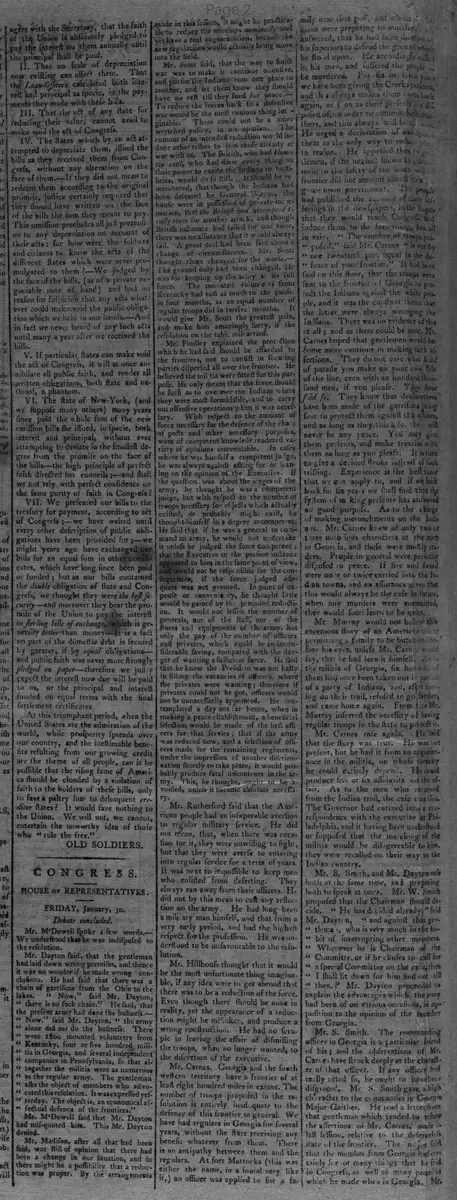
HOUSE OF REPRESENTATIVES.
FRIDAY, January 30.
Debate concluded.
Mr. M'Dowell spoke a few words.— We understood that he was indisposed to the resolution.
Mr. Dayton said, that the gentleman had laid down wrong premises, and thence it was no wonder if he made wrong conclusions. He had said that there was a chain of garrisons from the Ohio to the lakes. "Now," said Mr. Dayton, "there is no such chain." He said, that the present army had done the business.— "Now," said Mr. Dayton, "the army alone did not do the business. There were 1800 mounted volunteers from Kentucky, four or five hundred militia in Georgia, and several independent companies in Pennsylvania, so that altogether the militia were as numerous as the regular army. The gentleman asks the object of members who advocated this resolution. It was expressed yesterday. The object is, an economical effectual defence of the frontiers."
Mr. M'Dowell said that Mr. Dayton had mis-quoted him. This Mr. Dayton denied.
Mr. Madison, after all that had been said, was still of opinion that there had been a change in our situation, and so there might be a possibility that a reduction was proper. By the arrangements made in this session, it might be practicable to reduce the numbers nominally and new regulations would actually bring more into the field.
Mr. Scott said, that the way to finish the war was to make it continue Offensive, and pursue the Indians from one place to another, and let them know they should have no rest till they sued for peace.— To reduce the forces back to a defensive war would be the most ruinous thing imaginable. There could not be a more wretched policy, in his opinion. The rumour of an intended reduction would induce other tribes to join those already at war with us. The British, who had blown the coal, who had done every thing in their power to excite the Indians to hostilities, would do so still. it should be remembered, that though the Indians had been defeated by General Wayne, the house were in possession of private information, that the British had attempted to rally them for another attack, and though British influence had failed for one time, there was no assurance that it would always fail. A great deal had been said about a change of circumstances. Mr. Scott thought them changed for the worse.— The ground only had been changed. He was for keeping up the army at its full force. The mounted volunteers from Kentucky had cost as much to the public in four months, as an equal number of regular troops did in twelve months. It would give Mr. Scott the greatest pain, and make him amazingly sorry, if the resolution on the table miscarried.
Mr. Findley explained the protection which he had said should be afforded to the frontiers, not to consist in scouring parties dispersed all over the frontier. He believed the militia were fittest for this purpose. He only meant that the force should be such as to overawe the Indians where they were most formidable, and to carry out offensive operations when it was necessary. With respect to the amount of force necessary for the defence of the chain of posts and other necessary purposes, want of competent knowledge rendered variety of opinions unavoidable. In cases where he was himself a competent judge, he was always against asking for or leaning on the opinion of the Executive. If the question. was about the wages of the army, he thought he was a competent judge, but with respect to the number of troops necessary for objects which actually existed, or probably might exist, he thought himself in a degree incompetent. He said that if he was a general to command an army, he would not undertake it unless he judged the force competent ; that the Executive in the present instance appeared to him in the same point of view, and would not be responsible for the consequences, if the force judged adequate was not granted. In point of expense or convenience, he thought little would be gained by the proposed reduction. It would not lessen the number of generals, nor of the staff, nor of the stores and equipments of the army. but only the pay of the number of officers and privates, which would be an inconsiderable saving, compared with the danger of wanting a sufficient force. He said that he knew the President was not hasty in filling the vacancies of officers, where the privates were wanting; therefore if privates could not be got, officers would not be unnecessarily appointed. He contemplated a day not far hence, when in making a peace establishment, a beneficial election would be made of the best officers for that service; that if the army was reduced now, and a election of officers made for the remaining regiments, under the impression of another discrimination shortly to take place, it would probably produce fatal discontents in the army. This, he thought, ought to be avoided, unless it became absolute necessary.
Mr. Rutherford said that the American people had an insuperable aversion to regular military service. He did not mean, that, when there was occasion for it, they were unwilling to fight, but that they were averse to entering into regular service for a term of years. It was next to impossible to keep men who enlisted from deserting. They always ran away from their officers. He did not by this mean to cast any reflection on the army. He had long been a military man himself, and that from a very early period, and had the highest respect for the profession. He was understood to be unfavourable to the resolution.
Mr. Hillhouse thought that it would be the most unfortunate thing imaginable, if any idea were to get abroad that there was to be a reduction of the force. Even though there should be none in reality, yet the appearance of a reduction might be mistaken, and produce a wrong construction. He had no scruple in leaving the affair of diminishing the troops, when no longer wanted, to the discretion of the executive.
Mr. Carnes. Georgia and the southwestern territory have a frontier of at least eight hundred miles in extent. The number of troops proposed in the resolution is entirely inadequate to the defence of this frontier in general. We have had regulars in Georgia for several years, without the state receiving any benefit whatever from them. There is an antipathy between them and the regulars. At fort Mattox (this was either the name, or a sound very like it,) an officer was applied to for a family near that post, and whom Indians were preparing to murder. He answered, that he had been directed by his superiors to defend the ground which he stood upon. He accordingly called in his men, and suffered the people to be murdered. For six or seven years we have been giving the Creeks presents, and this always makes them come back again, as soon as their presents are disposed of, in order to commit such murders, and this always will be the case. He urged a declaration of war against them as the only way to reduce them to reason. He appealed then to gentlemen, if the neglect shown by government to the safety of the south western frontier did not amount almost to a disgrace upon government. The people had published the account of their sufferings in the newspapers, in the hopes that they would reach Congress, and induce them to do something, but all in vain. "The number, of troops proposed," said Mr. Carnes "is not by one twentieth part equal to the defence of your frontier." It had been said on this floor, that the troops were sent to the frontier in Georgia to protect the Indians against the white people, and it was the constant theme that the latter were always wronging the Indians. There was no evidence of this at all ; and as there could be none, Mr. Carnes hoped that gentlemen would become more cautious in making such assertions. 'They do not care what kind of parade you make on your own side of the line, even with an hundred thousand men, if you please. They have said so. They know that declarations have been made of the garrisons being sent to protect them against the whites, and as long as they think so, there will never be any peace. You may give them presents, and make treaties with them as long as you please. It is time to give a decided stroke instead of such trifling. Experience is the best tutor that we can apply to, and if we look back for six years we shall find that the system of making presents has answered no good purpose. As to the charge of making encroachments on the Indians. Mr. Carnes knew of only two or three notorious characters at the most in Georgia, and these were mostly traders. People in general were perfectly disposed to peace. If fire and sword were once or twice carried into the Indian towns, and an assurance given that this would always be the case in future, when any murders were committed, they would soon learn to be quiet.
Mr Murray would not believe this enormous story of an American officer permitting a family to be butchered before his eyes, unless Mr. Carnes would say, that he had seen it himself. As to the militia of Georgia, six hundred of them had once been taken out in pursuit of a party of Indians, and, after coming on the trail, refused to go farther, and came home again. From this Mr. Murray inferred the necessity of having regular troops in the state to protect it.
Mr. Carnes rose again. He said that the story was true. He was not present, but he had it from an acquaintance in the militia, on whose veracity he could entirely depend. He could produce five or six affidavits on the affair, As to the men who returned from the Indian trail, the case was this. The Governor had entered into a correspondence with the executive at Philadelphia, and it having been understood or supposed that the marching of the militia would be disagreeable to him, they were recalled on their way to the Indian country.
Mr. S. Smith, and Mr. Dayton rose both at the same time, and preparing both to speak at once.' Mr. W. Smith proposed that the Chairman should decide. "He has decided already" said Mr. Dayton, "and against that gentleman, who is very much in the habit of interrupting other members. "Whenever he is Chairman of the Committee, or if he chooses to call for a special Committee on the case, then I shall sit down for him and not till then.?" Mr. Dayton proceeded to explain the advantages which the army had been of on various occasions, in opposition to the opinion of the member from Georgia.
Mr. S. Smith. The commanding officer in Georgia is a particular friend of his; and the observations of Mr. Carnes have struck deeply at the character of that officer. If any officer had really acted so, he ought to have been disgraced'. Mr S. Smith gave a high character to the commanding officer in Georgia Major Gaither. He read a letter from that gentleman which tended to refute the assertions of Mr. Carnes, made in last session, relative to the defenceless state of the frontier. The major said that the member from Georgia had certainly forgot many things that he said in Congress, as well as many promises which he made when in Georgia. Mr. Carnes had certainly not a single [illegible fragment]; the consequences of such a change. The major is liable to punishment. In his letter he says in contradiction to what Mr. Carnes asserts, that he has been remarkably peaceable, and not a [illegible] the Indians for nine months past have committed any [illegible] horse has been stolen since the month of [illegible]. Mr. Mr. Smith designed to have kept the letter private and not to have made it public, but the having shown the letter to Mr. Carnes himself pri[or] and advanced his charge, forced Mr. Smith to produce it in defence of an absent and much respected friend. The precipitation with which the gentleman [acted] wa[s] [such that] Smith to produce it in defence of an absent and much respected friend.
Mr. Carnes had as high a respect for major Gaither as the gentleman himself. was well acquainted with him, and on amicable terms. He had also a very high opinion of the officers, and never had designed to make an attack on their characters. He considered them as gentlemen who knew how to act with propriety on almost every occasion, perhaps upon all occasions. He enquired the date of the letter now produced. Mr. Smith replied that it was dated the 1st of January last. Mr. Carnes said that when he went to Georgia, at the rising of last session, he found that maj. Gaither had, from misapprehending him, taken amiss something which he had said on that floor! He gave him an explanation, and the major seemed satisfied. He had not the least idea of injuring the reputation of officers. He did not carry that kind of malevolence about him But he had a right to state what he knew to be facts; and for one, that of the massacre of a family, though they were so near the fort, that he believed the garrison might have seen the smoke of their chimneys. He did not however say that the officer in the fort was to blame. He might have potent reasons for what he did, though Mr. Carnes did not know them, and had on that account, been cautious of saying anything more than merely stating the fact, and this he apprehended that he was entitled to do. It was not at the conduct of particular persons that Mr. Carnes levelled his observations; but at the feeble defensive system which they were enjoined to pursue. He concluded by declaring that he had a high opinion of major Gaither, and his conduct must have been misrepresented to that gentleman since they were last together, or he would not have written the letter in question.
The question was called for. Ayes 70.
The committee rose: the House agreed to the report of the chairman, and a committee are appointed to bring in a bill.
The report of the committee on fortifications was read, and ordered to be printed.
Mr. W. Smith moved to go into a committee, on the report of the elect committee, on the alterations requisite to be made in the duties on rum.
The House accordingly went into a committee. They agreed to the report. The chairman reported to the House, and a committee were appointed to bring in a bill.
The House next went into a committee on the bill allowing a drawback on part of the cargo of the ship Enterprise. The bill was read. The chairman reported to the House, and the bill was ordered to be engrossed for a third reading.
Adjourned.
What sub-type of article is it?
What keywords are associated?
What entities or persons were involved?
Domestic News Details
Event Date
January 30
Key Persons
Outcome
resolution passed with 70 ayes; house agreed to report and appointed committee to bring in a bill. committees handled fortifications report (printed), rum duties alterations (agreed, bill to be brought in), and ship enterprise drawback bill (ordered engrossed for third reading).
Event Details
Debate in the House of Representatives on a resolution to reduce the army, focusing on frontier defense needs against Indians, effectiveness of regular troops versus militia, British influence, and specific incidents in Georgia. Speakers opposed reduction, emphasizing offensive strategy and adequate force. Dispute arose over an alleged officer inaction during a family massacre near Fort Mattox. Letter from Major Gaither defended Georgia's situation.