Thank you for visiting SNEWPapers!
Sign up free
Republican Herald
Providence, Providence County, Rhode Island
What is this article about?
Newspaper editorials from the Pennsylvanian, North American, New York Tribune, and Albany Argus debate the Rhode Island crisis, supporting Gov. Dorr's efforts to establish a people's constitution against the charter government led by Gov. King. A Baltimore Democratic Convention adopts resolutions affirming democratic principles of popular sovereignty and reform rights.
Clipping
OCR Quality
Full Text
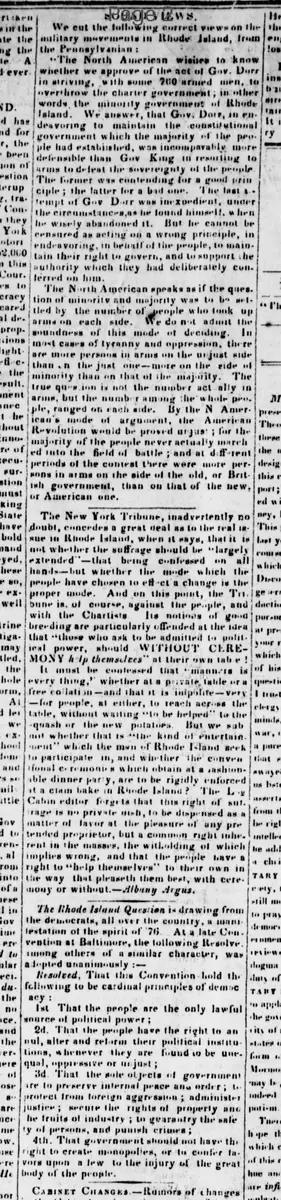
The North American wishes to know whether we approve of the act of Gov. Dorr in arriving, with some 700 armed men, to overthrow the charter government; in other words, the minority government of Rhode Island. We answer, that Gov. Dorr, in endeavoring to maintain the constitutional government which the majority of the people had established, was incomparably more defensible than Gov. King in resorting to arms to defeat the sovereignty of the people. The former was contending for a good principle; the latter for a bad one. The last attempt of Gov. Dorr was inexpedient, under the circumstances, as he found himself, when he wisely abandoned it. But he cannot be censured as acting on a wrong principle, in endeavoring, in behalf of the people, to maintain their right to govern, and to support the authority which they had deliberately conferred on him.
The North American speaks as if the question of minority and majority was to be settled by the number of people who took up arms on each side. We do not admit the soundness of this mode of deciding. In most cases of tyranny and oppression, there are more persons in arms on the unjust side than on the just one—more on the side of minority than on that of the majority. The true question is not the number actually in arms, but the number among the whole people, ranged on each side. By the American's mode of argument, the American Revolution would be proved unjust; for the majority of the people never actually marched into the field of battle; and at different periods of the contest there were more persons in arms on the side of the old, or British government, than on that of the new, or American one.
The New York Tribune, inadvertently no doubt, concedes a great deal as to the real issue in Rhode Island, when it says, that it is not whether the suffrage should be "largely extended"—that being confessed on all hands—but whether the mode which the people have chosen to effect a change is the proper mode. And on this point, the Tribune is, of course, against the people, and with the Chartists. Its notions of good breeding are particularly offended at the idea that those who ask to be admitted to political power, should WITHOUT CEREMONY help themselves at their own table!
It must be confessed that manners is every thing, whether at a private table or a free collation—and that it is impolite—very—for people, at either, to reach across the table, without waiting "to be helped" to the squash or the new potatoes. But we submit whether that is the kind of entertainment which the men of Rhode Island seek to participate in, and whether the conventional ceremonies which obtain at a fashionable dinner party, are to be rigidly enforced at a clam bake in Rhode Island? The Log Cabin editor forgets that this right of suffrage is no private dish, to be dispensed as a matter of favor at the pleasure of any pretended proprietor, but a common right inherent in the masses, the withholding of which implies wrong, and that the people have a right to "help themselves" to their own in the way that pleaseth them best, with ceremony or without.—Albany Argus.
The Rhode Island Question is drawing from the democrats, all over the country, a manifestation of the spirit of '76. At a late Convention at Baltimore, the following Resolutions among others of a similar character, was adopted unanimously:--
Resolved, That this Convention hold the following to be cardinal principles of democracy:
1st. That the people are the only lawful source of political power;
2d. That the people have the right to amend, alter and reform their political institutions, whenever they are found to be unequal, oppressive or unjust;
3d. That the sole objects of government are to preserve internal peace and order; to protect from foreign aggression; administer justice; secure the rights of property and the fruits of industry; to guarantee the safety of persons, and punish crimes;
4th. That government should not have the right to create monopolies, or to confer favors upon a few to the injury of the great body of the people.
What sub-type of article is it?
What keywords are associated?
What entities or persons were involved?
Where did it happen?
Domestic News Details
Primary Location
Rhode Island
Key Persons
Event Details
Newspaper commentary defends Gov. Dorr's armed attempt to establish a people's constitution against the charter government, criticizing opponents for supporting minority rule. Democratic convention in Baltimore adopts resolutions supporting popular sovereignty and reform rights in response to the Rhode Island crisis.