Thank you for visiting SNEWPapers!
Sign up free
The Louisiana Democrat
Alexandria, Rapides County, Louisiana
What is this article about?
Article details the U.S. Fish Commission's efforts in fish culture as an economic food source, led by Prof. Baird. Covers hatching methods (e.g., shad eggs in Macdonald jars), stations across states, species propagated (shad, cod, trout), and distribution via special cars, with recent outputs of millions of eggs and fry.
Clipping
OCR Quality
Full Text
Its Importance as an Economic Question—Latest Methods Employed by the U. S. Fish Commission.
[Original.]
As an economic question, the culture and propagation of fish is scarcely less important than the raising of cattle for meats and the production of cereals for breadstuffs. Yet few people ever stop to consider how the fish they daily consume are propagated. Fish-culture in its most restrictive sense, or fish-breeding, must sooner or later be resorted to in all densely-populated countries, for, with the utmost protection, nature, unaided, can do but little to meet the natural demand for fish as an article of food. The improvement of fish-culture in this country is so familiar to everyone who has the slightest interest in the subject it is unnecessary to refer to it at length, except to show that the improvement in the condition of our fisheries is chiefly due to the wise and energetic manner in which Prof. Baird, the Commissioner of Fish and Fisheries, has managed the interests intrusted to his charge. He is recognized by all nations as "the first fish-culturist in the world," evidenced by the grand prize awarded to him by the International Fisheries Exhibition at Berlin in 1880.
The principal activity of the commissioner, however, has been directed (1) to the wholesale replenishment of our depleted waters, (2) the investigation of the fisheries past and present, (3) the introduction and multiplication of useful food fishes throughout the country. These were the main purposes for which the commission was founded.
In an article of this nature it is impossible to review even casually the important work accomplished by the commission, and it is only within the purview of a newspaper article to give a brief account of the methods employed for hatching and distributing fish. The policy of Prof. Baird has been to carry out the idea that it is better to expend a small amount of public money in making fish so abundant that they can be caught without restriction, and serve as cheap food for people at large, rather than to expend a much larger amount in preventing the people from catching the few that still remain after generations of improvidence.
The commission has thus established hatching stations in various States of the country. These are known as collecting and distributing stations. The former are located near the spawning grounds of those species for which they are especially intended. The eggs are received at these stations, and, enough having been reserved to stock the waters of that region, the remainder are sent to distributing stations, usually located at some central point, to be hatched and shipped to the waters for which they are intended. The following stations have thus far been established: Grand Lake Stream, Maine; Bucksport, Maine; Woods Hole, Mass. (permanent coast-station, which serves as a base of operations for the scientific investigations of the commission as a hatching station for eggs of the codfish); Cold Spring Harbor, Long Island, N. Y.; Havre de Grace, Md.; Washington, D. C. (here is situated the central hatching station, fully equipped for scientific experiments connected with the propagation of fishes; it is also the principal distributing station of the Fish Commission for both eggs and young fish to all portions of the United States); Wytheville, Va.; Saint Jerome's Creek, Point Lookout, Md.; Avoca, N. C.; Northville, Mich.; Alpena, Mich.; Baird, Shasta County, Cal.; Clackamas river, Oregon. The following is a list of the species artificially hatched in the United States since the art was first practiced here: Brook trout, white-fish, lake trout, pike, perch, Atlantic salmon, shad, land-locked salmon, California salmon, striped bass, sea bass, grayling, sturgeon, smelt, herring, alewife, oyster, cod, haddock, carp, Spanish mackerel, moon-fish, gold-fish, tench, soft-shelled clam and lobster.
But perhaps the most interesting feature of the work is the method employed in hatching the eggs of fish artificially. We will take the shad as an example. As soon as the shad are taken in the nets or seines those which are ripe or soft are selected. If ripe the eggs flow freely from the female shad when the belly of the fish is pressed gently; if unripe the eggs will not flow at all; if the eggs are only nearly ripe they will come forth with difficulty, in masses; such fish are not taken. A short time before the shad spawns, clear eggs of large size will be found in the roe, while the rest are still hard; these become more and more numerous; after a time they separate and fall apart, a liquid stream of eggs flowing from the fish with the slightest pressure. The milter, or male shad, is rather smaller than the female, the sex being known by the flow of milt from the fish; a small quantity of milt will impregnate a large number of eggs; about one male in good condition to two or three females.
The spawner, or female shad, is easily known by its size and full appearance. When all the spawn is taken it will be shown by the blood appearing among the eggs. A male shad is then taken, two or three jets of milt are forced upon the eggs while the pan is swayed gently to and fro. A little water is added from time to time until the eggs rise, which will be, usually, in the course of half an hour. After impregnation the eggs will be found to have increased in size, and when they rise they can either be put on trays covered with cotton cloth or kept in the pan. In the latter case the water should be changed every hour. The bad eggs will float on top and are of a whitish color, being called water-blown; good eggs will be clear and like crystal in appearance. The eggs having been fertilized, the most difficult portion of the task remains, viz: the care of the eggs until they are hatched, and the care of the young fry until they are old enough to care for themselves.
The apparatus employed for this work varies in principle to correspond to the physical peculiarities of the eggs. As an example we will consider the process of hatching shad eggs, whose specific gravity is slightly greater than that of water. These eggs are placed together in large quantities, and to prevent their settling upon the bottom of the receptacle, it is necessary to introduce a gentle current from below. Several receptacles were made for the hatching of shad eggs, with only partially successful results, but finally the device now most in favor was perfected.
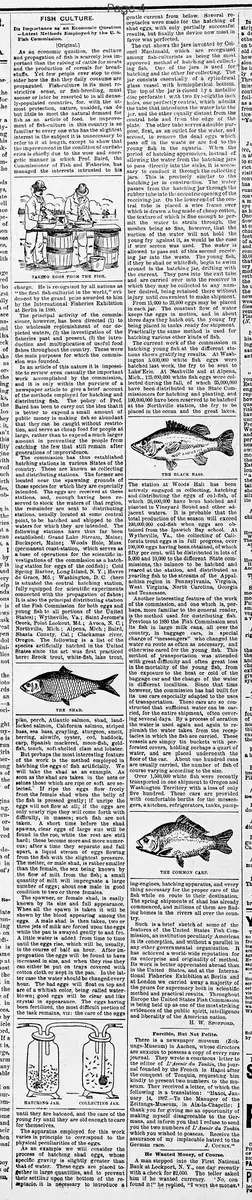
The cut shows the jars invented by Col. Macdonald, which are recognized among fish-culturists as being the most approved method of hatching and collecting ing fish. One of the jars is used for hatching and the other for collecting. The jar consists essentially of a cylindrical glass vessel with hemispherical bottom. The top of the jar is closed by a metallic disc perforated with two five-eighths inch holes, one perfectly central, which admits the tube that introduces the water into the jar, and the other equally distant from the central hole and from the edge of the plate. The other tube serves a double purpose, first, as an outlet for the water, and second, to remove the dead eggs which pass off in the waste or are fed to the young fish in the aquaria. When the period of hatching approaches, instead of allowing the water from the hatching jars to pass directly into the sinks, it is necessary to conduct it through the collecting jars. This is precisely similar to the hatching jar in construction. The water passes from the hatching jar through the rubber tube into the eccentric opening of the receiving-jar. On the lower end of the central tube is placed a wire frame over which is drawn a bag made of cheap cotton, the texture of which is fine enough to permit the water to strain through, the meshes being so fine, however, that the suction of the water will not hold the young fry against it, as would be the case if wire screen was used. The water is allowed to pass out of this second receiving jar into the waste. The young fish, if they be shad or whitefish, begin to swim around in the hatching jar, drifting with the current. They pass into the exit tube and are carried over into the receiver in which they may be collected to any number desired, being retained there without injury until convenient to make shipment.
From 15,000 to 20,000 eggs may be placed in each jar. The constant flow of water keeps the eggs in motion, and in about three days they hatch out, the young fry being placed in tanks ready for shipment. Practically the same method is used for hatching various other kinds of fish.
The current work of the commission in hatching young fish at the different stations shows gratifying results. At Washington 5,000,000 white fish eggs were hatched last week, the fry to be sent to Lake Erie. At Nashville and at Alpena, Mich., 125,000,000 white fish eggs were collected during the fall, of which 25,000,000 have been distributed to the State Commissioners for hatching and planting, and 100,000,000 have been reserved to be hatched at the Northville station, the fry to be placed in the ocean and the great lakes.
The Black Bass.
The station at Woods Hole has been actively engaged in collecting, hatching and distributing the eggs of cod-fish, of which 26,000,000 have been hatched and planted in Vineyard Sound and other adjacent waters. It is probable that the total production of the season will exceed 100,000,000 cod-fish when eggs are obtained from the Ipswich Bay school. At Wytheville, Va., the collecting of California trout eggs is in full progress, over 100,000 eggs having been obtained, of which fifty per cent. will be distributed in lots of 5,000 and 10,000 to the different State commissions, the balance to be hatched and reared at the station, and distributed as yearling fish to the streams of the Appalachian region in Pennsylvania, Virginia, West Virginia, North Carolina, Georgia and Tennessee.
Another interesting feature of the work of the commission, and one which is, perhaps, more familiar to the general reader, is the method used for distributing fish. Previous to 1880 the Fish Commission sent its fish in large milk cans, all over the country, in baggage cars, in special charge of "messengers" who changed the water en route as often as necessary, and otherwise cared for the young fish. This method of transportation was attended with great difficulty and often great loss in the mortality of the young fish, from the exposure to the heat or cold of the baggage car and the change of the water in different localities. Since that time, however, the commission has had built for its use cars especially adapted to the uses of transportation. These cars are so constructed that sufficient water can be carried for the entire shipment often covering several days. By a process of aeration the water is used again and again to replenish the water taken from the receptacles in which the fish are carried. These vessels are simply tin buckets with perforated covers, holding perhaps a quart of water, and are placed underneath the floor of the car. About one hundred cans are usually carried, the number of fish of course varying according to the size.
Over 1,500,000 white fish were recently transported in one shipment to Oregon and Washington Territory with a loss of only five hundred. These cars are provided with comfortable berths for the messengers, a kitchen, refrigerators, tanks, pumping-engines, hatching apparatus, and everything necessary for the proper care of the fish while en route to their destination.
The Common Carp.
The spring shipments of shad has already commenced, and millions of them are finding homes in the rivers all over the country.
Such is a brief sketch of some of the features of the United States Fish Commission, an institution peculiarly American in its conception, and without a parallel in any other governmental organization. It has achieved a world-wide reputation for its enterprise and originality of method. Its work is better appreciated abroad than in the United States, and at the International Fisheries Exhibition at Berlin and at London we carried away a majority of the prizes for supremacy both in scientific method and practical results. Throughout Europe the United States Fish Commission is being held up as one of the most striking evidences of the public spirit, intelligence and liberality of the American nation.
H. W. SPOFFORD.
What sub-type of article is it?
What keywords are associated?
What entities or persons were involved?
Where did it happen?
Domestic News Details
Primary Location
United States
Key Persons
Outcome
millions of fish eggs hatched and distributed, including 5,000,000 white fish at washington last week, 125,000,000 white fish collected at nashville and alpena, 26,000,000 cod-fish at woods hole, over 100,000 california trout eggs at wytheville; successful transportation with minimal losses, such as 1,500,000 white fish to oregon and washington with only 500 lost.
Event Details
The U.S. Fish Commission, under Prof. Baird, promotes fish culture for economic food production through hatching stations, artificial propagation methods like for shad using Macdonald jars, distribution of young fish via special cars, and introduction of species including brook trout, shad, cod, and carp. Stations established in various states for collecting, hatching, and distributing eggs and fry to replenish waters.