Thank you for visiting SNEWPapers!
Sign up free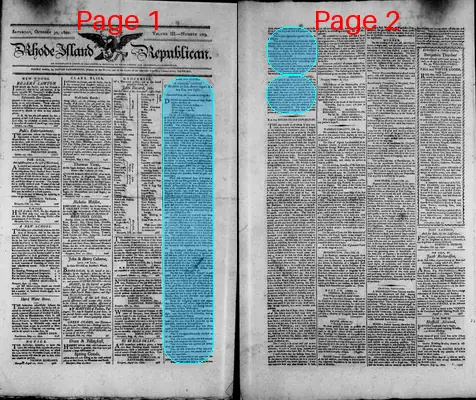
Rhode Island Republican
Newport, Newport County, Rhode Island
What is this article about?
Historical overview of U.S. congressional duties on salt, brown sugar, bohea tea, and coffee during Washington and Adams administrations, detailing increases, durations, and partisan debates between Federalists and Republicans over taxation for public debt repayment.
Merged-components note: These components form a single continuous story on the history of duties on salt, sugar, tea, and coffee, spanning from page 1 to page 2, with the text directly continuing across the components.
Clippings

1 of 2
OCR Quality
Full Text
A CONCISE HISTORY
Of the duties on Salt, Brown Sugar, Bohea Tea, and Coffee.
(Extracted from the Journals of Congress.)
DURING the administration of Gen. Washington, the duty on Salt was 12 cents per bushel,--
Bohea Tea 12 per lb.--
Brown Sugar 2 per lb.
Coffee 5 do.--
On the 8th of July 1797, in the first Congress of Mr. Adams's administration, additional duty of 8 cents per bushel was laid on salt;
making the whole duty on that article 20 cents a bushel. The additional duty was limited in its continuation to two years, that is, to the 8th of July, 1799, and from thence until the end of the next session of Congress.
But afterwards, on the 9th of May, 1800 a law was enacted, to continue this additional duty on salt for ten years from the 3d of March 1800, to 1810. The duty on brown sugar was also increased during the same administration from two to two and a half cents per pound.
By virtue of this act, and also of the acts of the 3d of March, 1797. and the 31st of May, 1796; passed during the administration of Washington. all the then as well as the further proceeds of the duties on goods, wares and merchandize, including of course all the duties before noticed. on salt, brown sugar, bohea tea, and coffee, were solemnly appropriated for the extinguishment of the public debt, until the whole of the said debt, foreign and domestic, should be paid and discharged.
When the additional duty of 8 cents per bushel on salt was first proposed in Congress on the 6th of June, 1797. it was rejected in the House of Representatives by the strenuous exertions of the Republican Members. Soon after,on the 26th of June; 1797, a bill was presented by William Smith, of Charleston, a federalist, to authorize a loan of two millions of dollars, which was passed into a law; and on the 8th of July,1797 being only six days before Congress adjourned, and when a number of members had left Congress and returned home, another motion was made by those then called the federal members; and carried for imposing the additional duty of eight cents per bushel on salt.
On this motion the yeas and nays were called, when the yeas were 47 and the nays 41.
Accordingly a bill was brought in and on the same day passed into a law by those then called federalists, for laying the additional duty of eight cents a bushel on salt. This bill was without limitation of time, and of course designed to make the duty permanent and a perpetual tax. The republicans thereupon moved a clause to be inserted which would limit the continuance of this additional duty to two years. This clause was violently opposed by the federalists, but carried by the republicans, on a vote 47 to 43.
At a subsequent session of Congress, during Mr. Adams's administration, and after an act had been passed by the federalists to authorize another loan of five millions of dollars, at an interest of eight per cent. a motion was made by the federalists for a law "to continue in force the act passed on the 8th of July 1797. laying an additional duty on Salt" -this motion was carried by the federalists, 54 to 38.
The bill was accordingly brought in and passed into a law by the federalists, directing the additional duty of eight cents per bushel on salt, to be continued in force for and during the term of ten years, from the 3d of March 1800, to the 3d of March 1810. On the discussion of this bill, the republicans moved to strike out ten years, and to insert instead thereof two years, so as to leave the law in force only until the 3d of March, 1802, but this alteration was rejected by the federalists, 44 to 50.
From the foregoing facts it will appear that the duties on salt, brown sugar bohea tea, and coffee, were originally laid during the administration of Gen. Washington.
That additional duties on salt and brown sugar were imposed by the federalists, during the administration of Adams.
That the additional duty of eight cents per bushel on salt was, when first proposed by the federalists, rejected by the republicans.
That the same additional duty was afterwards in the same session, moved and carried by the federalists.
That it was again strenuously objected to by the republicans.
That this additional duty was first proposed to be made perpetual by the federalists.
That this attempt was opposed and defeated by the republicans.
That the first limitation of the said additional duty to two years was moved and carried by the republicans.
That this limitation to two years was objected to and opposed by the federalists.
That the law passed May 9, 1800, to continue
Since the additional duty of eight cents per bushel on salt for ten years was first proposed by the federalists.
That it was vigorously opposed by the republicans.
That a second attempt to limit the additional duty to two years, that is, to the 3d of March, 1802, was made by the republicans.
That this attempt was defeated, and the law as it now stands, to continue the said additional duty until the 3d of March, 1810, was carried by the federalists.
That the increase and continuance of these duties were preceded by laws authorizing loans of money to the public, and,
That the proceeds of the duties on salt, bohea tea, brown sugar and coffee, were by law appropriated to the payment of the public debt until the whole of it should be discharged.
ANDREW MARVEL.
In notes to the above piece are stated the names of the Members who voted on the affirmative and negative of the questions stated in the text. We have not room to repeat them; nor is it necessary that we should. Every one knows that until the year 1801, a majority of both Houses of Congress were decidedly federal, and no important measure was effected contrary to their wishes, excepting the limitation of the additional tax on salt to two years instead of ten, which the republicans, with the assistance of six federalists, accomplished. The yeas and nays are on the Journals of Congress, and the public prints of those days.
What sub-type of article is it?
What keywords are associated?
What entities or persons were involved?
Where did it happen?
Story Details
Key Persons
Location
United States Congress
Event Date
1796 1810
Story Details
Account of initial duties under Washington and increases on salt and brown sugar under Adams, with Republican opposition to Federalist proposals for permanent or extended taxes, ultimately limited and appropriated for public debt.