Thank you for visiting SNEWPapers!
Sign up free
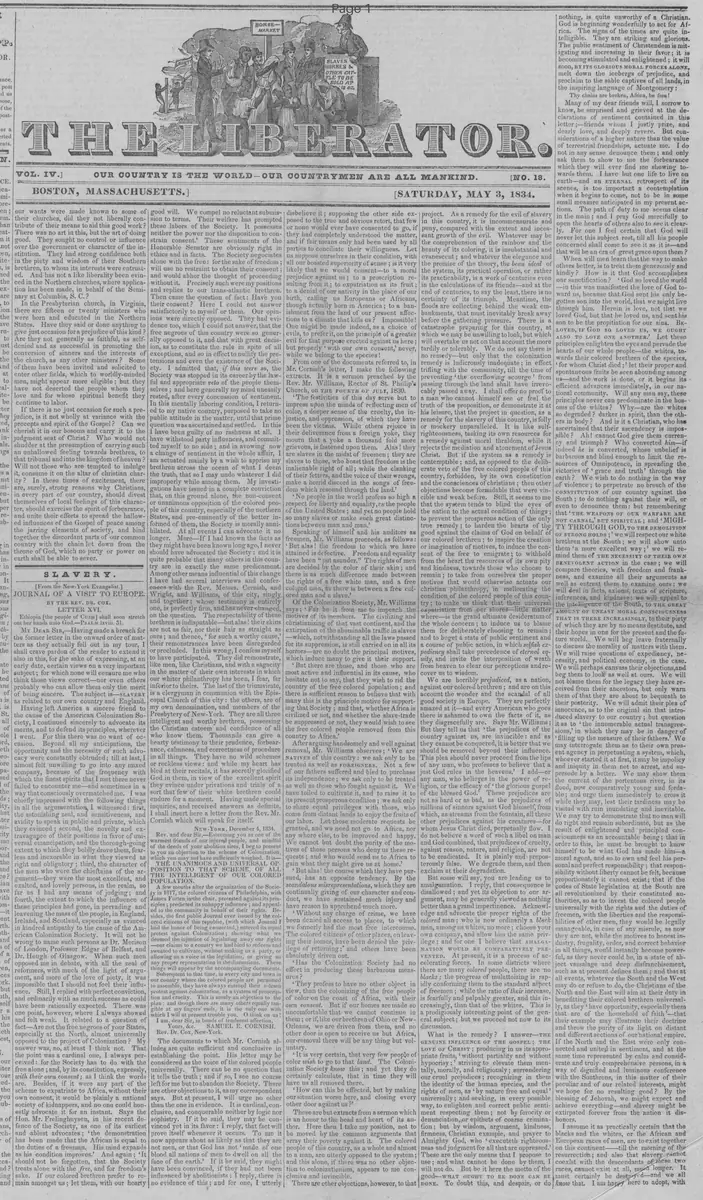
The Liberator
Boston, Suffolk County, Massachusetts
What is this article about?
Rev. Dr. Cox recounts his shift from supporting the American Colonization Society to opposing it after European debates and consultations with Black leaders like Rev. Cornish, citing unanimous free Black opposition and advocating gospel-driven equality to end slavery without expatriation.
Merged-components note: These components form a continuous article by Rev. Dr. Cox on slavery and colonization, originally labeled as story and editorials; unified under story as the dominant narrative content.
Clippings
1 of 2
OCR Quality
Full Text
[From the New-York Evangelist.]
JOURNAL OF A VISIT TO EUROPE.
BY THE REV. DR. COX.
LETTER XVI
Ethiopia [the people of Cush] shall soon stretch out her hands unto God.—Psalm lxviii. 31.
My Dear Sir,—Having made a breach for the former letter in the onward order of matters as they actually fell out in my tour, I shall crave pardon of the reader to extend it also in this, for the sake of expressing, at an early date, certain views on a very important subject; for which none will censure me who think those views correct—nor even others probably who can allow them only the merit of being sincere. The subject is—Slavery as related to our own country and England.
Having left America a sincere friend to the cause of the American Colonization Society, I continued sincerely to advocate its merits, and to defend its principles, wherever I went. For this there was no want of occasion. Beyond all my anticipations, the opportunity and the necessity of such advocacy were constantly obtruded; till at last, I almost felt unwilling to go into any mixed company, because of the frequency with which the finest spirits that I met there never failed to encounter me—and sometimes in a way that consciously overmatched me. I was chiefly impressed with the following things in all the argumentation I witnessed: first, the astonishing zeal, and sensitiveness, and avidity to speak in public and private, which they evinced; second, the novelty and extravagance of their positions in favor of universal emancipation, and the thorough-going extent to which they boldly drove them, fearless and inexorable in what they viewed as right and obligatory; third, the character of the men who were the chieftains of the argument—they were the most excellent, and exalted, and lovely persons, in the realm, so far as I had any means of judging; and fourth, the extent to which the influence of these principles had gone, in pervading and leavening the mass of the people, in England, Ireland, and Scotland, especially as evinced in kindred antipathy to the cause of the American Colonization Society. It will not be wrong to name such persons as Dr. Morison of London, Professor Edgar of Belfast, and Dr. Heugh of Glasgow. When such men opposed me in debate, with all the zeal of reformers, with much of the light of argument, and more of the love of piety, it was impossible that I should not feel their influence. Still, I replied with perfect conviction, and ordinarily with as much success as could have been rationally expected. There was one point, however, where I always showed and felt weak. It related to a question of fact—Are not the free negroes of your States, especially at the North, almost universally opposed to the project of Colonization? My answer was, no, at least I think not. That the point was a cardinal one, I always perceived: for the Society has to do with the free alone; and, by its constitution, expressly, with their own consent; as I think the words are. Besides, if it were any part of the scheme to expatriate to Africa, without their own consent, it would be plainly a national society of kidnappers, and no one could honestly advocate it for an instant. Says the Hon. Mr. Frelinghuysen, in his recent defence of the Society, as one of its earliest and ablest advocates; 'the demonstration has been made that the African is equal to the duties of a freeman. His mind expands as his condition improves.' And again; 'It should not be forgotten, that the Society treats alone with the free, and for freedom's sake. If our colored brethren prefer to remain amongst us: let them, with our hearty good will. We compel no reluctant submission to terms. Their welfare has prompted these labors of the Society. It possesses neither the power nor the disposition to constrain consent.' These sentiments of the Honorable Senator are obviously right in ethics and in facts. The Society negociates alone with the free: for the sake of freedom; will use no restraint to obtain their consent; and would abhor the thought of proceeding without it. Precisely such were my positions and replies to our trans-atlantic brethren.
Then came the question of fact: Have you their consent? Here I could not answer satisfactorily to myself or them. Our opinions were directly opposed. They had evidence too, which I could not answer, that the free negroes of this country were so generally opposed to it, and that with great decision, as to constitute the rule in spite of all exceptions, and so in effect to nullify the pretensions and even the existence of the Society. I admitted that, if this were so, the Society was stopped in its career by the lawful and appropriate veto of the people themselves; and here generally my mind uneasily rested, after every concussion of sentiment.
In this mentally laboring condition, I returned to my native country, purposed to take no public attitude in the matter, until that prime question was ascertained and settled. In this I have been guilty of no rashness at all. I have withstood party influences, and committed myself to no side: and in avowing now a change of sentiment in the whole affair, I am actuated mainly by a wish to apprise my brethren across the ocean of what I deem the truth, that so I may undo whatever I did improperly while among them. My investigations have issued in a complete conviction that, on this ground alone, the non-consent or unanimous opposition of the colored people of this country, especially of the northern States, and pre-eminently of the better informed of them, the Society is morally annihilated. At all events I can advocate it no longer. More—If I had known the facts as they might have been known long ago, I never should have advocated the Society: and it is quite probable that many others in this country are in exactly the same predicament.
Among other means influential of this change I have had several interviews and conferences with the Rev. Messrs. Cornish, and Wright, and Williams, of this city, singly and together; whose testimony is entirely one, is perfectly firm, and has never changed, on the question. The respectability of these brethren is indisputable—but alas! their skins are not as fair, nor their hair as straight as ours; and thence, 'for such a worthy cause,' their remonstrances have been disregarded or precluded. In this wrong, I confess myself to have participated. They did remonstrate, like men, like Christians, and with a sagacity in the matter of their own interests in which our whiter philanthropy has been, I fear, far inferior to theirs. The last of the triumvirate, is a clergyman in communion with the Episcopal Church of this city: the others, are of my own denomination, and members of the Presbytery of New-York. They are all three intelligent and worthy brethren, possessing the Christian esteem and confidence of all who know them. Thousands can give a hearty testimony to their prudence, forbearance, calmness, and correctness of procedure in all things. They have no wild schemes or reckless views: and while my heart has bled at their recitals, it has secretly glorified God in them, in view of the excellent spirit they evince under privations and trials of a sort that few of their white brethren could endure for a moment. Having made special inquiries, and received answers as definite, I shall insert here a letter from the Rev. Mr. Cornish which will speak for itself.
New-York, December 4, 1834.
Rev. and dear Sir.—Esteeming you as one of the warmest friends of our injured people, and mindful of the deeds of your abolition sires, I beg to present to you an objection to the scheme of Colonization, which you may not have sufficiently weighed. It is—
THE UNANIMOUS AND UNIVERSAL OPPOSITION TO THAT SCHEME, OF ALL THE INTELLIGENT OF OUR COLORED POPULATION.
A few months after the organization of the Society in 1817, the colored citizens of Philadelphia, with James Forten in the chair, protested against its principles; predicted its unhappy influence; and appealed to the community in behalf of their rights. Besides, the first public Journal ever issued by the colored citizens of this republic, (with which Journal I had the honor of being connected,) entered its equal protest against Colonization; showing what we deemed the injustice of legislating away our rights—our claims to a country we had bled to redeem and sweated to cultivate, without making us a party, or allowing us a voice in the legislation, or giving us any proper representation in the discussions. These things will appear by the accompanying documents.
Subsequent to that time, in every city and town in our country where the colored people are permitted to assemble, they have always entered their solemn protest against colonization, as a system of proscription and cruelty. This is surely an objection to the plan: and though there are many others equally tangible at my fingers' ends, it is the only one with which I will at present trouble you. O think on us!
I am, dear Sir, in bonds of tenderest affection,
Yours, &c.
SAMUEL E. CORNISH
Rev. Dr. Cox. New-York.
The documents to which Mr. Cornish alludes are quite sufficient and conclusive in establishing the point. His letter may be considered as the voice of the colored people universally. There can be no question that it tells the truth; and if so, I see no course left for me but to abandon the Society. There are other objections to it, as my correspondent says. But at present, I will urge no other than the one in evidence. It is cardinal, conclusive, and conquerable neither by logic nor sophistry. If it be said, they may be convinced yet in its favor: I reply, that fact will prove itself whenever it occurs. To me it now appears about as likely as that they are not men, or that God has not 'made of one blood all nations of men to dwell on all the face of the earth.' If it be said, they might have been convinced, if they had not been influenced by abolitionists; I reply, there is no evidence of this; and for one, I utterly disbelieve it: supposing the other side exposed to the true and obvious retort, that few or none would ever have consented to go, if they had completely understood the matter, and if fair means only had been used by all parties to conciliate their willingness. Let us suppose ourselves in their condition, with all our boasted superiority of sense; is it very likely that we would consent—to a moral prejudice against us; to a proscription resulting from it; to expatriation as its fruit; to a denial of our nativity in the place of our birth, calling us Europeans or Africans, though actually born in America; to a banishment from the land of our present affections to a climate that kills us? Impossible! One might be made indeed, as a choice of evils, on the principle of a greater evil for that purpose erected against us here; but properly 'with our own consent,' never, while we belong to the species!
From one of the documents referred to, in Mr. Cornish's letter, I make the following extracts. It is a sermon preached by the Rev. Mr. Williams, Rector of St. Phillip's Church, On THE FOURTH OF JULY, 1830.
The festivities of this day serve but to impress upon the minds of reflecting men of color, a deeper sense of the cruelty, the injustice, and oppression, of which they have been the victims. While others rejoice in their deliverance from a foreign yoke, they mourn that a yoke a thousand fold more grievous, is fastened upon them. Alas! they are slaves in the midst of freemen; they are slaves to those, who boast that freedom is the inalienable right of all; while the clanking of their fetters, and the voice of their wrongs, make a horrid discord in the songs of freedom which resound through the land.'
'No people in the world profess so high a respect for liberty and equality, as the people of the United States; and yet no people hold so many slaves or make such great distinctions between man and man.'
Speaking of himself and his auditors as freemen, Mr. Williams proceeds, as follows:
But alas! the freedom to which we have attained is defective. Freedom and equality have been 'put asunder.' The rights of men are decided by the color of their skin; and there is as much difference made between the rights of a free white man, and a free colored man, as there is between a free colored man and a slave.
Of the Colonization Society, Mr. Williams says; 'Far be it from me to impeach the motives of its members. The civilizing and christianizing of that vast continent, and the extirpation of the abominable traffic in slaves—which, notwithstanding all the laws passed for its suppression, is still carried on in all its horrors—are no doubt the principal motives, which induce many to give it their support. But there are those, and those who are most active and influential in its cause, who hesitate not to say, that they wish to rid the country of the free colored population; and there is sufficient reason to believe that with many this is the principle motive for supporting that Society; and that, whether Africa is civilized or not, and whether the slave-trade be suppressed or not, they would wish to see the free colored people removed from this country to Africa.'
After arguing handsomely and well against removal, Mr. Williams observes; 'We are Natives of this country: we ask only to be treated as well as Foreigners. Not a few of our fathers suffered and bled to purchase its independence; we ask only to be treated as well as those who fought against it. We have toiled to cultivate it, and to raise it to its present prosperous condition; we ask only to share equal privileges with those, who come from distant lands to enjoy the fruits of our labor. Let these moderate requests be granted, and we need not go to Africa, nor any where else, to be improved and happy. We cannot but doubt the purity of the motives of those persons who deny us these requests; and who would send us to Africa to gain what they might give us at home.'
'But alas! the course which they have pursued, has an opposite tendency. By the scandalous misrepresentations, which they are continually giving of our character and conduct, we have sustained much injury and have reason to apprehend much more. Without any charge of crime, we have been denied all access to places, to which we formerly had the most free intercourse. The colored citizens of other places, on leaving their homes, have been denied the privilege of returning; 'and others have been absolutely driven out.
Has the Colonization Society had no effect in producing these barbarous measures?
They profess to have no other object in view, than the colonizing of the free people of color on the coast of Africa, with their own consent. But if our homes are made so uncomfortable that we cannot continue in them; or if, like our brethren of Ohio or New Orleans, we are driven from them, and no other door is open to receive us but Africa, our removal there will be any thing but voluntary.
'It is very certain, that very few people of color wish to go to that land.' The Colonization Society know this; and yet they do certainly calculate, that in time they will have us all removed there. How can this be effected, but by making our situation worse here, and closing every other door against us?'
These are but extracts from a sermon which is an honor to the head and heart of its author. Here then I take my position, not to be moved by the common arguments that array their poverty against it. The colored people of this country, as a whole and almost to a man, are utterly opposed to the system; and this alone, if there was no other objection to colonizationism, appears to me conclusive and invincible.
There are other objections, however, to that project. As a remedy for the evil of slavery in this country, it is incommensurate and puny, compared with the extent and incessant growth of the evil. Whatever may be the comprehension of the rainbow and the beauty of its coloring, it is insubstantial and evanescent; and whatever the elegance and the promise of the theory, the beau ideal of the system, its practical operation, or rather its practicability, is a work of centuries even in the calculations of its friends—and at the end of centuries, to say the least, there is no certainty of its triumph. Meantime, the floods are collecting behind the weak embankments, that must inevitably break away before the gathering pressure. There is a catastrophe preparing for this country, at which we may be unwilling to look, but which will overtake us not on that account the more tardily or tolerably. We do not say there is no remedy—but only that the colonization remedy is ludicrously inadequate; in effect trifling with the community, till the time of preventing 'the overflowing scourge' from passing through the land shall have irrevocably passed away. I shall offer no proof to a man who cannot himself see or feel the truth of the proposition, or demonstrate it at his leisure, that the project in question, as a remedy for the slavery of this country, is folly or mockery unparalleled. It is like self-righteousness, tasking its own resources for a remedy against moral thraldom, while it rejects the mediation and atonement of Jesus Christ. But if the system as a remedy is contemptible: and, as opposed to the deliberate veto of the free colored people of this country, forbidden, by its own constitution and the consciences of christians; then other objections become formidable that were vincible and weak before. Still, it seems to me that the system tends to blind the eyes of the nation to the actual condition of things; to prevent the prosperous action of the only true remedy; to harden the hearts of the good against the claims of God on behalf of our colored brethren; to inspire the creation or imagination of motives, to induce the consent of the free to emigrate: to withhold from the heart the resources of its own pity and kindness, towards those who choose to remain; to take from ourselves the proper motives that would otherwise actuate our christian philanthropy, in meliorating the condition of the colored people of this country; to make us think that their universal expatriation from our shores—little matter where—is the grand ultimate desideratum of the whole concern: to induce us to blame them for deliberately choosing to remain; and to beget a state of public sentiment and a course of public action, in which selfish expediency shall take precedence of eternal equity, and invite the interposition of wrath from heaven to clear our perceptions and recover us to wisdom.
We are horribly prejudiced, as a nation, against our colored brethren; and are on this account the wonder and the scandal of all good society in Europe. They are perfectly amazed at it—and every American who goes there is ashamed to own the facts of it, as they disgracefully are. Says Mr. Williams;
But they tell us that 'the prejudices of the country against us, are invincible: and as they cannot be conquered, it is better that we should be removed beyond their influence. This plea should never proceed from the lips of any man, who professes to believe that a just God rules in the heavens.' I add—or any man, who believes in the power of religion, or the efficacy of 'the glorious gospel of the blessed God.' These prejudices are not as hard or as bad, as the prejudices of millions of sinners against God himself, from which, as streams from the fountain, all these other prejudices against his creatures—for whom Jesus Christ died, perpetually flow. I do not believe a word of such a libel on man and God combined, that prejudices of cruelty, against reason, nature, and religion, are not to be eradicated. It is plainly and preposterously false. We degrade them, and then exclaim at their degradation.
But some will say, you are leading us to amalgamation. I reply, that consequence is disallowed; and yet its objection to our argument, may be generally viewed as nothing better than a grand impertinence. Acknowledge and advocate the proper rights of the colored man: who is now ordinarily a black man, among us whites, no more; choose your own company, and allow him the same privilege; and for one I believe that AMALGAMATION WOULD BE COMPARATIVELY PREVENTED. At present, it is a process of accelerating forces. In some districts where there are many colored people, there are 'no blacks; the progress of mulattoizing is rapidly conforming them to the standard aspect of freemen; while the ratio of their increase, is fearfully and palpably greater, and this increasingly, than that of the whites. This is a prodigiously interesting point of the general subject; but we proceed not now to its discussion.
What is the remedy? I answer—THE GENUINE INFLUENCE OF THE GOSPEL; THE Love of Christ; producing in us its appropriate fruits, 'without partiality and without hypocrisy:' striving to elevate them mentally, morally, and religiously; surrendering our cruel prejudices; recognizing in them the identity of the human species, and the rights of men, as 'by nature free and equal' universally; and seeking, in every possible way, to enlighten and correct public sentiment respecting them; not by ferocity or denunciation, or epithets of coarse crimination; but by wisdom, argument, kindness, firmness, Christian example, and prayer to Almighty God, who executeth righteousness and judgment for all that are oppressed.' These are the only means that I propose to use; and what cannot be done by them, I will not do. But, be it here the motto of the GOOD—WHAT OUGHT TO BE DONE CAN BE DONE. To doubt this, and despair, or do nothing, is quite unworthy of a Christian.
God is beginning wonderfully to act for Africa. The signs of the times are quite intelligible. They are striking and glorious. The public sentiment of Christendom is mitigating and increasing in their favor; it is becoming stimulated and enlightened; it will SOON, BY ITS GLORIOUS MORAL FORCES ALONE, melt down the icebergs of prejudice, and proclaim to the sable captives of all lands, in the inspiring language of Montgomery:
Thy chains are broken, Africa, be free!
Many of my dear friends will, I sorrow to know, be surprised and grieved at the declarations of sentiment contained in this letter:—friends whom I justly prize, and dearly love, and deeply revere. But considerations of a higher nature than the value of terrestrial friendships, actuate me. I do not in any sense denounce them; and only ask them to show to me the forbearance which they will ever find me showing towards them. I have but one life to live on earth—and an ETERNAL retrospect of its scenes, is too important a contemplation when it begins to come, not to be in some small measure anticipated in my present actions. The path of duty to me seems clear in the main; and I pray God mercifully to open the hearts of others also to see it clearly. For one I feel certain that God will never let this subject rest, till all his people concerned shall come to see it as it is—and that will be an era of great grace upon them!
When will men learn that the way to make others better, is to treat them generously and kindly? How is it that God accomplishes our sanctification? 'God so loved the world —in this was manifested the love of God toward us, because that God sent his only begotten son into the world, that we might live through him. Herein is love, not that we loved God, but that he loved us, and sent his son to be the propitiation for our sins. BELOVED, IF GOD SO LOVED US, WE OUGHT ALSO TO LOVE ONE ANOTHER.' Let these principles enlighten the eyes and pervade the hearts of our whole people—the whites, towards their colored brethren of the species, 'for whom Christ died:' let their proper and spontaneous fruits be seen abounding among us—and the work is done, or it begins its efficient advances immediately, in our national community. Will any man say, these principles never can predominate in the bosoms of the whites? Why—are the whites so degraded? darker in spirit, than the others in body? And is it a Christian, who has ascertained that their ascendency is impossible? Ah! cannot God give them currency and triumph? Who converted him—if indeed he is converted, whose unbelief is barbarous and blind enough to limit the resources of Omnipotence, in spreading the victories of 'grace and truth' through the earth? We wish to do nothing in the way of violence; to perpetrate no breach of the coNSTITUTION of our countrY against the South; to do nothing against their will, or even to denounce them: but remembering that THE WEAPONS OF OUR WARFARE ARE NOT CARNAL,' BUT SPIRITUAL: and 'MIGH TY THROUGH GOD, TO THE DEMOLITION OF sTRoNG HoLpS:' we will respect our white brethren at the South: we will show unto them 'a more excellent way;' we will re- mind theM Of THE NECESSITY OF THEIR OWN BENEVOLENT ACTION in the caSe; We will compare theories, with freedom and frank- ness, and examine all their arguments as well as entreat them to examine ours; we will deal in facts, axioms, texts of scripture, inferences, and kindness: we will appeal to the intolligence of the South, to THE GReAT AMOUNT OF UNEASY MORAL CONSCIOUSNESS THAT IS THERE INCREASINGLY, to their piety of which they are by no means destitute, and their hopes in one for the present and the fu- ture world. We will beg leave fraternally to discuss the morality of matters with them. We will raise questions of expediency, ne- cessity, and political economy, in the case. We will perhaps canvass their objections,and beg them to look as well at ours. We will not blame them for the legacy they have re- ceived fromn their ancestors, but only warn them of that they are about to bequeath to their posterity. We will admit their plea of innocence, as to the original sin that intro- duced slavery to our country; but question it as to 'the innumerable actual transgres- sions,' in which they may be in danger of 'filling up the measure of their fathers.' We may interrogate them as to their own pres- ent agency in perpetuating a system, which, whoever started it at first, it may be impolicy and iniquity in them not to arrest, and su- persede by a better. We may show them the current of the portentous river, in its flood, now comparatively young and forda- ble; and urge them immediately to cross it while they may, lest their tardiness may be visited with ruin inundating and inevitable. We may try to demonstrate that no man will do right and remain subordinate, but as the result of enlightened and principled con- sciousness as an accountable being; that in order to this, he must be brought to know himself to be what God has made him—a moral agent, and so to own and feel his per- sonal and perfect responsibility; that respon- sibility without liberty cannot be felt, because proportionately it cannot exist; that if the codes of State legislation at the South are all revolutionized by their constituted au- thorities, so as to invest the colored people universally with the rights and the duties of freemen, with the liberties and the responsi- bilities of other men, they would be legally manageable, in case of any misrule, as now they are not, while the motives to honest in- dustry, frugality, order, and correct behavior in all things, would instantly become power- ful, as they never could be, in a state of ab- ject vassalage and deep disfranchisement, such as at present defines them; and that at all events, whatever the South and the West may do or refuse to do, the Christians of the North and the East will aim at their duty in benefitting their colored brethren universal- ly, as they 'have opportunity, especially them that are of the household of faith'—that their example may illustrate their doctrine and throw ihe purity of its light on distant and different sections of our national empire. If the North and the East were only con- nected and united in sentiment, and at the same time represented by caln and consid- erate and truly comprehensive persons, in a way of dignified and luminous conference with the Southrons, in this matter of their peculiar and of our related interests, might we hope for no resulting good? By the blessing of Jehovah, we might expect and achieve everything—and slavery might be extirpated forever from the nation it dis- honors.
I assume it as practically certain that the blacks and the whites, or the African and European races of men, are to exist together on this continent—till the morning of the resurrection; and also that slavery cannot coexist with the descendants of dhese two races, cannot exist at all, muen longer. It must certainly be destr yed—and we all know that. I am hapry here to adopt, with
little qualifying, the sentiments of my amiable friend, the Rev. Mr. Gurley, the distinguished Secretary of the Colonization Society. In his able letter to Henry Ibbotson, Esq., of Sheffield, England, he thus declares himself: 'I do not hesitate to acknowledge that my hope of the peaceful abolition of slavery in this country, rests mainly upon the moral and religious sentiments of my countrymen. This I believe to be inconsistent with the permanency of the system. If in any other land slavery can be perpetual, it cannot be perpetual here. As well might the iceberg remain undissolved amid the sunny tropics, as this system long remain amid the kind and gentle influences that are here working its destruction. The spirit and principles of our government, the precepts of our holy religion, and the general feelings of our people at the South, as well as at the North, are against it as a permanent system. But it must be abolished by, and not against the will of the South. All, or nearly all Americans, cherish the desire and expectation that it will one day be abolished.' Yes! and that day will be hastened, just about as fast as correct public sentiment is seen to predominate, causing the bloodless victories of righteousness, accelerating the blessed triumphs of mercy. Lord, what wilt THOU have me to do?' is the question which every soul of us ought, in the premises, heartily to agitate at the throne of grace; and sincerity, uttering such a faithful prayer, would be certainly directed from on high. He is forever the same God, who, in a case really analogous, said to Moses from the burning bush; 'I have surely seen the affliction of my people which are in Egypt, and have heard their cry by reason of their task-masters; for I know their sorrows, and I am come down to deliver them. Now, therefore, behold, the cry of the children of Israel is come unto me; and I have also seen the oppression wherewith the Egyptians oppress them.' O what iniquity does He witness in our country! Is it worth while gravely to prove that they are human beings and that the human race is identical? No! but it may be, to refute that common blunder, found sometimes even among the learned, that the curse of servitude is pronounced upon them to all generations, by the oracles of God. Gen. ix. 25. That curse demonstrably no more applies to them than to us! Cursed be Canaan: a servant of servants shall he be unto his brethren.' For the sin of Ham, the youngest son of Noah, that great progenitor pronounced a curse on Canaan, the youngest son of Ham. Now Ham had four sons; 'Cush, and Mizraim, and Phut, and Canaan.' Gen. x. 6. The curse was not on all of them, but on Canaan alone. But Canaan remained an Asiatic, and was the only one of the four who did not settle in Africa. It was his posterity whom Joshua, and Saul, and David, and others successively subdued in Asiatic Palestine: reduced to servitude: thus explaining and executing the curse. Mizraim was the planter of the Egyptians; Phut, of the tribes to the north-west of Africa, as the Lybians and Mauritanians; and Cush is the father of the great negro world, the ancestor of our colored people, against whom no such curse is recorded; disappointed as it may make some pious worthies, whose strongest motives for persecuting the Jews and enslaving the Africans, is merely for fear the Scriptures will not otherwise be competently fulfilled! Let us honestly answer their appeal—AM I NOT A MAN AND A BROTHER? Before concluding this long paper, I have a word affectionately to say to the citizens of New-York, and especially to all Christians of this city. About one-thirteenth or one-fourteenth of our whole population are colored persons; say, at least, 18,000. They are degraded, as a mass, unquestionably, far below the standard respectability on an average of the others. But they may be elevated. They are themselves making honorable efforts, of every sort, to raise themselves legitimately—in a way, that, 'unimpeached or usurpation and to no man's wrong,' increases their moral and social worth, and so augments the riches of the commonwealth, as it equally reduces the qualities that impair and dishonor it. The Phenix Society of New-York, of which the object is 'to promote the improvement of the colored people in morals, literature, and the mechanic arts,' is beginning to do much for them, and under flourishing and promising auspices to intend their proper good. It is surely lawful for them to rise, in a way that depresses no others, and that contributes to the real welfare of the community—of whom God has made them integral parts and personal constituents. And what has any man to object to it? What can the worldling oppose to it? Forgive them then, thou bustler in concerns Of little worth, an idler in the best, If, authors of no mischief and some good, They seek their proper happiness by means That may advance, but cannot hinder thine. Particularly would I ask Christians here to aid this Society—to make contributions of good books to its library and of good sums to its treasury—and to favor its interests as becometh the philanthropy of the redeemed. But more particularly still, to Christians would I say—think, my dear brethren, of the deplorable fact that these 18,000, with few exceptions, are actually heathenizing among us, by our neglect and their necessity! The church room, in all our dedicated temples of this city, appropriated for their use, is—awfully insufficient for one half of them! Is this as it should be, as it might be? One standing cause of my dissatisfaction with the edifice where my own dear congregation worship, is that there is almost no room in it for colored people! Let those churches who desire a blessing from God, open their doors and find fitting accommodations for colored people! For one, I would never again consent to go to any people, as their pastor, who had no room for colored people—though by us it was done long ago, and more from negligence than design. I am sure they can be signally benefitted by the gospel and the means of grace, even more than others, could they have equal opportunities. They are not ungrateful to their benefactors, not insensible to kindness, not unworthy of our considerate and most Christian regards. Does any Christian value as nothing the benedictions of the poor—'the blessing of many ready to perish?' Then is he a kind of a Christian—very much unlike Christ! Their blessings and their prayers on the head of WILBERFORCE at this moment mount to heaven with his works' that follow him; while, on earth they are a monument and a mausoleum, which princes might be praised for envying; for they have nothing to be compared to it, and such envy would be a wonderful improvement in their character. How was Wilberforce opposed and ridiculed at first! insulted and maligned by those that now build his sepulchre and assist in consecrating even his fame! Through what formidable obstructions did he force his way, and hold the right, and carry his cause till the throne felt the reach of his eloquence.
and the cottage responded to its manly elucidation. It was, however, not the orator but the argument, not the man but the cause, that electrified the nation and convinced the world. The cause of equity is the cause of God. It is also the cause of man, of human nature universally. Its attributes are eternal. It is anchored in the nature of things. It will infallibly prevail. It can be retarded only by sophistry, prejudice, a perverse self interest, the veto of cupidity, or the veto of determined pride. But even these are vulnerable, and they bleed; they are mortal and they die. If they are opposed to God God is also opposed to them. And 'if God be for us, who can be against us?' Let us thank God, and take courage.' Let us all never cease to pray for the people of color; and limit our requests not even to the two or three millions that are our own countrymen. Ah! what do I see? Is there such a proportion of the color among us? almost one-fifth, or quite one-sixth, of our whole national population? Alas! that so many should be disparaged by us, or forgotten in supplication before God. What a host of immortal beings! Is their salvation worth nothing? And yet how large a multitude of them are by law organized in ignorance of 'the holy scriptures that are able to make us wise unto salvation through faith which is in Christ Jesus!' This, this is the 'unkindest cut of all!' They are prevented from the means of mercy and the hope of salvation! This is bad! With Thomas Jefferson I say, and he was surely no bigot, no prude in virtue, no fanatic, no soft and sickly religionist! and yet even he said, 'I tremble for my country, when I reflect that God is just, and that HIS JUSTICE CANNOT SLEEP FOREVER.' Well and admirably said! Worthy this, of the pen that wrote the Declaration of Independence! May the whole nation also tremble, and repent in righteousness, and that universally and speedily! Is not this the fast that I have chosen? to loose the bands of wickedness, to undo the heavy burdens, and to let the oppressed go free, and that ye break every yoke?' Let us, my brother, do at least our duty. Yours, &c.
What sub-type of article is it?
What themes does it cover?
What keywords are associated?
What entities or persons were involved?
Where did it happen?
Story Details
Key Persons
Location
New York, United States, England, Europe
Event Date
December 4, 1834; July 4, 1830; 1817
Story Details
Rev. Dr. Cox describes his evolving views on slavery and the American Colonization Society after European encounters and U.S. consultations, concluding opposition due to free Black Americans' unanimous rejection, quoting letters and sermons advocating equality through Christian principles instead of expatriation.