Thank you for visiting SNEWPapers!
Sign up free
The Rhode Island American, And General Advertiser
Providence, Providence County, Rhode Island
What is this article about?
Report on the Kingdom of Hayti's government under King Henry I, including political structure, military, economy, and religion; details complaint over 1811 seizure of American property worth ~$125,000 due to alleged fraud, US efforts for redress, and legal principles from Vattel's Law of Nations.
Clipping
OCR Quality
Full Text
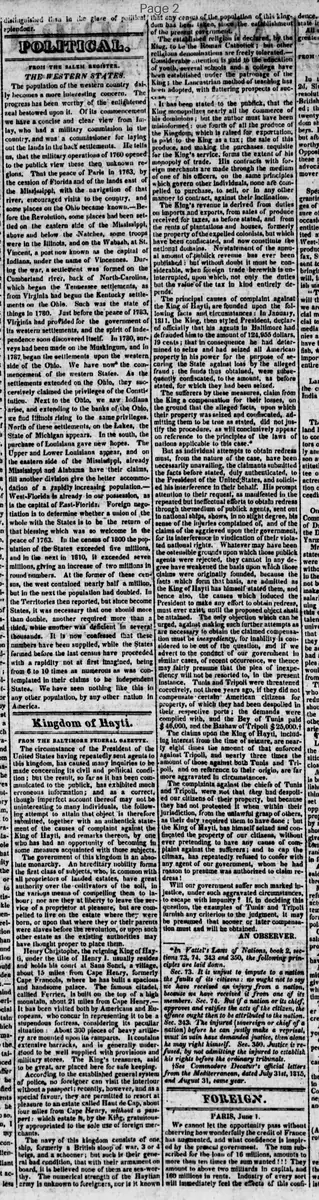
FROM THE BALTIMORE FEDERAL GAZETTE.
The circumstance of the President of the United States having repeatedly sent agents to this kingdom, has caused many inquiries to be made concerning its civil and political condition; but the result, so far as it has been communicated to the publick, has exhibited much erroneous information; and as a correct, though imperfect account thereof may not be uninteresting to many individuals, the following attempt to attain that object is therefore submitted, together with an authentick statement of the causes of complaint against the King of Hayti, and remarks thereon, by one who has had an opportunity of becoming in some measure acquainted with those subjects.
The government of this kingdom is an absolute monarchy. An hereditary nobility forms the first class of subjects, who, in common with all proprietors of lauded estates, have great authority over the cultivators of the soil, in the various means of compelling them to labour; nor are they at liberty to leave the service of a proprietor at pleasure, but are compelled to live on the estate where they were born, or upon that where they or their parents were slaves before the revolution, or upon such other estate as the existing authorities may have thought proper to place them.
Henry Christophe, the reigning King of Hayti, under the title of Henry I. usually resides and holds his court at Sans Souci, a village, about 15 miles from Cape Henry, formerly Cape François, where he has built a spacious and handsome palace. The famous citadel, called Ferrier, is built on the top of a high mountain, about 21 miles from Cape Henry. It has been visited both by Americans and Europeans, who concur in representing it to be a stupendous fortress, considering its peculiar situation: About 300 pieces of heavy artillery are mounted upon its ramparts. It contains extensive barracks, and is generally understood to be well supplied with provisions and military stores. The King's treasures, said to be great, are placed here for safe keeping.
According to the established general system of police no foreigner can visit the interior without a passport; recently, however, and as a special favour, they are permitted to resort at pleasure to an estate called Haut de Cap, about four miles from Cape Henry, without a passport: which estate is, by the King, gratuitously appropriated to the sole use of foreign merchants.
The navy of this kingdom consists of one ship, formerly a British sloop of war, 3 or 4 brigs, and a schooner; but such is their general bad condition, that with their armament on board, it is believed none of them are sea-worthy. The numerical strength of the Haytian army is unknown to foreigners, nor is it known that any census of the population of this kingdom has been taken, since the establishment of the present government.
The established religion is declared, by the King, to be the Roman Catholick; but other religious denominations are freely tolerated. Considerable attention is paid to the education of youth, several schools and a college have been established under the patronage of the King; the Lancastrian method of teaching has been adopted, with flattering prospects of success.
It has been stated to the publick, that the King monopolizes nearly all the commerce of his dominions; but the author must have been misinformed: one fourth of all the produce of the Kingdom; which is raised for exportation; is paid to the King as a tax; the sale of this produce, and making the purchases, requisite for the King's service, forms the extent of his monopoly of trade. His contracts with foreign merchants are made through the medium of one of his officers, on the same principles which govern other individuals, none are compelled to purchase, to sell, or in any other manner to contract, against their inclination.
The King's revenue is derived from duties on imports and exports, from sales of produce received for taxes, as before stated, and from the rents of plantations and houses, formerly the property of the expelled colonists, but which have been confiscated, and now constitute the national domains. No statement of the annual amount of publick revenue has ever been published: but without doubt it must be considerable, when foreign trade herewith is uninterrupted, upon which, not only the duties but the value of the tax in kind entirely depends.
The principal causes of complaint against the King of Hayti, are founded upon the following facts and circumstances: In January, 1811, the King, then styled President, declared officially that his agents in Baltimore had defrauded him to the amount of 124,955 dollars, 19 cents; that in consequence he had determined to seize and had seized all American property in his power for the purpose of securing the State against loss by the alleged fraud; the funds thus obtained, were subsequently confiscated, to the amount, as before stated, for which they had been seized.
The sufferers by these measures, claim from the King a compensation for their losses, on the ground that the alleged facts, upon which their property was seized and confiscated, admitting them to be true as stated, did not justify the procedure, as will conclusively appear on reference to the principles of the laws of nations applicable to this case.
But as individual attempts to obtain redress must, from the nature of the case, have been necessarily unavailing, the claimants submitted the facts before stated, duly authenticated, to the President of the United States, and solicited his interference in their behalf. His prompt attention to their request; as manifested in the repeated but ineffectual efforts to obtain redress through the medium of publick agents, sent out in national ships, shows, in no slight degree, his sense of the injuries complained of, and of the claims of the aggrieved upon their government, for its interference in vindication of their violated national rights. Whatever may have been the ostensible grounds upon which those publick agents were rejected, they cannot in any degree have weakened the basis upon which those claims were originally founded, because the facts which form that basis, are admitted as the King of Hayti has himself stated them, and hence also, the causes which induced the President to make any effort to obtain redress, must ever exist, until the proposed object shall be attained. The only objection which can be urged, against making such further attempts as are necessary to obtain the claimed compensation must be inexpediency, for inability is considered to be out of the question, and if we advert to the conduct of our government in similar cases, of recent occurrence, we thence may fairly presume that the plea of inexpediency will not be resorted to, in the present instance. Tunis and Tripoli were threatened coercively, not three years ago, if they did not compensate certain American citizens for property, of which they had been despoiled in their respective ports; the demands were complied with, and the Bey of Tunis paid $46,000, and the Bashaw of Tripoli $25,000.
The claims upon the King of Hayti, including interest from the time of seizure, are nearly eight times the amount of that enforced against Tripoli, and nearly three times the amount of those against both Tunis and Tripoli, and on reference to their origin, are far more aggravated in circumstances.
The complaints against the chiefs of Tunis and Tripoli, were not that they had despoiled our citizens of their property, but because they had not protected it when within their jurisdiction, from the unlawful grasp of others, as their duty required them to have done; but the King of Hayti has himself seized and confiscated the property of our citizens, without ever pretending to have any cause of complaint against the sufferers; and to cap the climax, has repeatedly refused to confer with any agent of our government, whom he had reason to presume was authorized to claim redress!
Will our government suffer such marked injustice, under such aggravated circumstances, to escape with impunity? If, in deciding this question, the examples of Tunis and Tripoli furnish any criterion to the judgment, it may be presumed that sooner or later compensation must and will be obtained.
AN OBSERVER.
*In Vattel's Law of Nations, book 2. sections 73, 74, 343 and 350, the following principles are laid down.
Sec. 73. It is unjust to impute to a nation the faults of its citizens: we ought not to say we have received an injury from a nation, because we have received it from one of its members. Sec. 74. But if a nation or its chief approves and ratifies the acts of the citizen, the offence ought then to be attributed to the nation. Sec. 343. The injured (sovereign or chief of a nation) before he can justly make a reprisal, must in vain have demanded justice, then alone he may right himself. Sec. 350. Justice is refused, by not admitting the injured to establish his rights before the ordinary tribunals.
(See Commodore Decatur's official letters from the Mediterranean, dated July 31st, 1815, and August 31st, same year.)
What sub-type of article is it?
What keywords are associated?
What entities or persons were involved?
Where did it happen?
Foreign News Details
Primary Location
Kingdom Of Hayti
Event Date
January 1811
Key Persons
Outcome
seizure and confiscation of american property amounting to 124,955 dollars, 19 cents; claims for compensation including interest, nearly eight times the amount enforced against tripoli
Event Details
Description of the absolute monarchy under King Henry I, including hereditary nobility, control over cultivators, royal residences at Sans Souci and citadel Ferrier, passport requirements, navy condition, army strength unknown, Roman Catholic religion with tolerance, education initiatives, royal tax on produce, revenue sources; principal complaint: King's seizure of American property in January 1811 due to alleged fraud by his agents in Baltimore, leading to US presidential interventions via agents, comparisons to Tunis and Tripoli cases, references to Vattel's Law of Nations.