Thank you for visiting SNEWPapers!
Sign up free
Story
February 17, 1819
Daily National Intelligencer
Washington, District Of Columbia
What is this article about?
In 1819, Senate Committee on Public Lands reports via Mr. Morrow on discontinuing credit for future public land sales to avoid past issues like forfeitures and relief needs. Proposes $1.50/acre price in 80-acre tracts for cash purchases benefiting small farmers and national revenue.
Clipping
OCR Quality
98%
Excellent
Full Text
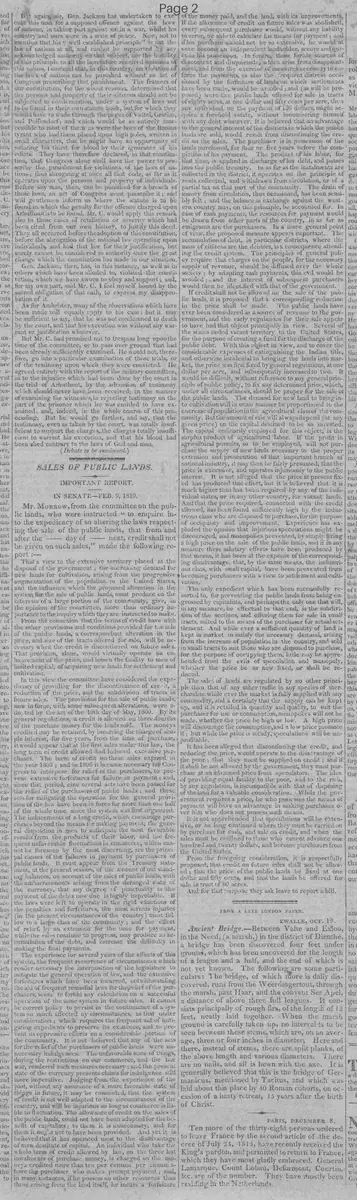
SALES OF PUBLIC LANDS.
IMPORTANT REPORT.
IN SENATE—FEB. 9, 1819.
Mr. Morrow, from the committee on the public lands, who were instructed "to enquire into the expediency of so altering the laws respecting the sale of the public lands, that from and after the -- day of - next, credit shall not be given on such sales," made the following report: —
That a view to the extensive territory placed at the disposal of the government; the encreasing demand for new lands for cultivation, arising from the progressive augmentation of the population in the United States, and the influence which the proposed alteration in the system for the sale of public lands, must produce on the interests of a large portion of the community, give, in the opinion of the committee, more than ordinary importance to the inquiry which they are instructed to make.
From the connexion that the terms of credit have with the other provisions and conditions provided for the sale of the public lands, a correspondent alteration in the price, and size of the tracts offered for sale, will be necessary when the credit is discontinued on future sales. That provision, alone, would virtually operate an enhancement of the price, and lessen the facility to men of limited capital, of acquiring new lands for settlement and cultivation.
In this view the committee have considered the expediency of providing for the discontinuance of credit, a reduction of the price, and the subdivision of tracts in future sales. The provisions for the sale of public lands, now in force, with some subsequent alterations, were adopted by the act of the 10th day of May, 1800. By its general regulations, a credit is allowed on three-fourths of the purchase money for the lands sold. The moneys credited may be retained, by incurring the charge of simple interest, for five years, from the time of purchase.
It would appear that at the first sales under this law, the long term of credit allowed had induced excessive purchases. The term of credit on these sales expired in the year 1805; and in 1806 it became necessary for Congress to interpose for relief of the purchasers, to prevent extensive forfeitures for failure in payment; and, since that period, nine several acts have been passed for the relief of the purchasers of public lands; and these acts for mitigating the operation for the general provision of the law have been in force for more than one half of the whole time since the system was first organized.
The inducements of a long credit, which encourage purchases beyond the means for making payment; the general disposition in men to anticipate the most favorable results from the products of their labor, and the frequent unfavorable fluctuations in commerce, which cannot be foreseen by the most discerning, are the principal causes of the failures in payment by purchasers of public lands. It must appear from the Treasury statement, at the present session, of the amount of outstanding balances, on account of the sales of public lands, with the embarrassments arising from the deranged state of the currency, that any degree of punctuality in the payment of the debts now due is highly improbable. If the laws were left to operate in the rigid exactions of the penalties and forfeitures, the most serious injuries (in the present circumstances of the country) must follow to a large class of the community; and the effect of relief, by an extension for the time for payment, while the sales continue to progress, may produce an accumulation of the debt, and increase the difficulty in making the final payments.
The experience for several years of the effects of this system, the frequent recurrence of circumstances which render necessary the interposition of the legislature to mitigate the general operation of law, and the extensive forfeitures which have been incurred, notwithstanding the aid of frequent remedial laws for their relief of the purchasers, seem to forbid any calculation on a successful operation of the same system in future sales. It cannot be correct policy to persist in the continuance of a system so much affected by circumstances, as that under consideration; which requires the frequent aid of mitigating expedients to preserve its existence, and to prevent its oppressive effects on a considerable portion of the community. It is not believed that any of the acts for the relief of the purchasers of public lands were unnecessary indulgences. The unfavorable state of things during the restrictions on our commerce, and the late war, rendered such measures necessary; and the present state of the currency presents claims for indulgence still more imperative. Judging from the experience of the past, without any assurance of a more favorable state of things in future, it may be concluded, that the system of credit is not well adapted to the circumstances of the country, and will be injurious so long as commerce is liable to fluctuation. The allowance of credit on the sales of the public lands, could not have been adopted for the benefit of capitalists; to them it is unnecessary, and for them it ought not to have been provided. And yet it is believed that it has operated most to the disadvantage of men destitute of capital. An individual who take the whole term of credit allowed by law, on the three last instalments of purchase money, is charged on the moneys credited more than ten per centum per annum above the purchaser who makes prompt payment; and, in many instances, if he possess no other resources than those arising from the land itself, he incurs a forfeiture of the money paid, and the land, with its improvements.
If the allowance of credit on future sales was abolished, every subsequent purchaser would, without any liability to error, be able to calculate his means for payment; and if his purchase should not be so extensive, he would at once become an independent landholder, secure and quiet in his possession. In future, those fertile sources of discontent and disquietude, which arise from disappointment, and from the exercise of measures necessary to enforce the payments, as also the frequent distress occasioned by the forfeiture of lands on which settlements have been made, would be avoided; and (as will be proposed) were the public lands offered for sale in tracts of eighty acres, at one dollar and fifty cents per acre, then any individual, on the payment of 120 dollars, might acquire a freehold estate, without incumbering himself with any debt whatever. It is believed that an advantage to the general interest of the districts in which the public lands are sold, would result from discontinuing the credit on the sales. The purchaser is in possession of the lands purchased, for four or five years before the completion of his payment. The product of his labor, for that time, is applied in discharge of his debt, and passes into the public treasury. In as far as the instalments are collected in the district, it operates on the principle of rents collected, and withdrawn from circulation, or of a partial tax on that part of the community. The drain of money from circulation, thus occasioned, has been sensibly felt; and the balance in exchange against the western country may, on this principle, be accounted for. In case of cash payments, the resources for payment would be drawn from other parts of the country, in as far as emigrants are the purchasers. In a more general point of view, the proposed measure appears important. The accumulation of debt, in particular districts, where the mass of citizens are the debtors, is a consequence attending the credit system. The principles of general policy require that charges on the people, for the necessary supply of revenue, should be diffused over the whole society; by adopting cash payments, this evil would be avoided; and the interest of subsequent purchasers would then be identified with that of the government.
If credit shall not be allowed on the sale of the public lands, it is proposed that a corresponding reduction in the price shall be made. The public lands have ever been considered as a source of revenue to the government, and the early regulations for their sale appear to have had that object principally in view. Several of the states ceded vacant territory to the United States, for the purpose of creating a fund for the discharge of the public debt. With this object in view, and to cover the considerable expenses of extinguishing the Indian title, and otherwise incidental to bringing the lands into market, the price was first fixed by general regulations, at one dollar per acre, and subsequently increased to two. It would be difficult, without reference to any general principle of public policy, to fix any determined price, which, under all circumstances, should be proper for the sale of the public lands. The demand for new land to bring into cultivation will in some manner be proportioned to the encrease of population in the agricultural class of the community. But the amount of sale will always depend (at any given price) on the capital destined to be so invested. The capital ordinarily employed for this object, is the surplus product of agricultural labor. If the profit in agricultural pursuits, so to be employed, will not purchase the supply of new lands necessary to the proper extension and prosecution of that important branch of national industry, it may then be fairly presumed, that the price is excessive, and operates injuriously to the public interest. It is not alleged that the price at present fixed has produced that effect, but it is believed that it is much higher than has been required by any of the individual states, or in any other country, for vacant lands. And that the price required, connected with the credit allowed, has been found sufficiently high by the industrious class who are disposed to purchase, for the purpose of occupancy and improvement. Experience has exploded the opinion that injurious speculations might be discouraged, and monopolies prevented, by simply fixing a high price on the sale of the public lands, and if in any measure these salutary effects have been produced by that means, it has been at the expense of the corresponding disadvantage, that, by the same means, the industrious class, with small capital, have been prevented from becoming purchasers with a view to settlement and cultivation.
The only expedient which has been successfully resorted to, for preventing the public lands from being engrossed by capitalists, and perhaps the only one that will, in any measure, be effectual to that end, is the subdivision of the sections, and offering them for sale in small tracts, suited to the means of the purchaser for actual settlement. And while ever a sufficient quantity of land is kept in market to satisfy the necessary demand, arising from the increase of population in the country, and sold in small tracts to suit those who are disposed to purchase, for the purpose of occupying them, little may be apprehended from the evils of speculation and monopoly whether the price be as now fixed, or shall be reduced.
The sales of lands are regulated by no other principle than that of any other traffic in any species of merchandise: while ever the market is fully supplied with any commodity, and a certainty that the supply can be kept up, and it is retailed in quantity and quality, to suit the purchaser for use or consumption, monopolies will not be made, whether the price be high or low. A high price will discourage the consumption, and a low price promote it; but while the price is steady, speculations will be unprofitable.
It has been alleged that discontinuing the credit, and reducing the price, would operate to the disadvantage of the poor: that they must be supplied on credit; and if it shall be not allowed by the government, they must purchase at an advanced price from speculators. The idea of providing equal facility to the poor, and to the rich, by any regulation, is incompatible with that of disposing of the land for a valuable consideration. While the government requires a price, he who possesses the means of payment will have an advantage in making purchases over him who does not possess such means.
It is not apprehended that speculations will be extensive, or be long continued where they must be carried on by purchase for cash, and sale on credit, and when the sales must be confined to those who cannot advance one hundred and twenty dollars, and become purchasers from the United States.
From the foregoing consideration, it is respectfully proposed, that credit on future sales shall not be allowed; that the price of the public lands be fixed at one dollar and fifty cents, and that the lands be offered for sale in tract of 80 acres.
And for that purpose they ask leave to report a bill.
IMPORTANT REPORT.
IN SENATE—FEB. 9, 1819.
Mr. Morrow, from the committee on the public lands, who were instructed "to enquire into the expediency of so altering the laws respecting the sale of the public lands, that from and after the -- day of - next, credit shall not be given on such sales," made the following report: —
That a view to the extensive territory placed at the disposal of the government; the encreasing demand for new lands for cultivation, arising from the progressive augmentation of the population in the United States, and the influence which the proposed alteration in the system for the sale of public lands, must produce on the interests of a large portion of the community, give, in the opinion of the committee, more than ordinary importance to the inquiry which they are instructed to make.
From the connexion that the terms of credit have with the other provisions and conditions provided for the sale of the public lands, a correspondent alteration in the price, and size of the tracts offered for sale, will be necessary when the credit is discontinued on future sales. That provision, alone, would virtually operate an enhancement of the price, and lessen the facility to men of limited capital, of acquiring new lands for settlement and cultivation.
In this view the committee have considered the expediency of providing for the discontinuance of credit, a reduction of the price, and the subdivision of tracts in future sales. The provisions for the sale of public lands, now in force, with some subsequent alterations, were adopted by the act of the 10th day of May, 1800. By its general regulations, a credit is allowed on three-fourths of the purchase money for the lands sold. The moneys credited may be retained, by incurring the charge of simple interest, for five years, from the time of purchase.
It would appear that at the first sales under this law, the long term of credit allowed had induced excessive purchases. The term of credit on these sales expired in the year 1805; and in 1806 it became necessary for Congress to interpose for relief of the purchasers, to prevent extensive forfeitures for failure in payment; and, since that period, nine several acts have been passed for the relief of the purchasers of public lands; and these acts for mitigating the operation for the general provision of the law have been in force for more than one half of the whole time since the system was first organized.
The inducements of a long credit, which encourage purchases beyond the means for making payment; the general disposition in men to anticipate the most favorable results from the products of their labor, and the frequent unfavorable fluctuations in commerce, which cannot be foreseen by the most discerning, are the principal causes of the failures in payment by purchasers of public lands. It must appear from the Treasury statement, at the present session, of the amount of outstanding balances, on account of the sales of public lands, with the embarrassments arising from the deranged state of the currency, that any degree of punctuality in the payment of the debts now due is highly improbable. If the laws were left to operate in the rigid exactions of the penalties and forfeitures, the most serious injuries (in the present circumstances of the country) must follow to a large class of the community; and the effect of relief, by an extension for the time for payment, while the sales continue to progress, may produce an accumulation of the debt, and increase the difficulty in making the final payments.
The experience for several years of the effects of this system, the frequent recurrence of circumstances which render necessary the interposition of the legislature to mitigate the general operation of law, and the extensive forfeitures which have been incurred, notwithstanding the aid of frequent remedial laws for their relief of the purchasers, seem to forbid any calculation on a successful operation of the same system in future sales. It cannot be correct policy to persist in the continuance of a system so much affected by circumstances, as that under consideration; which requires the frequent aid of mitigating expedients to preserve its existence, and to prevent its oppressive effects on a considerable portion of the community. It is not believed that any of the acts for the relief of the purchasers of public lands were unnecessary indulgences. The unfavorable state of things during the restrictions on our commerce, and the late war, rendered such measures necessary; and the present state of the currency presents claims for indulgence still more imperative. Judging from the experience of the past, without any assurance of a more favorable state of things in future, it may be concluded, that the system of credit is not well adapted to the circumstances of the country, and will be injurious so long as commerce is liable to fluctuation. The allowance of credit on the sales of the public lands, could not have been adopted for the benefit of capitalists; to them it is unnecessary, and for them it ought not to have been provided. And yet it is believed that it has operated most to the disadvantage of men destitute of capital. An individual who take the whole term of credit allowed by law, on the three last instalments of purchase money, is charged on the moneys credited more than ten per centum per annum above the purchaser who makes prompt payment; and, in many instances, if he possess no other resources than those arising from the land itself, he incurs a forfeiture of the money paid, and the land, with its improvements.
If the allowance of credit on future sales was abolished, every subsequent purchaser would, without any liability to error, be able to calculate his means for payment; and if his purchase should not be so extensive, he would at once become an independent landholder, secure and quiet in his possession. In future, those fertile sources of discontent and disquietude, which arise from disappointment, and from the exercise of measures necessary to enforce the payments, as also the frequent distress occasioned by the forfeiture of lands on which settlements have been made, would be avoided; and (as will be proposed) were the public lands offered for sale in tracts of eighty acres, at one dollar and fifty cents per acre, then any individual, on the payment of 120 dollars, might acquire a freehold estate, without incumbering himself with any debt whatever. It is believed that an advantage to the general interest of the districts in which the public lands are sold, would result from discontinuing the credit on the sales. The purchaser is in possession of the lands purchased, for four or five years before the completion of his payment. The product of his labor, for that time, is applied in discharge of his debt, and passes into the public treasury. In as far as the instalments are collected in the district, it operates on the principle of rents collected, and withdrawn from circulation, or of a partial tax on that part of the community. The drain of money from circulation, thus occasioned, has been sensibly felt; and the balance in exchange against the western country may, on this principle, be accounted for. In case of cash payments, the resources for payment would be drawn from other parts of the country, in as far as emigrants are the purchasers. In a more general point of view, the proposed measure appears important. The accumulation of debt, in particular districts, where the mass of citizens are the debtors, is a consequence attending the credit system. The principles of general policy require that charges on the people, for the necessary supply of revenue, should be diffused over the whole society; by adopting cash payments, this evil would be avoided; and the interest of subsequent purchasers would then be identified with that of the government.
If credit shall not be allowed on the sale of the public lands, it is proposed that a corresponding reduction in the price shall be made. The public lands have ever been considered as a source of revenue to the government, and the early regulations for their sale appear to have had that object principally in view. Several of the states ceded vacant territory to the United States, for the purpose of creating a fund for the discharge of the public debt. With this object in view, and to cover the considerable expenses of extinguishing the Indian title, and otherwise incidental to bringing the lands into market, the price was first fixed by general regulations, at one dollar per acre, and subsequently increased to two. It would be difficult, without reference to any general principle of public policy, to fix any determined price, which, under all circumstances, should be proper for the sale of the public lands. The demand for new land to bring into cultivation will in some manner be proportioned to the encrease of population in the agricultural class of the community. But the amount of sale will always depend (at any given price) on the capital destined to be so invested. The capital ordinarily employed for this object, is the surplus product of agricultural labor. If the profit in agricultural pursuits, so to be employed, will not purchase the supply of new lands necessary to the proper extension and prosecution of that important branch of national industry, it may then be fairly presumed, that the price is excessive, and operates injuriously to the public interest. It is not alleged that the price at present fixed has produced that effect, but it is believed that it is much higher than has been required by any of the individual states, or in any other country, for vacant lands. And that the price required, connected with the credit allowed, has been found sufficiently high by the industrious class who are disposed to purchase, for the purpose of occupancy and improvement. Experience has exploded the opinion that injurious speculations might be discouraged, and monopolies prevented, by simply fixing a high price on the sale of the public lands, and if in any measure these salutary effects have been produced by that means, it has been at the expense of the corresponding disadvantage, that, by the same means, the industrious class, with small capital, have been prevented from becoming purchasers with a view to settlement and cultivation.
The only expedient which has been successfully resorted to, for preventing the public lands from being engrossed by capitalists, and perhaps the only one that will, in any measure, be effectual to that end, is the subdivision of the sections, and offering them for sale in small tracts, suited to the means of the purchaser for actual settlement. And while ever a sufficient quantity of land is kept in market to satisfy the necessary demand, arising from the increase of population in the country, and sold in small tracts to suit those who are disposed to purchase, for the purpose of occupying them, little may be apprehended from the evils of speculation and monopoly whether the price be as now fixed, or shall be reduced.
The sales of lands are regulated by no other principle than that of any other traffic in any species of merchandise: while ever the market is fully supplied with any commodity, and a certainty that the supply can be kept up, and it is retailed in quantity and quality, to suit the purchaser for use or consumption, monopolies will not be made, whether the price be high or low. A high price will discourage the consumption, and a low price promote it; but while the price is steady, speculations will be unprofitable.
It has been alleged that discontinuing the credit, and reducing the price, would operate to the disadvantage of the poor: that they must be supplied on credit; and if it shall be not allowed by the government, they must purchase at an advanced price from speculators. The idea of providing equal facility to the poor, and to the rich, by any regulation, is incompatible with that of disposing of the land for a valuable consideration. While the government requires a price, he who possesses the means of payment will have an advantage in making purchases over him who does not possess such means.
It is not apprehended that speculations will be extensive, or be long continued where they must be carried on by purchase for cash, and sale on credit, and when the sales must be confined to those who cannot advance one hundred and twenty dollars, and become purchasers from the United States.
From the foregoing consideration, it is respectfully proposed, that credit on future sales shall not be allowed; that the price of the public lands be fixed at one dollar and fifty cents, and that the lands be offered for sale in tract of 80 acres.
And for that purpose they ask leave to report a bill.
What sub-type of article is it?
Historical Event
What themes does it cover?
Justice
Misfortune
What keywords are associated?
Public Lands
Credit Sales
Senate Report
Land Forfeitures
Policy Reform
Small Tracts
What entities or persons were involved?
Mr. Morrow
Where did it happen?
United States
Story Details
Key Persons
Mr. Morrow
Location
United States
Event Date
1819 02 09
Story Details
Mr. Morrow's committee reports on ending credit for public land sales, citing past excessive purchases, forfeitures, and relief acts since 1800. Proposes cash sales at $1.50 per acre in 80-acre tracts to aid small settlers, reduce debt accumulation, and prevent speculation.