Thank you for visiting SNEWPapers!
Sign up free
Alexandria Gazette, Commercial And Political
Alexandria, Virginia
What is this article about?
Editorial in the Federal Republican criticizes former Democratic-Republican leader Mr. Giles for his past fierce opposition to George Washington's administration and support for radical policies like the French Revolution and Jefferson's embargoes. It highlights Giles' recent letter urging caution against amending Virginia's constitution based on untested theories, favoring experience, thus implicitly vindicating Federalist positions.
Merged-components note: Continuation of the editorial across pages 2 and 3, with text flowing directly from one to the next.
Clippings
1 of 2
OCR Quality
Full Text
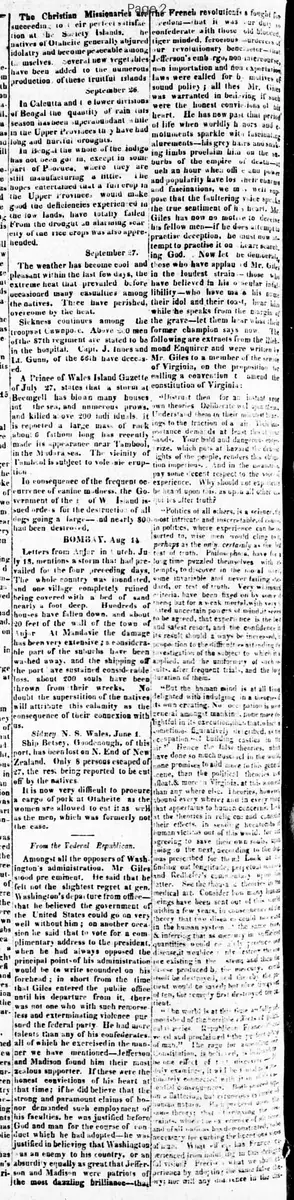
Amongst all the opposers of Washington's administration, Mr. Giles stood pre-eminent. He said that he felt not the slightest regret at Gen. Washington's departure from office—that he believed the government of the United States could go on very well without him; on another occasion he said that to vote for a complimentary address to the president, when he had always opposed the principal points of his administration would be to write scoundrel on his forehead; in short from the time that Giles entered the public office until his departure from it, there was not one who with such remorseless and exterminating violence pursued the federal party. He had more talents than any of his confederates, all of which he exercised in the manner we have mentioned—Jefferson and Madison found him their most zealous supporter. If these were the honest convictions of his heart at that time; if he did believe that the strong and paramount claims of honor demanded such employment of his faculties, he was justified before God and man for the course of conduct which he had adopted—he was justified in believing that Washington as an enemy to his country, or an absurdity equally as great that Jefferson and Madison were patriots
The French Revolution was brought forward as reasons—that it was our duty to confederate with those cold-blooded, tiger-minded, ferocious murderers of our revolutionary benefactor—that Jefferson's embargo, non-intercourse non importation and non exportation laws were called for by motives of sound policy; all these Mr. Giles was warranted in believing if such were the honest convictions of his heart. He has now past climacteric period of life when worldly honors and emoluments sparkle with luscious allurements—his grey hairs and shaking limbs proclaim him on the suburbs of the empire of death—at such an hour when office and power and popularity have lost their charms and fascinations, we may well suppose that the faltering voice speaks the true sentiment of his heart. Mr. Giles has now no motive to deceive his fellow men—if he does attempt to practise deception, he must now attempt to practise it on a searching God. Now let the democrats those who have applauded Mr. Giles in the loudest strain—those who have believed in his oracular infallibility—who have made his voice their idol and their toast, hear him while he speaks from the margin of the grave—let them hear what their former champion says now The following are extracts from the Richmond Enquirer and were written by Mr. Giles to a member of the senate of Virginia, on the proposition for calling a convention to amend the constitution of Virginia :
"Sirs, stop then for an instant your own theories. Deliberate well upon them. Understand them in their minutest bearings to the fraction of a hair. Its importance demands at least that we are cautious. Your bold and dangerous enterprise, which puts at hazard diadem rights of the people, renders the election imperious. And in the usual way pay some recent respect to the voice experience. Why should not experience be heard upon this, as upon all other questions of truth?
Politics of all others, is a science most intricate and inscrutable. Of course in politics, where experience can be resorted to, wise men would cling to it, perhaps as the only, certainly as the best test of truth. Philosophers have for long time puzzled themselves with attempts, to discover in the moral world some invariable and never failing standard, or test of truth. Very wise criteria have been fixed on by some men; but for a weak mind, with very limited uncertain powers of mind, it seems to be agreed that experience is the best and safest resort, and the confidence in its result should always be increased in proportion to the difficulty attending the investigation of the subject to which it is applied, and the uniformity of such results, after frequent trials, and the long duration of them.
But the human mind is at all times delighted with indulging in theories and drawn creating. No occupation is more general amongst mankind, none more delightful in its execution, than that, where sometimes figuratively described as the occupation of building castles in the air. Hence the false theories which have done so much mischief in the world, none promises to add more to this general scene, than the political theories afloat, and more in Virginia at this moment than any where else. Theories however abound every where and in every thing that appertains to human concerns. Look at the theories in religion: and consider their effects in sending hecatombs of human victims out of this world, for not agreeing to save their own souls, upon going into the next, according to the dogmas prescribed for them. Look at the finding out longitude, perpetual motion, and Redhefer's cunningly wrought steam engine. See the theories in medical art. Consider how many human beings have been sent out of this world within a few years, in consequence of the theory that two drachms of mercury could increase in the human system: the same book quantities would continually produce as an inference that as higher quantities in sufficient disease, it would be only destroy three pre-existing in the system; and diseases produced by the mercury, and itself be destroyed, in the third department would be saved: but nine times out of ten, the remedy but destroyed one patient.
Calpries Republican Fame 70 monished of the Virginia Test it p.d "he world is at the time an false ad. vr ed aud proclaimed -the re fer any to one effect of :i aeun-) Constitution, in ori ed, a belials of man."
The rage for advancing all boldly examine, it all be t mal to ae jon a Datteting, bu' cirunrons o irre -f -ential cnsegr-ner. Both praed op- tim telv cotnectel rih jo on vi nunan noture.
Hri: mnocrd u.m, tx raints. whe r ieax erience of sht toe aw- throgy; that taciaving ts and ofnii rainns hasdrmonat:ated, toke weccasary tor curbing the hicert ors vers perienca by ado; ting the same fal-ethe- Ful vision Precie . nlat we sbeer of u3n. snenced iron inaint ine in ths deligt Wugt rir yp. Las Frarce Cr wry; nor oill sny did rence in the dis-
Wise, produce any difference in the effects.
It is believed, that the most zealous theorist amongst us, is more certain of the good effects of his own visions, than were the patriotic zealots of France, in their grand discovery of the perfectibility of man? A conception so flattering to human nature, as to silence the voice of truth, and frown down every effort of fair investigation. From perusing one false theory after another, what has France suffered? And to what is she now reduced? Nay, in the very zenith of the practice, under this false theory; what an inconsistent spectacle did Republican France exhibit to the world! At the same time proclaiming the perfectibility of man; and daily sending to the guillotine, hundreds of her wisest and best citizens, for human imperfections: under accusations too, evidencing still greater human imperfections. Pause! Reflect. Make assurance doubly sure, before you put at hazard the best government in the world, on the vain hope of making it better.
These are the doctrines constantly maintained by the federal party, and were as constantly assailed by Mr. Giles, when he was running the giddy chase of popular applause; this very France, revolutionary France, which he now holds up to his countrymen for abhorrence, was then the real or pretended idol of his heart and the theme of his incessant panegyrics. With what obloquy has he loaded the federal party for opposing the French revolution which he now so solemnly warns his countrymen against! He tells in all but express terms the federal party that they were right and that he was wrong notwithstanding he has persecuted them with such exterminating rapacity. Instead of all these novelties, he recommends us to follow what the federal party have never ceased to recommend, whether in or out of office, experience. On the subject of complaints relative to local grievances, Mr. Giles thus expresses himself:
The variety of arguments drawn from the catalogue of grievances growing out of the system of taxation, such as contrasting a war tax upon a calf with that on a young negro slave, &c. are designedly pretermitted. Because, whilst they may serve to excite local discontents, they cannot serve in any way to elucidate the subject. They are of the class of arguments which orators sometimes take the liberty of using, not that they themselves place any reliance on them; but because they suppose them suited to the capacities of others, and in the best light can only be considered a menta ad captandum vulgus--which by using a little freedom of translation, may be rendered in English--a bait of chaff thrown out merely to catch YOUNG GULLS!
This is no more than true, mortifying as it must be to the democrats to hear such sentiments expressed by the lips of their idol. They have been the dupes of men, who outwuse them for their own convenience and then laugh at them for their folly. On the subject of the proposed alteration in the constitution of Virginia, Mr. Giles thus feelingly speaks:
Pause! good gentlemen! before you proceed. Pause! before you advance in this work of destruction. For, if you make one false step, it can never be retraced! Revolutions, sirs, never go backwards! Why not then bear the unparalleled practice glory of the existing rover.yo. a itrtelou ger? Why not deliberate a little while in this enviable state of tranquillity and happiness: before you plunge us into a labyrinth of theories all mischievous effects of which, no human foresight can see; but a small portion of human reason may, it is believed with certainty point to enough, to deter any impartial, reflecting mind from the attempt: a mind, not too much enamoured with its own theories, to give fair play to the understanding. Are you afraid, that by indulging us to deliberate a little longer in a state of happiness, our rage for innovations should cool down: our senses should return; that we should become supine of our indulgence, and postpone or forget altogether, the fanciful work of making ourselves happier? It would be more rational to conclude that the moment of happiness would be the most inauspicious of all moments, to suggest appropriate remedies for fancied evils. It is only when real evil exists, that proper remedies, suited to such evils, can be applied. For, if you first fancy the evil, and then fancy the remedy, is it not more than probable that some error will creep into these fantastical exercises of the mind?
Mr. Giles has found by experience the mischiefs attendant on such novelties; he has seen his country their prey, and more than almost any other man of his day, he has contributed to such sufferings. But he does not like go well that his own theories should touch the freehold of Virginia.
What sub-type of article is it?
What keywords are associated?
What entities or persons were involved?
Editorial Details
Primary Topic
Critique Of Mr. Giles' Political Evolution And Warning Against Constitutional Amendments
Stance / Tone
Pro Federalist, Critical Of Democratic Republicans And Giles' Past Radicalism
Key Figures
Key Arguments