Thank you for visiting SNEWPapers!
Sign up free
Story
March 18, 1830
Lynchburg Virginian
Lynchburg, Virginia
What is this article about?
A treatise distinguishing types of manures: enriching (animal/vegetable), mechanical (clay/sand), and stimulating (lime/gypsum) that exhaust soil unless balanced. Discusses gypsum's benefits and risks, lime application, with references to experts like Sir John Sinclair.
Clipping
OCR Quality
95%
Excellent
Full Text
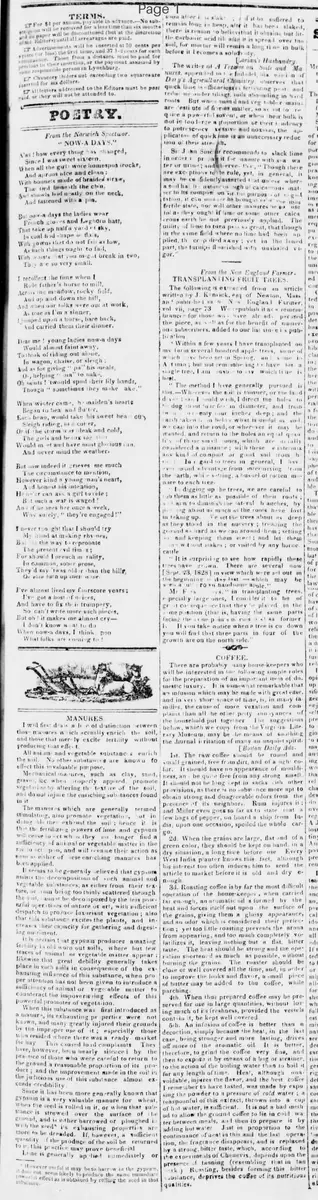
MANURES.
I will first draw a line of distinction between those manures which actually enrich the soil, and those that merely excite fertility without producing that effect.
Animal and vegetable substances enrich the soil. No other substances are known to effect this invaluable purpose.
Mechanical manures, such as clay, sand, gravel, &c. when properly applied, promote vegetation by altering the texture of the soil, and do not injure the enriching substances found in it.
The manures which are generally termed stimulating, also promote vegetation, but in doing this they exhaust the soil: hence it is that the fertilizing powers of lime and gypsum will cease to act when they no longer find a sufficiency of animal or vegetable matter in the soil to act upon, and will resume their action as soon as either of these enriching manures has been applied.
It seems to be generally believed that gypsum assists the decomposition of such animal and vegetable substances, as either from their texture, or from being too thinly scattered through the soil, cannot be decomposed by the less powerful operations of nature or art, with sufficient despatch to produce luxuriant vegetation; also that this substance excites the plants, and increases their capacity for gathering and digesting nutriment.
It is certain that gypsum produces amazing fertility in old worn out soils, where but few traces of animal or vegetable matter appear: likewise that great debility generally takes place in such soils in consequence of the exhausting influence of this substance, when proper attention has not been given to introduce a sufficiency of animal or vegetable matter to counteract the impoverishing effects of this powerful promoter of vegetation.
When this substance was first introduced as a manure, its exhausting properties were not known, and many greatly injured their grounds by the improper use of it; especially those who resided where there was a ready market for hay. This caused loud complaints. They have, however, been nearly silenced by the practice of those who were careful to return to the ground a reasonable proportion of its produce; and the improvement made in the soil in the judicious use of this substance almost exceeds credibility.
Since it has been more generally known that gypsum is a very valuable manure for wheat, when the seed is rolled in it, or when that substance is strewed over the surface of the ground, and is either harrowed or ploughed in with the seed, its exhausting properties are more to be dreaded. If, however, a sufficient quantity of the produce of the soil be returned to it, this practice may prove beneficial.
Lime is generally applied immediately or soon after it is slacked, but if it be suffered to remain long in heap, after it has been slaked, there is reason to believe that it obtains but little of the carbonic acid till after it is spread over the soil, for mortar will remain a long time in bulk before it becomes a solid body.
Lorian's Husbandry.
The writer of A Treatise on Soils and Manures, appended to the full edition of Davy’s Agricultural Chemistry observes that quick lime is efficacious in fertilizing poor and reducing under-drainage, soils abounding in hard roots. But when animal and vegetable remains are destitute of fibrous matter, so as not to require a powerful solvent, or when their bulk is not in too large a proportion to their tendency to putrescency, excessive and noxious, the application of quick lime is an unnecessary reduction of their strength.
Sir John Sinclair recommends to slack lime in order to prepare it for manure with sea water or urine; and observes, "Though there are exceptions to the rule, yet, in general, it may be confidently asserted that unless where a soil has but little calcareous matter in its composition, for the purpose of vegetation, it can never be brought into a more fertile state, nor will other manures be so useful as they ought if lime or some other calcareous earth be not previously applied. The utility of lime to turnips is so great, that though in the same field where no lime had been applied, the crop dried away; yet in the limed part, the turnips flourished with unabated vigor."
I will first draw a line of distinction between those manures which actually enrich the soil, and those that merely excite fertility without producing that effect.
Animal and vegetable substances enrich the soil. No other substances are known to effect this invaluable purpose.
Mechanical manures, such as clay, sand, gravel, &c. when properly applied, promote vegetation by altering the texture of the soil, and do not injure the enriching substances found in it.
The manures which are generally termed stimulating, also promote vegetation, but in doing this they exhaust the soil: hence it is that the fertilizing powers of lime and gypsum will cease to act when they no longer find a sufficiency of animal or vegetable matter in the soil to act upon, and will resume their action as soon as either of these enriching manures has been applied.
It seems to be generally believed that gypsum assists the decomposition of such animal and vegetable substances, as either from their texture, or from being too thinly scattered through the soil, cannot be decomposed by the less powerful operations of nature or art, with sufficient despatch to produce luxuriant vegetation; also that this substance excites the plants, and increases their capacity for gathering and digesting nutriment.
It is certain that gypsum produces amazing fertility in old worn out soils, where but few traces of animal or vegetable matter appear: likewise that great debility generally takes place in such soils in consequence of the exhausting influence of this substance, when proper attention has not been given to introduce a sufficiency of animal or vegetable matter to counteract the impoverishing effects of this powerful promoter of vegetation.
When this substance was first introduced as a manure, its exhausting properties were not known, and many greatly injured their grounds by the improper use of it; especially those who resided where there was a ready market for hay. This caused loud complaints. They have, however, been nearly silenced by the practice of those who were careful to return to the ground a reasonable proportion of its produce; and the improvement made in the soil in the judicious use of this substance almost exceeds credibility.
Since it has been more generally known that gypsum is a very valuable manure for wheat, when the seed is rolled in it, or when that substance is strewed over the surface of the ground, and is either harrowed or ploughed in with the seed, its exhausting properties are more to be dreaded. If, however, a sufficient quantity of the produce of the soil be returned to it, this practice may prove beneficial.
Lime is generally applied immediately or soon after it is slacked, but if it be suffered to remain long in heap, after it has been slaked, there is reason to believe that it obtains but little of the carbonic acid till after it is spread over the soil, for mortar will remain a long time in bulk before it becomes a solid body.
Lorian's Husbandry.
The writer of A Treatise on Soils and Manures, appended to the full edition of Davy’s Agricultural Chemistry observes that quick lime is efficacious in fertilizing poor and reducing under-drainage, soils abounding in hard roots. But when animal and vegetable remains are destitute of fibrous matter, so as not to require a powerful solvent, or when their bulk is not in too large a proportion to their tendency to putrescency, excessive and noxious, the application of quick lime is an unnecessary reduction of their strength.
Sir John Sinclair recommends to slack lime in order to prepare it for manure with sea water or urine; and observes, "Though there are exceptions to the rule, yet, in general, it may be confidently asserted that unless where a soil has but little calcareous matter in its composition, for the purpose of vegetation, it can never be brought into a more fertile state, nor will other manures be so useful as they ought if lime or some other calcareous earth be not previously applied. The utility of lime to turnips is so great, that though in the same field where no lime had been applied, the crop dried away; yet in the limed part, the turnips flourished with unabated vigor."
What sub-type of article is it?
Agricultural Treatise
Farming Advice
What keywords are associated?
Manures
Lime
Gypsum
Soil Enrichment
Agriculture
Farming Practices
What entities or persons were involved?
Sir John Sinclair
Story Details
Key Persons
Sir John Sinclair
Story Details
Distinguishes enriching manures (animal/vegetable) from stimulating ones (lime/gypsum) that exhaust soil; explains gypsum's role in decomposition and risks; discusses lime application and benefits for crops like turnips.