Thank you for visiting SNEWPapers!
Sign up free
Letter to Editor
September 13, 1783
The New Hampshire Gazette And General Advertiser
Portsmouth, Exeter, Rockingham County, New Hampshire
What is this article about?
A letter refuting claims of American subjection to the British King before 1776, arguing that his attacks starting at Lexington on April 19, 1775, absolved allegiance. The Declaration informed foreign powers. Tories are traitors unfit to return to America.
Clipping
OCR Quality
95%
Excellent
Full Text
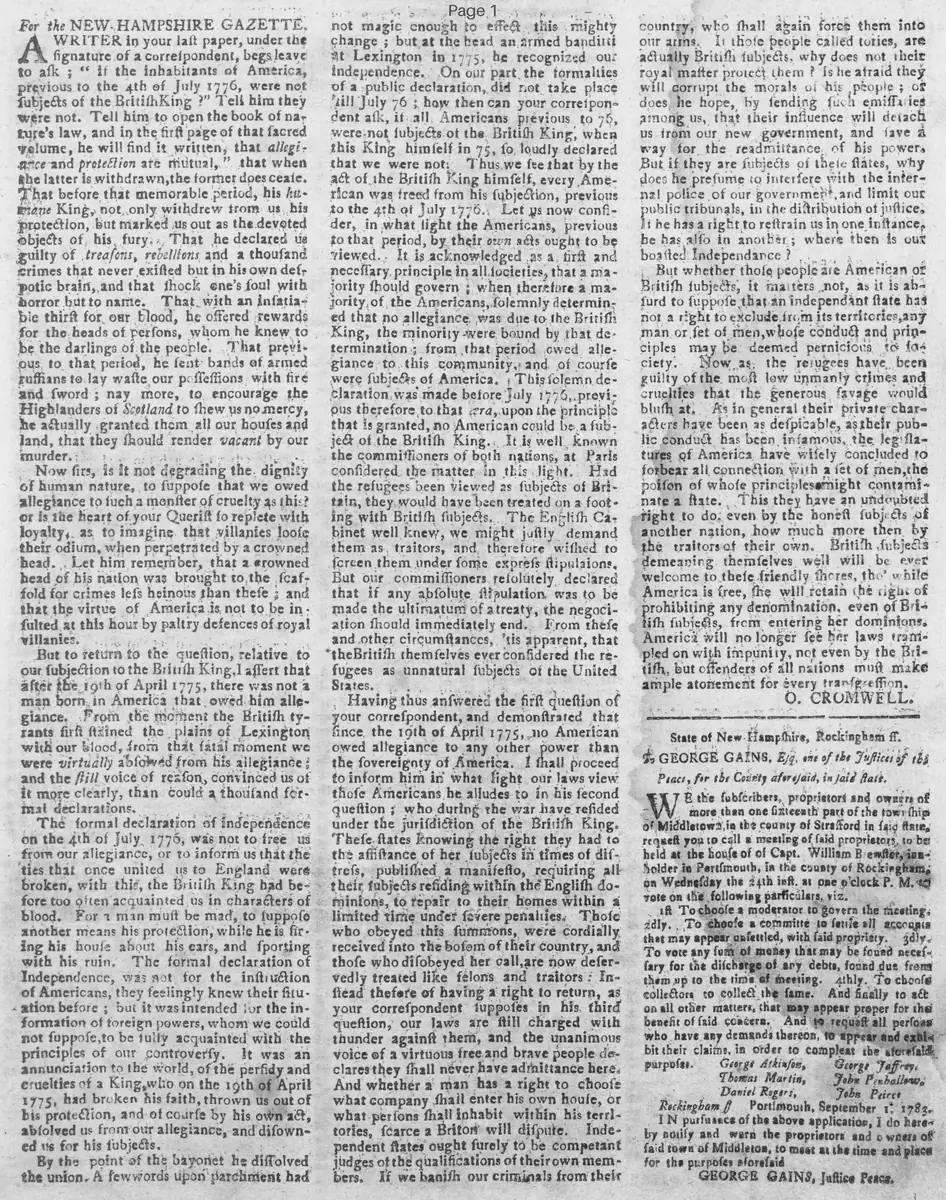
For the NEW-HAMPSHIRE GAZETTE.
A WRITER in your last paper, under the signature of a correspondent, begs leave to ask; "if the inhabitants of America, previous to the 4th of July 1776, were not subjects of the British King?" Tell him they were not. Tell him to open the book of nature's law, and in the first page of that sacred volume, he will find it written, that allegiance and protection are mutual. "that when the latter is withdrawn, the former does cease."
That before that memorable period, his humane King, not only withdrew from us, his protection, but marked us out as the devoted objects of, his fury. That he declared us guilty of treasons, rebellions and a thousand crimes that never existed but in his own despotic brain, and that shock one's soul with horror but to name. That with an insatiable thirst for our blood, he offered rewards for the heads of persons, whom he knew to be the darlings of the people. That previous to that period, he sent bands of armed ruffians to lay waste our possessions with fire and sword; nay more, to encourage the Highlanders of Scotland to shew us no mercy, he actually granted them all our houses and land, that they should render vacant by our murder.
Now sir, is it not degrading the dignity of human nature, to suppose that we owed allegiance to such a monster of cruelty as this? or is the heart of your Querist so replete with loyalty, as to imagine, that villanies loose their odium, when perpetrated by a crowned head. Let him remember, that a crowned head of his nation was brought to, the scaffold for crimes less heinous than these: and that the virtue of America is not to be insulted at this hour by paltry defences of royal villanies.
But to return to the question, relative to our subjection to the British King. I assert that after the 19th of April 1775, there was not a man born, in America that owed him allegiance. From the moment the British tyrants first stained the plains of Lexington with our blood, from that fatal moment we were virtually absolved from his allegiance: and the still voice of reason, convinced us of it more clearly, than could a thousand formal declarations.
The formal declaration of independence on the 4th of July, 1776, was not to free us from our allegiance, or to inform us that the ties that once united us to England were broken. with this, the British King had before too often acquainted us in characters of blood. For a man must be mad, to suppose another means his protection, while he is firing his house about his ears, and sporting with his ruin. The formal declaration of Independence, was not for the instruction of Americans, they feelingly knew their situation before: but it was intended for the information of foreign powers, whom we could not suppose, to be justly acquainted with the principles of our controversy. It was an annunciation to the world, of the perfidy and cruelties of a King, who on the 19th of April 1775, had broken his faith, thrown us out of his protection, and of course by his own act, absolved us from our allegiance, and disowned us for his subjects.
By the point of the bayonet he dissolved the union. A few words upon parchment had not magic enough to effect this mighty change; but at the head an armed banditti at Lexington in 1775, he recognized our independence. On our part the formalities of a public declaration, did not take place "till July 76; how then can your correspondent ask, if all Americans previous to 76, were not subjects of the British King, when this King himself in 75, so loudly declared that we were not: Thus we see that by the act of the British King himself, every American was freed from his subjection. previous to the 4th of July 1776. Let us now consider, in what light the Americans, previous to that period, by their own acts ought to be viewed. It is acknowledged as a first and necessary principle in all societies, that a majority should govern: when therefore a majority, of the Americans, solemnly determined that no allegiance was due to the British King, the minority were bound by that determination; from that period owed allegiance to this community, and of course were subjects of America. This solemn declaration was made before July 1776, previous therefore to that era, upon the principle that is granted, no American could be a subject of the British King. It is well known the commissioners of both nations, at Paris considered the matter in this light. Had the refugees been viewed as subjects of Britain, they would have been treated on a footing with British subjects. The English Cabinet well knew, we might justly demand them as traitors, and therefore wished to screen them under some express stipulations. But our commissioners resolutely declared that if any absolute stipulation was to be made the ultimatum of a treaty, the negotiation should immediately end. From these and other circumstances, tis apparent, that the British themselves ever considered the refugees as unnatural subjects Of the United States,
Having thus answered the first question of your correspondent, and demonstrated that since the 19th of April 1775, no American owed allegiance to any other power than the sovereignty of America. I shall proceed to inform him in what light our laws view those Americans he alludes to in his second question; who during the war have resided under the jurisdiction of the British King. These states knowing the right they had to the assistance of her subjects in times of distress, published a manifesto, requiring all their subjects residing within the English dominions, to repair to their homes within a limited time under severe penalties. Those who obeyed this summons, were cordially received into the bosom of their country, and those who disobeyed her call, are now deservedly treated like felons and traitors: Instead therefore of having a right to return, as your correspondent supposes in his third question, our laws are ill charged with thunder against them, and the unanimous voice of a virtuous free and brave people declares they shall never have admittance here. And whether a man has a right to choose what company shall enter his own house, or what persons shall inhabit within his territories, scarce a Briton will dispute. Independent states ought surely to be competent judges of the qualifications of their own members. If we banish our criminals from their country, who shall again force them into our arms. If those people called tories, are actually British subjects, why does not their royal master protect them? Is he afraid they will corrupt the morals of his people; or does he hope, by sending such emissaries among us, that their influence will detach us from our new government, and save a way for the readmittance of his power. But if they are subjects of these states, why does he presume to interfere with the internal police of our government, and limit our public tribunals in the distribution of justice. If he has a right to restrain us in one instance, he has also in another; where then is our boasted Independance?
But whether those people are American or British subjects, it matters not, as it is absurd to suppose that an independent state has not a right to exclude from its territories, any man or set of men, whose conduct and principles may be deemed pernicious to society. Now, as the refugees have been guilty of the most low unmanly crimes and cruelties that the generous savage would blush at. As in general their private characters have been as despicable, as their public conduct has been infamous, the legislatures of America have wisely concluded to forbear all connection with a set of men, the poison of whose principles might contaminate a state. This they have an undoubted right to do: even by the honest subjects of another nation, how much more then by the traitors of their own. British subjects demeaning themselves well will be ever welcome to these friendly shores, tho' while America is free, she will retain the right of prohibiting any denomination, even of British subjects, from entering her dominions. America will no longer see her laws trampled on with impunity, not even by the British, but offenders of all nations must make ample atonement for every transgression.
O. CROMWELL.
A WRITER in your last paper, under the signature of a correspondent, begs leave to ask; "if the inhabitants of America, previous to the 4th of July 1776, were not subjects of the British King?" Tell him they were not. Tell him to open the book of nature's law, and in the first page of that sacred volume, he will find it written, that allegiance and protection are mutual. "that when the latter is withdrawn, the former does cease."
That before that memorable period, his humane King, not only withdrew from us, his protection, but marked us out as the devoted objects of, his fury. That he declared us guilty of treasons, rebellions and a thousand crimes that never existed but in his own despotic brain, and that shock one's soul with horror but to name. That with an insatiable thirst for our blood, he offered rewards for the heads of persons, whom he knew to be the darlings of the people. That previous to that period, he sent bands of armed ruffians to lay waste our possessions with fire and sword; nay more, to encourage the Highlanders of Scotland to shew us no mercy, he actually granted them all our houses and land, that they should render vacant by our murder.
Now sir, is it not degrading the dignity of human nature, to suppose that we owed allegiance to such a monster of cruelty as this? or is the heart of your Querist so replete with loyalty, as to imagine, that villanies loose their odium, when perpetrated by a crowned head. Let him remember, that a crowned head of his nation was brought to, the scaffold for crimes less heinous than these: and that the virtue of America is not to be insulted at this hour by paltry defences of royal villanies.
But to return to the question, relative to our subjection to the British King. I assert that after the 19th of April 1775, there was not a man born, in America that owed him allegiance. From the moment the British tyrants first stained the plains of Lexington with our blood, from that fatal moment we were virtually absolved from his allegiance: and the still voice of reason, convinced us of it more clearly, than could a thousand formal declarations.
The formal declaration of independence on the 4th of July, 1776, was not to free us from our allegiance, or to inform us that the ties that once united us to England were broken. with this, the British King had before too often acquainted us in characters of blood. For a man must be mad, to suppose another means his protection, while he is firing his house about his ears, and sporting with his ruin. The formal declaration of Independence, was not for the instruction of Americans, they feelingly knew their situation before: but it was intended for the information of foreign powers, whom we could not suppose, to be justly acquainted with the principles of our controversy. It was an annunciation to the world, of the perfidy and cruelties of a King, who on the 19th of April 1775, had broken his faith, thrown us out of his protection, and of course by his own act, absolved us from our allegiance, and disowned us for his subjects.
By the point of the bayonet he dissolved the union. A few words upon parchment had not magic enough to effect this mighty change; but at the head an armed banditti at Lexington in 1775, he recognized our independence. On our part the formalities of a public declaration, did not take place "till July 76; how then can your correspondent ask, if all Americans previous to 76, were not subjects of the British King, when this King himself in 75, so loudly declared that we were not: Thus we see that by the act of the British King himself, every American was freed from his subjection. previous to the 4th of July 1776. Let us now consider, in what light the Americans, previous to that period, by their own acts ought to be viewed. It is acknowledged as a first and necessary principle in all societies, that a majority should govern: when therefore a majority, of the Americans, solemnly determined that no allegiance was due to the British King, the minority were bound by that determination; from that period owed allegiance to this community, and of course were subjects of America. This solemn declaration was made before July 1776, previous therefore to that era, upon the principle that is granted, no American could be a subject of the British King. It is well known the commissioners of both nations, at Paris considered the matter in this light. Had the refugees been viewed as subjects of Britain, they would have been treated on a footing with British subjects. The English Cabinet well knew, we might justly demand them as traitors, and therefore wished to screen them under some express stipulations. But our commissioners resolutely declared that if any absolute stipulation was to be made the ultimatum of a treaty, the negotiation should immediately end. From these and other circumstances, tis apparent, that the British themselves ever considered the refugees as unnatural subjects Of the United States,
Having thus answered the first question of your correspondent, and demonstrated that since the 19th of April 1775, no American owed allegiance to any other power than the sovereignty of America. I shall proceed to inform him in what light our laws view those Americans he alludes to in his second question; who during the war have resided under the jurisdiction of the British King. These states knowing the right they had to the assistance of her subjects in times of distress, published a manifesto, requiring all their subjects residing within the English dominions, to repair to their homes within a limited time under severe penalties. Those who obeyed this summons, were cordially received into the bosom of their country, and those who disobeyed her call, are now deservedly treated like felons and traitors: Instead therefore of having a right to return, as your correspondent supposes in his third question, our laws are ill charged with thunder against them, and the unanimous voice of a virtuous free and brave people declares they shall never have admittance here. And whether a man has a right to choose what company shall enter his own house, or what persons shall inhabit within his territories, scarce a Briton will dispute. Independent states ought surely to be competent judges of the qualifications of their own members. If we banish our criminals from their country, who shall again force them into our arms. If those people called tories, are actually British subjects, why does not their royal master protect them? Is he afraid they will corrupt the morals of his people; or does he hope, by sending such emissaries among us, that their influence will detach us from our new government, and save a way for the readmittance of his power. But if they are subjects of these states, why does he presume to interfere with the internal police of our government, and limit our public tribunals in the distribution of justice. If he has a right to restrain us in one instance, he has also in another; where then is our boasted Independance?
But whether those people are American or British subjects, it matters not, as it is absurd to suppose that an independent state has not a right to exclude from its territories, any man or set of men, whose conduct and principles may be deemed pernicious to society. Now, as the refugees have been guilty of the most low unmanly crimes and cruelties that the generous savage would blush at. As in general their private characters have been as despicable, as their public conduct has been infamous, the legislatures of America have wisely concluded to forbear all connection with a set of men, the poison of whose principles might contaminate a state. This they have an undoubted right to do: even by the honest subjects of another nation, how much more then by the traitors of their own. British subjects demeaning themselves well will be ever welcome to these friendly shores, tho' while America is free, she will retain the right of prohibiting any denomination, even of British subjects, from entering her dominions. America will no longer see her laws trampled on with impunity, not even by the British, but offenders of all nations must make ample atonement for every transgression.
O. CROMWELL.
What sub-type of article is it?
Persuasive
Political
Reflective
What themes does it cover?
Constitutional Rights
Politics
Military War
What keywords are associated?
American Independence
British Allegiance
Lexington Battle
Declaration Of Independence
Tories Refugees
Traitors Banishment
What entities or persons were involved?
O. Cromwell
New Hampshire Gazette
Letter to Editor Details
Author
O. Cromwell
Recipient
New Hampshire Gazette
Main Argument
americans were absolved from allegiance to the british king by his own aggressive actions starting april 19, 1775, at lexington; the declaration of independence was for foreign audiences. tories and refugees who sided with britain are traitors with no right to return to america.
Notable Details
References To Lexington Battle On April 19, 1775
Declaration Of Independence On July 4, 1776
King's Cruelties Including Rewards For Heads And Grants To Highlanders
Paris Commissioners' Negotiations On Refugees
Manifesto Requiring Subjects To Return Home