Thank you for visiting SNEWPapers!
Sign up free
Editorial
July 4, 1857
American Union
Morgantown, Monongalia County, West Virginia
What is this article about?
Editorial from Baltimore Clipper criticizes William Walker's letter denouncing Captain Davis's rescue of his filibusters in Nicaragua, defends Davis's humane intervention, condemns Walker's expedition as despotic and failed, urges US government to prevent further recruitment for such invasions, and calls for consistent expatriation policy.
Clipping
OCR Quality
97%
Excellent
Full Text
General Walker's Letter to the President.
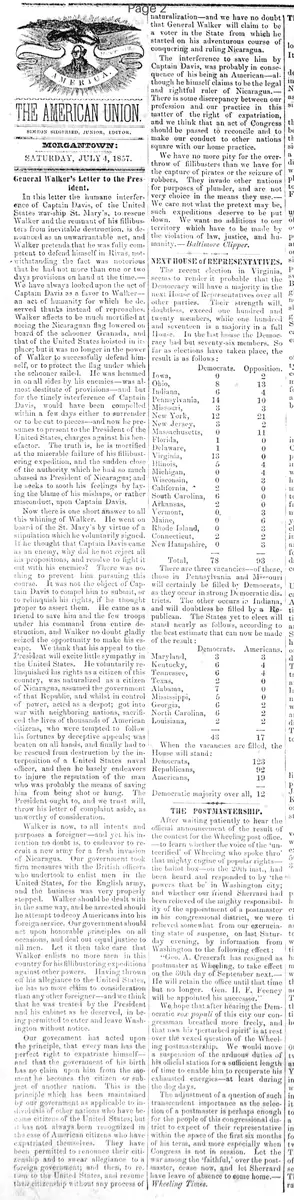
In this letter the humane interference of Captain Davis, of the United States war-ship St. Mary's, to rescue Walker and the remnant of his filibusters from inevitable destruction, is denounced as an unwarrantable act, and Walker pretends that he was fully competent to defend himself in Rivas, notwithstanding the fact was notorious that he had not more than one or two days provisions on hand at the time. We have always looked upon the act of Captain Davis as a favor to Walker—an act of humanity for which he deserved thanks instead of reproaches. Walker affects to be much mortified at seeing the Nicaraguan flag lowered on board of the schooner Granada, and that of the United States hoisted in its place; but it was no longer in the power of Walker to successfully defend himself, or to protect the flag under which the schooner sailed. He was hemmed in on all sides by his enemies—was almost destitute of provisions—and but for the timely interference of Captain Davis, would have been compelled within a few days either to surrender or to be cut to pieces—and now he presumes to present to the President of the United States, charges against his benefactor. The truth is, he is mortified at the miserable failure of his filibustering expedition, and the sudden close of the authority which he had so much abused as President of Nicaragua; and he seeks to sooth his feelings by laying the blame of his mishaps, or rather misconduct, upon Captain Davis. Now there is one short answer to all this whining of Walker. He went on board of the St. Mary's by virtue of a stipulation which he voluntarily signed. If he thought that Captain Davis came as an enemy, why did he not reject all his propositions, and resolve to fight it out with his enemies? There was no thing to prevent him pursuing this course. It was not the object of Captain Davis to compel him to submit, or to relinquish his rights, if he thought proper to assert them. He came as a friend to save him and the few troops under his command from entire destruction, and Walker no doubt gladly seized the opportunity to make his escape. We think that his appeal to the President will excite little sympathy in the United States. He voluntarily relinquished his rights as a citizen of this country, was naturalized as a citizen of Nicaragua, assumed the government of that Republic, and whilst in control of power, acted as a despot; got into war with neighboring nations, sacrificed the lives of thousands of American citizens, who were tempted to follow his fortunes by deceptive appeals; was beaten on all hands, and finally had to be rescued from destruction by the interposition of a United States naval officer, and then he basely endeavors to injure the reputation of the man who was probably the means of saving him from being shot or hung. The President ought to, and we trust will, throw his letter of complaint aside, as unworthy of consideration. Walker is now, to all intents and purposes a foreigner—and yet his intention no doubt is, to endeavor to recruit a new army for a fresh invasion of Nicaragua. Our government took firm measures with the British officers who undertook to enlist men in the United States, for the English army, and the business was very properly stopped. Walker should be dealt with in the same way, and be arrested should he attempt to decoy Americans into his foreign service. Our government should act upon honorable principles on all occasions, and deal out equal justice to all men. Let it then take care that Walker enlists no more men in this country for his filibustering expeditions against other powers. Having thrown off his allegiance to the United States, he has no more claim to consideration than any other foreigner—and we think that he was treated by the President and his cabinet as he deserved, in being permitted to enter and leave Washington without notice. Our government has acted upon the principle, that every man has the perfect right to expatriate himself—and that the government of his birth has no claim upon him from the moment he becomes the citizen or subject of another nation. This is the principle which has been maintained by our government as applicable to individuals of other nations who have become citizens of the United States; but it has not always been recognized in the case of American citizens who have expatriated themselves. They have been permitted to renounce their citizenship and to swear allegiance to a foreign government: and then, to return to the United States, and resume their citizenship without any process of naturalization—and we have no doubt that General Walker will claim to be a voter in the State from which he started on his adventurous course of conquering and ruling Nicaragua. The interference to save him by Captain Davis, was probably in consequence of his being an American—although he himself claims to be the legal and rightful ruler of Nicaragua. There is some discrepancy between our profession and our practice in this matter of the right of expatriation, and we think that an act of Congress should be passed to reconcile and to make our conduct to other nations square with our home practice. We have no more pity for the overthrow of filibusters than we have for the capture of pirates or the seizure of robbers. They invade other nations for purposes of plunder, and are not very choice in the means they use. We care not what the pretext may be, such expeditions deserve to be put down. We want no additions to our territory which have to be made by the violation of law, justice, and humanity.—Baltimore Clipper.
In this letter the humane interference of Captain Davis, of the United States war-ship St. Mary's, to rescue Walker and the remnant of his filibusters from inevitable destruction, is denounced as an unwarrantable act, and Walker pretends that he was fully competent to defend himself in Rivas, notwithstanding the fact was notorious that he had not more than one or two days provisions on hand at the time. We have always looked upon the act of Captain Davis as a favor to Walker—an act of humanity for which he deserved thanks instead of reproaches. Walker affects to be much mortified at seeing the Nicaraguan flag lowered on board of the schooner Granada, and that of the United States hoisted in its place; but it was no longer in the power of Walker to successfully defend himself, or to protect the flag under which the schooner sailed. He was hemmed in on all sides by his enemies—was almost destitute of provisions—and but for the timely interference of Captain Davis, would have been compelled within a few days either to surrender or to be cut to pieces—and now he presumes to present to the President of the United States, charges against his benefactor. The truth is, he is mortified at the miserable failure of his filibustering expedition, and the sudden close of the authority which he had so much abused as President of Nicaragua; and he seeks to sooth his feelings by laying the blame of his mishaps, or rather misconduct, upon Captain Davis. Now there is one short answer to all this whining of Walker. He went on board of the St. Mary's by virtue of a stipulation which he voluntarily signed. If he thought that Captain Davis came as an enemy, why did he not reject all his propositions, and resolve to fight it out with his enemies? There was no thing to prevent him pursuing this course. It was not the object of Captain Davis to compel him to submit, or to relinquish his rights, if he thought proper to assert them. He came as a friend to save him and the few troops under his command from entire destruction, and Walker no doubt gladly seized the opportunity to make his escape. We think that his appeal to the President will excite little sympathy in the United States. He voluntarily relinquished his rights as a citizen of this country, was naturalized as a citizen of Nicaragua, assumed the government of that Republic, and whilst in control of power, acted as a despot; got into war with neighboring nations, sacrificed the lives of thousands of American citizens, who were tempted to follow his fortunes by deceptive appeals; was beaten on all hands, and finally had to be rescued from destruction by the interposition of a United States naval officer, and then he basely endeavors to injure the reputation of the man who was probably the means of saving him from being shot or hung. The President ought to, and we trust will, throw his letter of complaint aside, as unworthy of consideration. Walker is now, to all intents and purposes a foreigner—and yet his intention no doubt is, to endeavor to recruit a new army for a fresh invasion of Nicaragua. Our government took firm measures with the British officers who undertook to enlist men in the United States, for the English army, and the business was very properly stopped. Walker should be dealt with in the same way, and be arrested should he attempt to decoy Americans into his foreign service. Our government should act upon honorable principles on all occasions, and deal out equal justice to all men. Let it then take care that Walker enlists no more men in this country for his filibustering expeditions against other powers. Having thrown off his allegiance to the United States, he has no more claim to consideration than any other foreigner—and we think that he was treated by the President and his cabinet as he deserved, in being permitted to enter and leave Washington without notice. Our government has acted upon the principle, that every man has the perfect right to expatriate himself—and that the government of his birth has no claim upon him from the moment he becomes the citizen or subject of another nation. This is the principle which has been maintained by our government as applicable to individuals of other nations who have become citizens of the United States; but it has not always been recognized in the case of American citizens who have expatriated themselves. They have been permitted to renounce their citizenship and to swear allegiance to a foreign government: and then, to return to the United States, and resume their citizenship without any process of naturalization—and we have no doubt that General Walker will claim to be a voter in the State from which he started on his adventurous course of conquering and ruling Nicaragua. The interference to save him by Captain Davis, was probably in consequence of his being an American—although he himself claims to be the legal and rightful ruler of Nicaragua. There is some discrepancy between our profession and our practice in this matter of the right of expatriation, and we think that an act of Congress should be passed to reconcile and to make our conduct to other nations square with our home practice. We have no more pity for the overthrow of filibusters than we have for the capture of pirates or the seizure of robbers. They invade other nations for purposes of plunder, and are not very choice in the means they use. We care not what the pretext may be, such expeditions deserve to be put down. We want no additions to our territory which have to be made by the violation of law, justice, and humanity.—Baltimore Clipper.
What sub-type of article is it?
Foreign Affairs
Imperialism
Military Affairs
What keywords are associated?
William Walker
Filibustering
Nicaragua
Captain Davis
Us Intervention
Expatriation
Recruitment
Naval Rescue
What entities or persons were involved?
William Walker
Captain Davis
President Of The United States
Nicaragua
United States
St. Mary's
Granada
Rivas
Baltimore Clipper
Editorial Details
Primary Topic
Criticism Of William Walker's Filibustering Expedition In Nicaragua And Defense Of Us Captain Davis's Intervention
Stance / Tone
Strongly Critical Of Walker, Supportive Of Us Government Actions And Captain Davis
Key Figures
William Walker
Captain Davis
President Of The United States
Nicaragua
United States
St. Mary's
Granada
Rivas
Baltimore Clipper
Key Arguments
Captain Davis's Rescue Was A Humane Act Deserving Thanks, Not Denunciation
Walker Was Unable To Defend Himself Due To Lack Of Provisions And Encirclement By Enemies
Walker Voluntarily Signed A Stipulation To Board The St. Mary's, Indicating Acceptance Of Rescue
Walker's Expedition Was A Despotic Failure That Sacrificed American Lives
Us Government Should Prevent Walker From Recruiting For Further Filibustering
Walker, As An Expatriate, Has No Special Claims On Us Sympathy Or Rights
Inconsistent Us Policy On Expatriation Needs Congressional Reform
Filibustering Expeditions Are Akin To Piracy And Should Be Suppressed