Thank you for visiting SNEWPapers!
Sign up free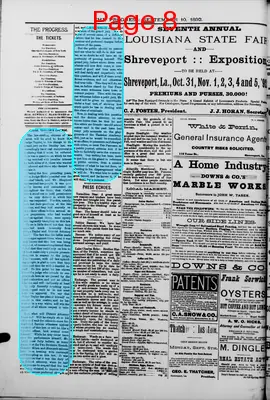
Editorial
September 10, 1892
The Progress
Shreveport, Caddo County, Louisiana
What is this article about?
Editorial praises Judge Taylor's firm charge to the grand jury mandating enforcement of the Sunday law in Caddo Parish, notes past strict adherence under Judge Hicks leading to their ouster, criticizes saloon violators expecting leniency from new officials, and urges District Attorney Land to proactively prosecute breaches.
Clipping
OCR Quality
95%
Excellent
Full Text
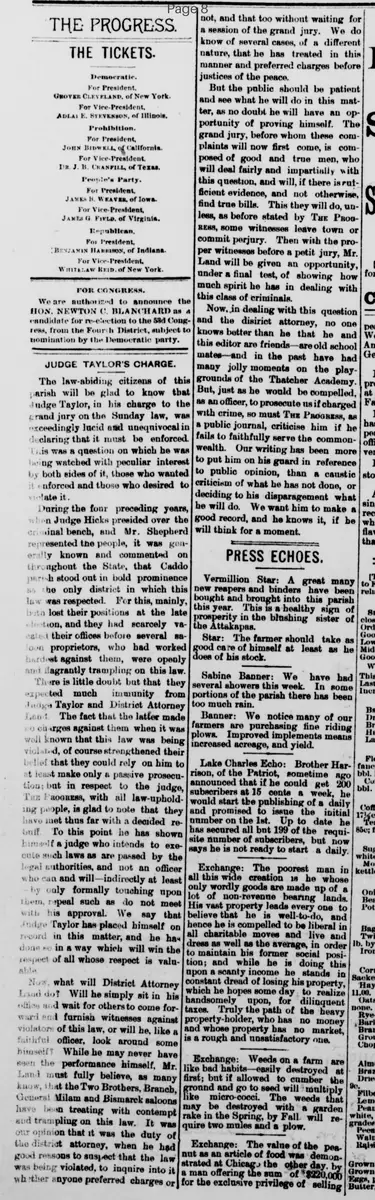
JUDGE TAYLOR'S CHARGE.
The law-abiding citizens of this parish will be glad to know that Judge Taylor, in his charge to the grand jury on the Sunday law, was exceedingly lucid and unequivocal in declaring that it must be enforced. This was a question on which he was being watched with peculiar interest by both sides of it, those who wanted it enforced and those who desired to violate it.
During the four preceding years, when Judge Hicks presided over the criminal bench, and Mr. Shepherd represented the people, it was generally known and commented on throughout the State, that Caddo parish stood out in bold prominence as the only district in which this law was respected. For this, mainly, both lost their positions at the late election, and they had scarcely regained their offices before several saloon proprietors, who had worked hardest against them, were openly and flagrantly trampling on this law.
There is little doubt but that they expected much immunity from Judge Taylor and District Attorney Land. The fact that the latter made no charges against them when it was well known that this law was being violated, of course strengthened their belief that they could rely on him to at least make only a passive prosecution; but in respect to the judge, The Progress, with all law-upholding people, is glad to note that they have met thus far with a decided rebuff. To this point he has shown himself a judge who intends to execute such laws as are passed by the legal authorities, and not an officer who can and will—indirectly at least by only formally touching upon them—repeal such as do not meet with his approval. We say that Judge Taylor has placed himself on record in this matter, and he has done so in a way which will win the respect of all whose respect is valuable.
Now, what will District Attorney Land do? Will he simply sit in his office and wait for others to come forward and furnish witnesses against violators of this law, or will he, like a faithful officer, look around some himself? While he may never have seen the performance himself, Mr. Land must fully believe, as many know, that the Two Brothers, Branch, General Milam and Bismarck saloons have been treating with contempt and trampling on this law. It was our opinion that it was the duty of the district attorney, when he had but good reasons to suspect that the law was being violated, to inquire into it whether anyone preferred charges or not, and that too without waiting for a session of the grand jury.
We do know of several cases, of a different nature, that he has treated in this manner and preferred charges before justices of the peace.
But the public should be patient and see what he will do in this matter, as no doubt he will have an opportunity of proving himself. The grand jury, before whom these complaints will now first come, is composed of good and true men, who will deal fairly and impartially with this question, and will, if there is sufficient evidence, and not otherwise, find true bills. This they will do, unless, as before stated by The Progress, some witnesses leave town or commit perjury. Then with the proper witnesses before a petit jury, Mr. Land will be given an opportunity, under a final test, of showing how much spirit he has in dealing with this class of criminals.
Now, in dealing with this question and the district attorney, no one knows better than he that he and this editor are friends—are old school mates—and in the past have had many jolly moments on the playgrounds of the Thatcher Academy. But, just as he would be compelled, as an officer, to prosecute us if charged with crime, so must The Progress, as a public journal, criticise him if he fails to faithfully serve the commonwealth. Our writing has been more to put him on his guard in reference to public opinion, than a caustic criticism of what he has not done, or deciding to his disparagement what he will do. We want him to make a good record, and he knows it, if he will think for a moment.
The law-abiding citizens of this parish will be glad to know that Judge Taylor, in his charge to the grand jury on the Sunday law, was exceedingly lucid and unequivocal in declaring that it must be enforced. This was a question on which he was being watched with peculiar interest by both sides of it, those who wanted it enforced and those who desired to violate it.
During the four preceding years, when Judge Hicks presided over the criminal bench, and Mr. Shepherd represented the people, it was generally known and commented on throughout the State, that Caddo parish stood out in bold prominence as the only district in which this law was respected. For this, mainly, both lost their positions at the late election, and they had scarcely regained their offices before several saloon proprietors, who had worked hardest against them, were openly and flagrantly trampling on this law.
There is little doubt but that they expected much immunity from Judge Taylor and District Attorney Land. The fact that the latter made no charges against them when it was well known that this law was being violated, of course strengthened their belief that they could rely on him to at least make only a passive prosecution; but in respect to the judge, The Progress, with all law-upholding people, is glad to note that they have met thus far with a decided rebuff. To this point he has shown himself a judge who intends to execute such laws as are passed by the legal authorities, and not an officer who can and will—indirectly at least by only formally touching upon them—repeal such as do not meet with his approval. We say that Judge Taylor has placed himself on record in this matter, and he has done so in a way which will win the respect of all whose respect is valuable.
Now, what will District Attorney Land do? Will he simply sit in his office and wait for others to come forward and furnish witnesses against violators of this law, or will he, like a faithful officer, look around some himself? While he may never have seen the performance himself, Mr. Land must fully believe, as many know, that the Two Brothers, Branch, General Milam and Bismarck saloons have been treating with contempt and trampling on this law. It was our opinion that it was the duty of the district attorney, when he had but good reasons to suspect that the law was being violated, to inquire into it whether anyone preferred charges or not, and that too without waiting for a session of the grand jury.
We do know of several cases, of a different nature, that he has treated in this manner and preferred charges before justices of the peace.
But the public should be patient and see what he will do in this matter, as no doubt he will have an opportunity of proving himself. The grand jury, before whom these complaints will now first come, is composed of good and true men, who will deal fairly and impartially with this question, and will, if there is sufficient evidence, and not otherwise, find true bills. This they will do, unless, as before stated by The Progress, some witnesses leave town or commit perjury. Then with the proper witnesses before a petit jury, Mr. Land will be given an opportunity, under a final test, of showing how much spirit he has in dealing with this class of criminals.
Now, in dealing with this question and the district attorney, no one knows better than he that he and this editor are friends—are old school mates—and in the past have had many jolly moments on the playgrounds of the Thatcher Academy. But, just as he would be compelled, as an officer, to prosecute us if charged with crime, so must The Progress, as a public journal, criticise him if he fails to faithfully serve the commonwealth. Our writing has been more to put him on his guard in reference to public opinion, than a caustic criticism of what he has not done, or deciding to his disparagement what he will do. We want him to make a good record, and he knows it, if he will think for a moment.
What sub-type of article is it?
Moral Or Religious
Crime Or Punishment
What keywords are associated?
Sunday Law
Enforcement
Judge Taylor
District Attorney Land
Caddo Parish
Saloon Violations
Grand Jury
Law Respect
What entities or persons were involved?
Judge Taylor
District Attorney Land
Judge Hicks
Mr. Shepherd
Saloon Proprietors
Two Brothers Saloon
Branch Saloon
General Milam Saloon
Bismarck Saloon
The Progress
Editorial Details
Primary Topic
Enforcement Of The Sunday Law
Stance / Tone
Supportive Of Strict Enforcement And Critical Of Potential Leniency
Key Figures
Judge Taylor
District Attorney Land
Judge Hicks
Mr. Shepherd
Saloon Proprietors
Two Brothers Saloon
Branch Saloon
General Milam Saloon
Bismarck Saloon
The Progress
Key Arguments
Judge Taylor Declared Unequivocally That The Sunday Law Must Be Enforced
Caddo Parish Was The Only District Respecting The Law Under Judge Hicks And Mr. Shepherd, Leading To Their Electoral Loss
Saloon Proprietors Expected Immunity From Judge Taylor And District Attorney Land
Judge Taylor Has Shown Intent To Execute Laws Passed By Authorities
District Attorney Land Should Actively Investigate Violations Rather Than Wait For Complaints
Grand Jury Will Deal Fairly If Sufficient Evidence Is Provided
The Progress Criticizes To Encourage Faithful Service, Not Personally