Thank you for visiting SNEWPapers!
Sign up free
The Evening Telegraph
Philadelphia, Philadelphia County, Pennsylvania
What is this article about?
A correspondent describes a delightful summer journey from Philadelphia to New York by rail, noting the fertile countryside and good crops, an amusing encounter with a young traveler, then steams up the Hudson to Albany, praising the scenery under moonlight while criticizing reckless steamboat practices that risk accidents.
Clipping
OCR Quality
Full Text
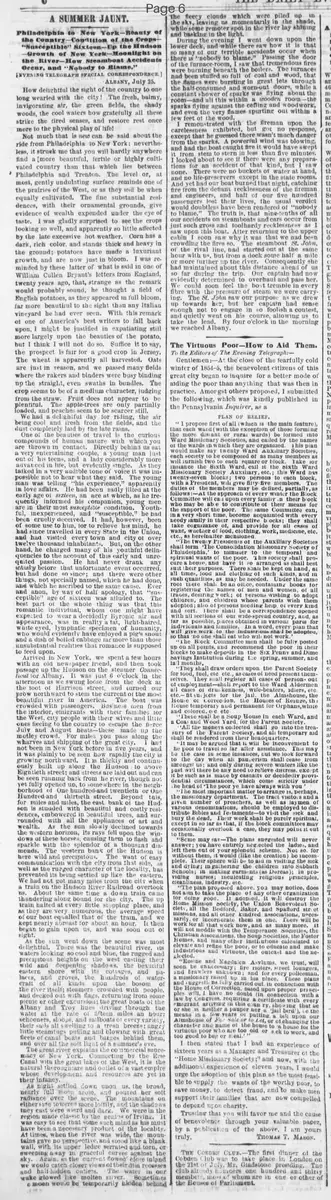
Philadelphia to New York—Beauty of the Country—Condition of the Crops—"Susceptible" Sixteen—Up the Hudson—Growth of New York—Moonlight on the River—How Steamboat Accidents Occur, and "Nobody to Blame."
[EVENING TELEGRAPH SPECIAL CORRESPONDENCE.]
ALBANY, July 25.
How delightful the sight of the country to one long wearied with the city! The fresh, balmy, invigorating air, the green fields, the shady woods, the cool waters—how gratefully all these strike the tired senses, and restore rest once more to the physical play of life!
Not much that is new can be said about the ride from Philadelphia to New York: nevertheless, it struck me that you will hardly anywhere find a more beautiful, fertile or highly cultivated country than that which lies between Philadelphia and Trenton. The level or, at most, gently undulating surface reminds one of the prairies of the West, or as they will be when equally cultivated. The fine substantial residences, with their ornamental grounds, give evidence of wealth expended under the eye of taste. I was gladly surprised to see the crops looking so well, and apparently so little affected by the late excessive hot weather. Corn has a dark, rich color, and stands thick and heavy in the ground; potatoes have made a luxuriant growth, and are now just in bloom. I was reminded by these latter of what is said in one of William Cullen Bryant's letters from England, twenty years ago, that, strange as the remark would probably sound, he thought a field of English potatoes, as they appeared in full bloom, far more beautiful to the sight than any Italian vineyard he had ever seen. With this remark of one of America's best writers to fall back upon, I might be justified in expatiating still more largely upon the beauties of the potato, but I think I will not do so. Suffice it to say, the prospect is fair for a good crop in Jersey. The wheat is apparently all harvested. Oats are just in season, and we passed many fields where the rakers and binders were busy binding up the straight, even swaths in bundles. The crop seems to be of a medium character, judging from the straw. Fruit does not appear to be plentiful. The apple-trees are only partially loaded, and peaches seem to be scarcer still. We had a delightful day for riding, the air being cool and fresh from the fields, and the dust completely laid by the late rains.
One of the beauties of travel is the curious compounds of human nature with which you are thrown in contact. Directly behind us sat a very entertaining couple, a young man just out of his teens, and a lady considerably more advanced in life, but evidently single. As they talked in a very audible tone of voice it was impossible not to hear what they said. The young man was telling his experience, apparently in love affairs. He had been sadly jilted at the early age of sixteen, an age at which, as he frequently informed his companion, young men are in their most susceptible condition. Youthful, inexperienced, and susceptible, he had been cruelly deceived. It had, however, been of some use to him, for to relieve his mind, he had since travelled in every State in the Union, and had visited every town and city of over twelve thousand inhabitants. But, on the other hand, he charged many of his youthful delinquencies to the account of this early and unrequited passion. He had never drank any whisky before that unfortunate event occurred, but had done so since: and there were other things, not specially named, which he had done, and which he ascribed to the same cause. Ever and anon, by way of half apology, that "susceptible" age of sixteen was alluded to. The best part of the whole thing was that this romantic individual, whom one might have expected to wear a decidedly Byronic air and appearance, was in reality a fat, light-haired, white-eyed, lymphatic specimen of humanity, who would evidently have enjoyed a pig's snout and a dish of boiled cabbage far more than those unsubstantial realities that romance is supposed to feed upon.
Arrived in New York, we spent a few hours with an old newspaper friend, and then took passage up the Hudson on the steamer Connecticut for Albany. It was just 6 o'clock in the afternoon as we swung loose from the dock at the foot of Harrison street, and turned our prow northward to stem the current of the most beautiful river in America. The boat was crowded with passengers. Business men from the interior, emigrants with their families for the West, city people with their wives and little ones fleeing to the country to escape the fierce July and August heats—these made up the motley crowd. For miles you pass along the wharves and shipping of the great city. I had not been in New York before in five years, and it was plainly to be seen how rapidly the city is growing northward. It is thickly and continuously built up along the Hudson to above Eightieth street; and streets are laid out and can be seen running back from the river, though not yet fully opened up, to somewhere in the neighborhood of One hundred-and-twentieth or One Hundred-and-thirtieth street. Beyond this, for miles and miles, the east bank of the Hudson is studded with beautiful and costly residences, embowered in beautiful trees, and surrounded with all the appliances of art and wealth. As the sun slowly declined towards the western horizon, its rays fell upon the windows of these houses, causing them to flash and sparkle with the splendor of a thousand diamonds. The western bank of the Hudson is here wild and precipitous. The want of easy communication with the city from that side, as well as the rugged character of the locality, has prevented its being settled up like the eastern.
We had not got many miles from the city when a train on the Hudson River Railroad overtook us. About the same time a down train came thundering along bound for the city. The up train halted at every little stopping place, and as they are very numerous, the average speed of our boat equalled that of the train, and we kept nearly abreast for about an hour. It then began to gain upon us, and was soon out of sight.
As the sun went down the scene was most delightful. There was the beautiful river, its waters looking so cool and blue, the rugged and precipitous heights on the west casting their wild and deepening shadows, the beautiful eastern shore with its cottages, and palaces, and groves, the hundreds of water-craft of all kinds upon the bosom of the river itself; steamers crowded with people, and decked out with flags, returning from some picnic or other excursion; the great boats of the Albany and Troy lines driving through the water at the rate of fifteen miles an hour; schooners, sloops, and sailboats of every variety, their sails all swelling to a fresh breeze; angry little steam-tugs puffing and blowing with great fleets of canal boats and barges behind them, and over all the sunlight of a summer's eve. The great river explains the commercial supremacy of New York. Connecting by the Erie Canal with the great lakes of the West, it is the natural thoroughfare and outlet of a vast empire whose developments and resources are yet in their infancy.
As night settled down upon us, the broad, nearly full moon arose, and poured her soft radiance over the scene. The mountains on either side towered more loftily, and the shadows they cast were weird and dark. We were in the region made classic by the genius of Irving. It was easy to see that some such mind as his must have been a necessary product of the locality. At times, when the river was wide, the mountains gave no perspective, and stood like a blank wall, with its upper ledge serrated and torn, or sweeping away in graceful curves against the sky. Again, as the current flowed close inland we would catch closer views of their dim recesses and half hidden outlets. The water in our wake glowed like molten silver. Sometimes the moon would be temporarily hidden behind the fleecy clouds which were piled up in the sky, leaving us momentarily in the shade, while some remoter spot in the river lay shining and basking in the light.
During the evening I went down upon the lower deck, and while there saw how it is that so many of our terrible accidents occur when there is "nobody to blame." Passing the door of the furnace-room, I saw that tremendous fires were burning beneath the boilers. The furnaces had been stuffed so full of coal and wood, that the flames were bursting in great jets through the half-consumed and worn-out doors, while a constant shower of sparks was flying about the room—and all this within a wooden room—the sparks flying against the ceiling and woodwork, and even the very flames spurting out within a few feet of the wood. I remonstrated with the fireman upon the carelessness exhibited, but got no response, except that he guessed there wasn't much danger from the sparks. A powerful wind was blowing, and had the boat caught fire it would have swept it from stem to stern in less than five minutes. I looked about to see if there were any preparations for an accident of that kind, but I saw none. There were no buckets of water at hand, and no life-preservers except in the state rooms. And yet had our boat burned that night, catching fire from the defiant recklessness of the fireman and engineers, and half of our five hundred passengers lost their lives, the usual verdict would doubtless have been rendered of "nobody to blame." The truth is, that nine-tenths of all our accidents on steamboats and cars occur from just such gross and foolhardy recklessness as I saw upon this boat. After returning to the upper cabin I soon saw why it was that we had been crowding the fires so. The steamboat St. John, of the rival line, had started out at the same hour with us, but from a dock some half a mile or more further up the river. Consequently she had maintained about this distance ahead of us so far during the trip. Our captain had now evidently determined to overhaul and pass her. We could soon feel the boat tremble in every fibre with the pressure of steam we were carrying. The St. John saw our purpose as we drew up towards her, but her captain had sense enough not to engage in so foolish a contest, and quietly went on his course, allowing us to take the lead. By four o'clock in the morning we reached Albany.
What sub-type of article is it?
What themes does it cover?
What keywords are associated?
What entities or persons were involved?
Where did it happen?
Story Details
Key Persons
Location
Philadelphia To New York, Hudson River To Albany
Event Date
July 25
Story Details
Correspondent travels by rail from Philadelphia to New York, observes beautiful countryside and crops; encounters chatty young man recounting jilting at sixteen; then steams up Hudson on Connecticut, admires growing New York, scenic river by sunset and moonlight; witnesses reckless firing risking fire, critiques steamboat safety amid race with rival St. John.