Thank you for visiting SNEWPapers!
Sign up free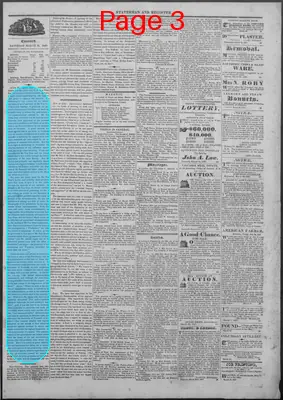
Editorial
March 31, 1827
New Hampshire Statesman And Concord Register
Concord, Merrimack County, New Hampshire
What is this article about?
Editorial regrets C. P. Van Ness's published address criticizing President Adams over his failed Vermont Senate election, defends Adams by denying influence via John Bailey, and quotes correspondent 'Vindicator' highlighting Van Ness's inconsistent past support for Adams.
Clipping

OCR Quality
98%
Excellent
Full Text
A late Burlington Sentinel contains an Address to the public from C. P. Van Ness, Esq. of Vermont—which has been greedily caught at and republished by the Opposition prints throughout the country. Entertaining a high respect for the talents and general good qualities of Mr. Van Ness—with some feelings of gratitude for personal attentions and civilities—we were extremely sorry to witness the publication of the communication referred to.
Mr. Van Ness, very naturally, and we have no doubt honestly, feels aggrieved at the proceedings which resulted in his failure of an election to the National Senate by the Legislature of Vermont. A great interest was made against him in the State of Vermont, and we are not certain that he is under any mistake in believing the opposition to have been animated and encouraged by an expression of opinions from abroad. But that he is right in attributing to President Adams the exertion of any influence against him, we are far from believing. If any such was exerted, Mr. Van Ness and his friends admit that it was mainly through the instrumentality of Mr. John Bailey. But Mr. Bailey has promptly and explicitly denied having had any conversation with President Adams on the subject, until after the election of Mr. Seymour had taken place, or at least until after he had written to Mr. Buck the letter in question.
We have not found room for Mr. Van Ness's Letter, and probably shall not hereafter find room to give it to the public through the medium of our columns. As friends to Mr. Van Ness, we should certainly be little desirous of publishing it—for it can reflect no credit on his fixedness of principle, or his political sagacity;—and as friends to the Administration, we are not ambitious of setting up a man of straw, for the purpose of its prostration by the arguments of our correspondents. With this view, and under these circumstances, we must decline the publication of an able Letter, which we have received, addressed to Mr. Van Ness—but the force of which would not be fully felt and appreciated unless preceded by the reading of Mr. Van Ness's communication. One extract, however, from the letter of our correspondent "Vindicator," we take the liberty of subjoining. It refers, as will be perceived, to that part of Mr. Van Ness's communication where he expresses his conviction "that Mr. Adams ought not to be honored a second term with the office of President," and urges "the propriety of not continuing any President hereafter for more than one term,"
"Your disinterested advice, in relation to the term of office of the Presidency, will be duly appreciated at this time by those who perceive the temper which dictates it. In the numerous communications you made, as Governor of Vermont, no such suggestion was ever heard. Compare the tone of some of these with your late address. In the latter you say, "Mr. Adams' administration commenced, and although far from being unexceptionable I continued my support until the last session of the Legislature of this State." Again, "When we look at the system of management which is carried on by this administration, as well as the confusion and contention which exist in the country," &c. What is it, Sir, let me ask, that has so suddenly sharpened your optics—private pique, or solicitude for your country's welfare? And, if you are now to be believed, what a sacrifice to patriotism and truth did you make, when, nearly eight months after this "not unexceptionable" administration had been in operation, in October 1825, you addressed the Assembly of Vermont as follows—"Our country steadily and rapidly advances on her march to that elevation which she appears destined to reach, and which constitutes the highest happiness, as well as greatness of a Nation. The administration of her government has indeed passed from the hands of the last revolutionary patriot, who will probably ever direct her course. But it is a source of great felicity, that the succession has fallen on a statesman and a patriot of the present day—whose transcendent talents, extensive experience, and purity of character, furnish an unfailing pledge that under his guidance her progress, to say the least, will be unimpeded and untarnished."
Mr. Van Ness, very naturally, and we have no doubt honestly, feels aggrieved at the proceedings which resulted in his failure of an election to the National Senate by the Legislature of Vermont. A great interest was made against him in the State of Vermont, and we are not certain that he is under any mistake in believing the opposition to have been animated and encouraged by an expression of opinions from abroad. But that he is right in attributing to President Adams the exertion of any influence against him, we are far from believing. If any such was exerted, Mr. Van Ness and his friends admit that it was mainly through the instrumentality of Mr. John Bailey. But Mr. Bailey has promptly and explicitly denied having had any conversation with President Adams on the subject, until after the election of Mr. Seymour had taken place, or at least until after he had written to Mr. Buck the letter in question.
We have not found room for Mr. Van Ness's Letter, and probably shall not hereafter find room to give it to the public through the medium of our columns. As friends to Mr. Van Ness, we should certainly be little desirous of publishing it—for it can reflect no credit on his fixedness of principle, or his political sagacity;—and as friends to the Administration, we are not ambitious of setting up a man of straw, for the purpose of its prostration by the arguments of our correspondents. With this view, and under these circumstances, we must decline the publication of an able Letter, which we have received, addressed to Mr. Van Ness—but the force of which would not be fully felt and appreciated unless preceded by the reading of Mr. Van Ness's communication. One extract, however, from the letter of our correspondent "Vindicator," we take the liberty of subjoining. It refers, as will be perceived, to that part of Mr. Van Ness's communication where he expresses his conviction "that Mr. Adams ought not to be honored a second term with the office of President," and urges "the propriety of not continuing any President hereafter for more than one term,"
"Your disinterested advice, in relation to the term of office of the Presidency, will be duly appreciated at this time by those who perceive the temper which dictates it. In the numerous communications you made, as Governor of Vermont, no such suggestion was ever heard. Compare the tone of some of these with your late address. In the latter you say, "Mr. Adams' administration commenced, and although far from being unexceptionable I continued my support until the last session of the Legislature of this State." Again, "When we look at the system of management which is carried on by this administration, as well as the confusion and contention which exist in the country," &c. What is it, Sir, let me ask, that has so suddenly sharpened your optics—private pique, or solicitude for your country's welfare? And, if you are now to be believed, what a sacrifice to patriotism and truth did you make, when, nearly eight months after this "not unexceptionable" administration had been in operation, in October 1825, you addressed the Assembly of Vermont as follows—"Our country steadily and rapidly advances on her march to that elevation which she appears destined to reach, and which constitutes the highest happiness, as well as greatness of a Nation. The administration of her government has indeed passed from the hands of the last revolutionary patriot, who will probably ever direct her course. But it is a source of great felicity, that the succession has fallen on a statesman and a patriot of the present day—whose transcendent talents, extensive experience, and purity of character, furnish an unfailing pledge that under his guidance her progress, to say the least, will be unimpeded and untarnished."
What sub-type of article is it?
Partisan Politics
What keywords are associated?
Van Ness Address
Adams Administration
Vermont Senate Election
Presidential Term Limits
Political Opposition
Personal Pique
What entities or persons were involved?
C. P. Van Ness
President Adams
John Bailey
Mr. Seymour
Mr. Buck
Vindicator
Editorial Details
Primary Topic
Defense Of President Adams Against C. P. Van Ness's Criticisms
Stance / Tone
Supportive Of Adams Administration And Critical Of Van Ness
Key Figures
C. P. Van Ness
President Adams
John Bailey
Mr. Seymour
Mr. Buck
Vindicator
Key Arguments
Van Ness Aggrieved By Failed Senate Election But Wrongly Attributes Opposition To Adams
Bailey Denied Conversing With Adams About Van Ness Before Election
Van Ness's Letter Reflects Poorly On His Principles And Sagacity
Decline To Publish Van Ness's Letter To Avoid Crediting It
Van Ness's Suggestion Against Second Presidential Term Motivated By Personal Pique
Contrast Van Ness's Past Support For Adams With Current Criticism
Van Ness's Earlier Praise Of Adams As Statesman And Patriot