Thank you for visiting SNEWPapers!
Sign up free
The New Hampshire Gazette
Portsmouth, Rockingham County, New Hampshire
What is this article about?
On Dec. 19, 1799, President John Adams informed Congress of George Washington's death on Dec. 16 from a sore throat. Tobias Lear's letter described the illness and peaceful passing. Rep. Marshall eulogized Washington and proposed mourning resolutions, unanimously adopted, including a joint committee and black attire.
Clipping
OCR Quality
Full Text
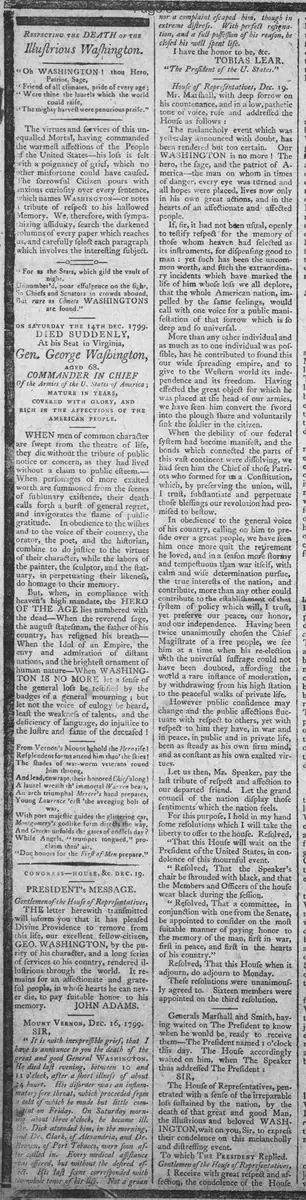
PRESIDENT's MESSAGE.
Gentlemen of the House of Representatives,
THE letter herewith transmitted
will inform you that it has pleased
Divine Providence to remove from
this life, our excellent fellow-citizen,
GEO. WASHINGTON, by the purity of his character, and a long series
of services to his country, rendered illustrious through the world. It remains for an affectionate and grateful
people, in whose hearts he can never
die, to pay suitable honor to his
memory.
JOHN ADAMS.
Mount Vernon, Dec. 16, 1799.
SIR,
" It is with inexpressible grief, that I
have to announce to you the death of the
great and good General WASHINGTON.
He died last evening, between 10 and
11 o'clock, after a short illness of about
24 hours. His disorder was an inflammatory sore throat, which proceeded from
a cold of which he made but little complaint on Friday. On Saturday morning
about three o'clock, he became ill.
Dr. Dick attended him, in the morning,
and Dr. Clark, of Alexandria, and Dr.
Brown, of Port Tobacco, were soon after called in. Every medical assistance
has been offered, but without the desired effect. His last scene corresponded with
the whole tenor of his life. Not a groan
nor a complaint escaped him, though in
extreme distress. With perfect resignation, and a full possession of his reason, he
closed his well spent life.
I have the honor to be, &c.
TOBIAS LEAR.
"The President of the U. States."
House of Representatives, Dec. 19.
Mr. Marshall, with deep sorrow on
his countenance, and in a low, pathetic
tone of voice, rose and addressed the
House as follows :
The melancholy event which was
yesterday announced with doubt, has
been rendered but too certain. Our
WASHINGTON is no more! The
hero, the sage, and the patriot of America--the man on whom in times
of danger, every eye was turned and
all hopes were placed, lives now only
in his own great actions, and in the
hearts of an affectionate and affected
people. If, sir, it had not been usual, openly
to testify respect for the memory of
those whom heaven had selected as
its instruments, for dispensing good to
man : yet such has been the uncommon worth, and such the extraordinary
incidents which have marked the
life of him whose loss we all deplore,
that the whole American nation, impelled by the same feelings, would
call with one voice for a public manifestation of that sorrow which is so
deep and so universal.
More than any other individual and
as much as to one individual was possible, has he contributed to found this
our wide spreading empire, and to
give to the Western world its independence and its freedom. Having
effected the great object for which he
was placed at the head of our armies,
we have seen him convert the sword
into the plough share and voluntarily
sink the soldier in the citizen.
When the debility of our federal
system had become manifest, and the
bonds which connected the parts of
this vast continent were dissolving, we
had seen him the Chief of those Patriots who formed for us a Constitution,
which, by preserving the union, will,
I trust, substantiate and perpetuate
those blessings our revolution had promised to bestow.
In obedience to the general voice
of his country, calling on him to preside over a great people, we have seen
him once more quit the retirement
he loved, and in a season more stormy
and tempestuous than war itself, with
calm and wise determination pursue,
the true interests of the nation, and
contribute, more than any other could
contribute to the establishment of that
system of policy which will, I trust,
yet preserve our peace, our honor,
and our independence. Having been
twice unanimously chosen the Chief
Magistrate of a free people, we see
him at a time when his re-election
with the universal suffrage could not
have been doubted, affording the
world a rare instance of moderation,
by withdrawing from his high station
to the peaceful walks of private life.
However public confidence may
change and the public affections fluctuate with respect to others, yet with
respect to him they have, in war and
in peace, in public and in private life,
been as steady as his own firm mind,
and as constant as his own exalted virtues.
Let us then, Mr. Speaker, pay the
last tribute of respect and affection to
our departed friend. Let the grand
council of the nation display those
sentiments which the nation feels.
For this purpose, I hold in my hand
some resolutions which I will take the
liberty to offer to the house. Resolved,
"That this House will wait on the
President of the United States, in condolence of this mournful event.
" Resolved, That the Speaker's
chair be shrouded with black, and that
the Members and Officers of the house
wear black during the session.
" Resolved, That a committee, in
conjunction with one from the Senate,
be appointed to consider on the most
suitable manner of paying honor to
the memory of the man, first in war,
first in peace, and first in the hearts
of his country."
Resolved, That this House when it
adjourn, do adjourn to Monday.
These resolutions were unanimously
agreed to. Sixteen members were
appointed on the third resolution.
Generals Marshall and Smith, having waited on The President to know
when he would be ready to receive
them—The President named 1 o'clock
this day. The House accordingly
waited on him, when The Speaker
thus addressed The President :
SIR,
The House of Representatives, penetrated with a sense of the irreparable
loss sustained by the nation, by the
death of that great and good Man,
the illustrious and beloved WASHINGTON, wait on you, Sir, to express
their condolence on this melancholy
and distressing event.
To which The President Replied.
Gentlemen of the House of Representatives,
I Receive with great respect and affection, the condolence of the House
of Representatives, on the melancholy
What sub-type of article is it?
What keywords are associated?
What entities or persons were involved?
Where did it happen?
Domestic News Details
Primary Location
United States Congress
Event Date
Dec. 19, 1799
Key Persons
Outcome
george washington died on dec. 16, 1799, from an inflammatory sore throat after a short illness. congress passed resolutions to mourn him, including waiting on the president, shrouding the speaker's chair in black, appointing a committee, and adjourning to monday.
Event Details
President John Adams transmitted a message to the House of Representatives announcing George Washington's death, including a letter from Tobias Lear detailing the circumstances. Mr. Marshall addressed the House with a eulogy and offered resolutions for public mourning, which were unanimously agreed to. The House waited on the President to express condolences.