Thank you for visiting SNEWPapers!
Sign up free
The American Citizen
Topeka, Kansas City, Shawnee County, Wyandotte County, Kansas
What is this article about?
The USS Vesuvius, a dynamite gun cruiser, has proven effective in attacking Spanish fortifications off Santiago, Cuba, using pneumatic guns to launch high-explosive projectiles silently, revolutionizing naval tactics in the Spanish-American War.
Clipping
OCR Quality
Full Text
The Little Ship That Amazed the Spaniards by Flinging Earthquakes at the Santiago Hills.
The whirligig of time brings in its revenges.
Six months ago the Vesuvius was finally consigned to the junk pile by all save a few despairing zealots. Her day was done, her reputation was a thing in shreds and patches.
Today she is giving new cares to anxious admiralties; she is the unknown, not the discredited, factor in modern naval warfare, and her whistling tubes are awakening echoes that circle a startled world.
It is not given every nation to produce at the mathematically exact moment the mathematically exact remedy for a desperate disease. We did it once, surely, when the Monitor, the cheese box on a raft, defied the flying wedges of the Merrimac. That revolutionized modern warfare and ushered in the clanking age of iron and steel.
Have we done this again in the first successful employment of high explosives afloat? Who may tell but when it comes to heaving earthquakes at an enemy, of noiselessly depositing volcanoes, eager and ready for eruption in his midriff we may without undue boasting believe that the material revolution of this war will be in this safe handling of untried forces, and it is American to the core.
The Vesuvius deserves her good luck every ounce of it; and when one considers the fight her champions had to make before practical proof established their theories, our regret for their neglect is made more poignant by the moral every other inventive crank will draw from her to adorn their tales of woe. We may expect a deluge of dynamite mechanism, a flood of guncotton fuses, a tornado of desperate devices which in a jiffy will extinguish fleets and obliterate landscapes. The Spanish druggist (or is he a Spanish barkeeper?) who is to smear the ocean with an explosive oil and change the face of nature will be nothing in promise when compared with the threatening shoals of lightly explosive inventive gentlemen—or with what is left of them after our experiments that are to haunt admiralties and devastate war offices.
Some good, of course, will come out of them, but it may be well to state that the field has long been exploited, that chemists and engineers have striven for years to attain the perfect combination of tremendous destruction allied to safe handling, and that, after all has been tried and done, the only actual success is that achieved so wondrously by the Vesuvius off Santiago.
It is not for a moment thought, even after the splendid recent performance of this boat, that she will create a revolution in naval tactics, as was at first contended by her projectors. Similar exaggerated offensive capabilities were for a long time ascribed to torpedo boats, and very recently to torpedo boat destroyers, but the more sober minded naval men and tacticians, it can be asserted, realize that the armored ship and the cruiser are the true types of ships for fighting battles at sea.
These others are serviceable for special purposes and are necessary adjuncts of a fleet. They play an important part, but not the most important.
The Guns of the Vesuvius.
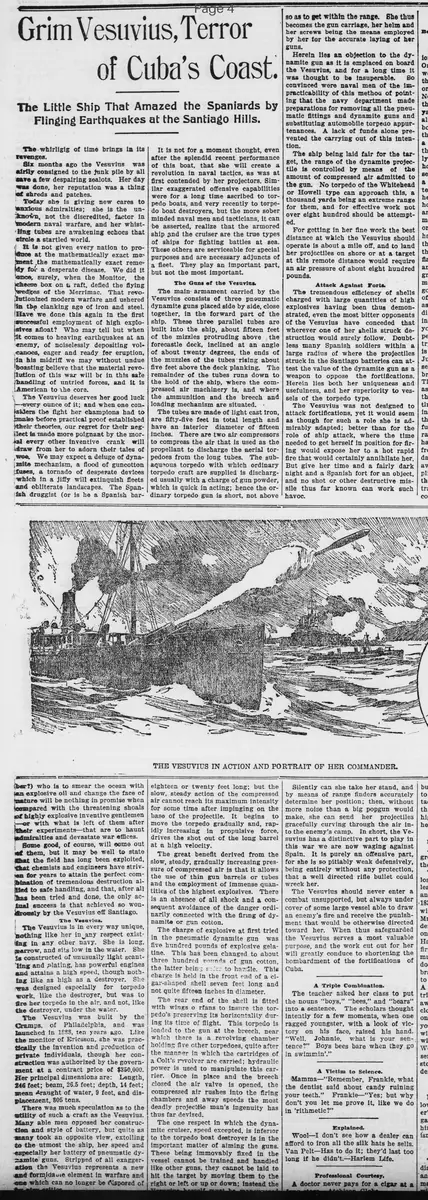
The main armament carried by the Vesuvius consists of three pneumatic dynamite guns placed side by side, close together, in the forward part of the ship. These three parallel tubes are built into the ship, about fifteen feet of the muzzles protruding above the forecastle deck, inclined at an angle of about twenty degrees, the ends of the muzzles of the tubes rising about five feet above the deck planking. The remainder of the tubes runs down to the hold of the ship, where the compressed air machinery is, and where the ammunition and the breech and loading mechanism are situated.
The tubes are made of light cast iron, are fifty-five feet in total length and have an interior diameter of fifteen inches. There are two air compressors to compress the air that is used as the propellant to discharge the aerial torpedoes from the long tubes. The sub-aqueous torpedo with which ordinary torpedo craft are supplied is discharged usually with a charge of gun powder, which is quick in acting; hence the ordinary torpedo gun is short, not above eighteen or twenty feet long; but the slow, steady action of the compressed air cannot reach its maximum intensity for some time after impinging on the base of the projectile. It begins to move the torpedo gradually and, rapidly increasing in propulsive force, drives the shot out of the long barrel at a high velocity.
The great benefit derived from the slow, steady, gradually increasing pressure of compressed air is that it allows the use of thin gun barrels or tubes and the employment of immense quantities of the highest explosives. There is an absence of all shock and a consequent avoidance of the danger ordinarily connected with the firing of dynamite or gun cotton.
The charge of explosive at first tried in the pneumatic dynamite gun was five hundred pounds of explosive gelatine. This has been changed to about three hundred pounds of gun cotton, the latter being safe to handle. This charge is held in the front end of a cigar-shaped shell seven feet long and not quite fifteen inches in diameter. The rear end of the shell is fitted with wings or fans to insure the torpedo's preserving its horizontality during its time of flight. This torpedo is loaded to the gun at the breech, near which there is a revolving chamber holding five other torpedoes, quite after the manner in which the cartridges of a Colt's revolver are carried; hydraulic power is used to manipulate this carrier. Once in place and the breech closed the air valve is opened, the compressed air rushes into the firing chambers and away speeds the most deadly projectile man's ingenuity has thus far devised.
The one respect in which the dynamite cruiser, speed excepted, is inferior to the torpedo boat destroyer is in the important matter of aiming the guns. These being immovably fixed in the vessel cannot be trained and handled like other guns, they cannot be laid to hit the target by moving them to the right or left or up or down; instead the ship herself must be maneuvered so as to get within the range. She thus becomes the gun carriage, her helm and her screws being the means employed by her for the accurate laying of her guns.
Herein lies an objection to the dynamite gun as it is emplaced on board the Vesuvius, and for a long time it was thought to be insuperable. So convinced were naval men of the impracticability of this method of pointing that the navy department made preparations for removing all the pneumatic fittings and dynamite guns and substituting automobile torpedo appurtenances. A lack of funds alone prevented the carrying out of this intention.
The ship being laid fair for the target, the range of the dynamite projectile is controlled by means of the amount of compressed air admitted to the gun. No torpedo of the Whitehead or Howell type can approach this, a thousand yards being an extreme range for them, and for effective work not over eight hundred should be attempted.
For getting in her fine work the best distance at which the Vesuvius should operate is about a mile off, and to land her projectiles on shore or at a target at this remote distance would require an air pressure of about eight hundred pounds.
Attack Against Forts.
The tremendous efficiency of shells charged with large quantities of high explosives having been thus demonstrated, even the most bitter opponents of the Vesuvius have conceded that wherever one of her shells struck destruction would surely follow. Doubtless many Spanish soldiers within a large radius of where the projectiles struck in the Santiago batteries can attest the value of the dynamite gun as a weapon to oppose the fortifications.
Herein lies both her uniqueness and usefulness, and her superiority to vessels of the torpedo type.
The Vesuvius was not designed to attack fortifications, yet it would seem as though for such a role she is admirably adapted; better than for the role of ship attack, where the time needed to get herself in position for firing would expose her to a hot rapid fire that would certainly annihilate her.
But give her time and a fairly dark night and a Spanish fort for an object, and no shot or other destructive missile thus far known can work such havoc.
Silently can she take her stand, and by means of range finders accurately determine her position; then, without more noise than a big popgun would make, she can send her projectiles gracefully curving through the air into the enemy's camp. In short, the Vesuvius has a distinctive part to play in this war we are now waging against Spain. It is purely an offensive part, for she is so pitiably weak defensively, being entirely without any protection, that a well directed rifle bullet could wreck her.
The Vesuvius should never enter a combat unsupported, but always under cover of some large vessel able to draw an enemy's fire and receive the punishment that would be otherwise directed toward her. When thus safeguarded the Vesuvius serves a most valuable purpose, and the work cut out for her will greatly conduce to shortening the bombardment of the fortifications of Cuba.
THE VESUVIUS IN ACTION AND PORTRAIT OF HER COMMANDER.
What sub-type of article is it?
What keywords are associated?
Where did it happen?
Foreign News Details
Primary Location
Santiago, Cuba
Event Date
Recently
Outcome
destruction to spanish batteries and fortifications in santiago; no specific casualties reported
Event Details
The USS Vesuvius, equipped with three pneumatic dynamite guns firing 300-pound gun cotton projectiles, successfully attacked Spanish forts off Santiago, demonstrating silent, high-explosive bombardment effective against fortifications, though vulnerable defensively and requiring support.