Thank you for visiting SNEWPapers!
Sign up free
Letter to Editor
July 26, 1771
The New Hampshire Gazette And Historical Chronicle
Portsmouth, Greenland, Rockingham County, New Hampshire
What is this article about?
A colonial writer rebuts an essay in the Gazette asserting Parliament's right to tax the American colonies without consent, arguing it violates constitutional principles of representation and liberty, warns of potential empire dissolution, and proposes union under the King with separate assemblies.
Clipping
OCR Quality
95%
Excellent
Full Text
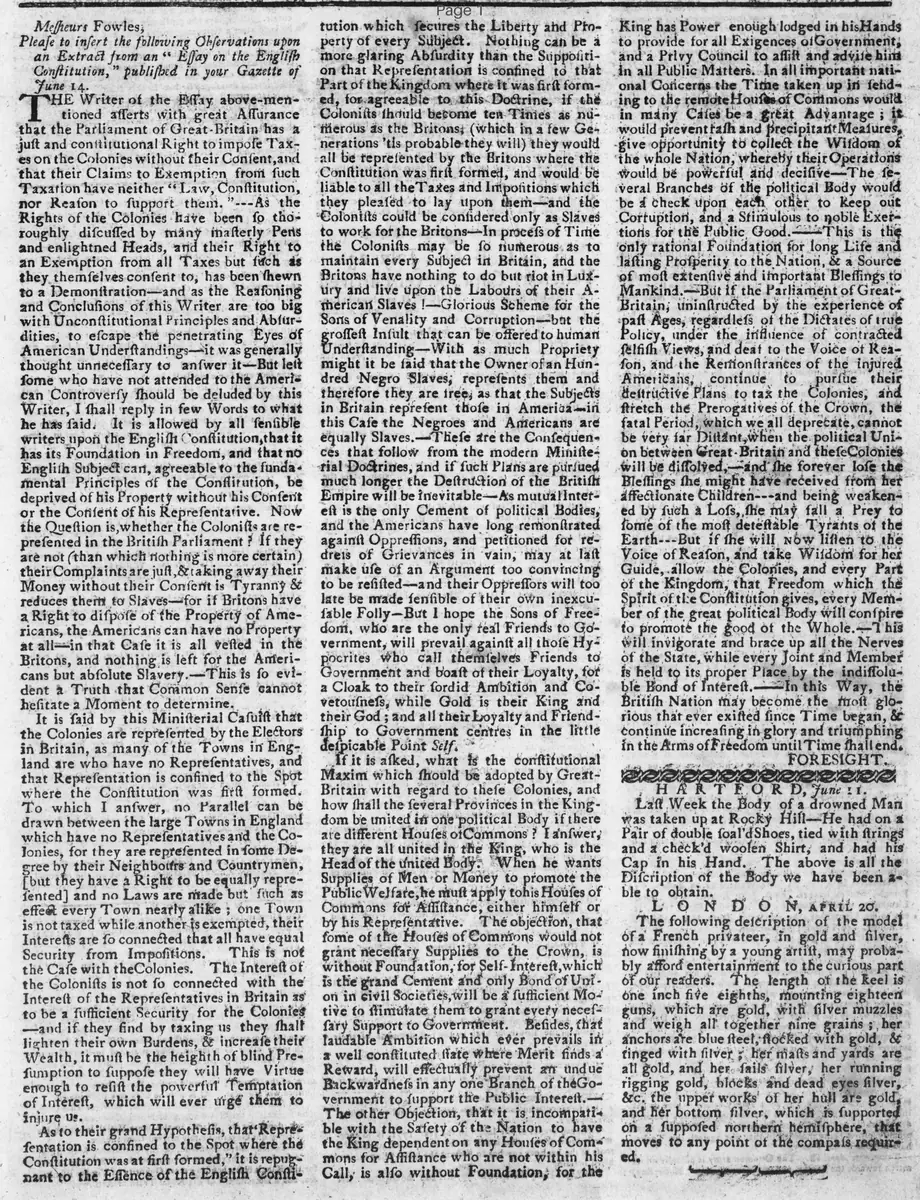
Messieurs Fowle;
Please to insert the following Observations upon an Extract from an "Essay on the English Constitution," published in your Gazette of June 14.
The Writer of the Essay above-mentioned asserts with great Assurance that the Parliament of Great-Britain has a just and constitutional Right to impose Taxes on the Colonies without their Consent, and that their Claims to Exemption from such Taxation have neither "Law, Constitution, nor Reason to support them."--As the Rights of the Colonies have been so thoroughly discussed by many masterly Pens and enlightened Heads, and their Right to an Exemption from all Taxes but such as they themselves consent to, has been shewn to a Demonstration--and as the Reasoning and Conclusions of this Writer are too big with Unconstitutional Principles and Absurdities, to escape the penetrating Eyes of American Understandings--it was generally thought unnecessary to answer it--But lest some who have not attended to the American Controversy should be deluded by this Writer, I shall reply in few Words to what he has said. It is allowed by all sensible writers upon the English Constitution that it has its Foundation in Freedom, and that no English Subject can, agreeable to the fundamental Principles of the Constitution, be deprived of his Property without his Consent or the Consent of his Representative. Now the Question is, whether the Colonies are represented in the British Parliament? If they are not (than which nothing is more certain) their Complaints are just, & taking away their Money without their Consent is Tyranny & reduces them to Slaves--for if Britons have a Right to dispose of the Property of Americans, the Americans can have no Property at all--in that Case it is all vested in the Britons, and nothing is left for the Americans but absolute Slavery.--This is so evident a Truth that Common Sense cannot hesitate a Moment to determine.
It is said by this Ministerial Casuist that the Colonies are represented by the Electors in Britain, as many of the Towns in England are who have no Representatives, and that Representation is confined to the Spot where the Constitution was first formed.
To which I answer, no Parallel can be drawn between the large Towns in England which have no Representatives and the Colonies, for they are represented in some Degree by their Neighbours and Countrymen, but they have a Right to be equally represented] and no Laws are made but' such as affect every Town nearly alike: one Town is not taxed while another is exempted. their Interests are so connected that all have equal Security from Impositions. This is not the Case with the Colonies. The Interest of the Colonists is not so connected with the Interest of the Representatives in Britain as to be a sufficient Security for the Colonies and if they find by taxing us they shall lighten their own Burdens. & increase their Wealth. it must be the height of blind Presumption to suppose they will have Virtue enough to resist the powerful Temptation of Interest, which will ever urge them to injure us.
As to their grand Hypothesis, that 'Representation is confined to the Spot where the Constitution was at first formed.' it is repugnant to the Essence of the English Constitution which secures the Liberty and Property of every Subject. Nothing can be a more glaring Absurdity than the Supposition that Representation is confined to that Part of the Kingdom where it was first formed. for agreeable to this Doctrine, if the Colonies should become ten-Times as numerous as the Britons (which in a few Generations 'tis probable they will) they would all be represented by the Britons where the Constitution was first formed. and would be liable to all the Taxes and Impositions which they pleased to lay upon them--and the Colonies could be considered only as Slaves to work for the Britons--In process of Time the Colonies may be so numerous as to maintain every Subject in Britain. and the Britons have nothing to do but riot in Luxury and live upon the Labours of their American Slaves!--Glorious Scheme for the Sons of Venality and Corruption--but the grossest Insult that can be offered to human Understanding--With as much Propriety might it be said that the Owner of an Hundred Negro Slaves; represents them and therefore they are free; as that the Subjects in Britain represent those in America--in this Case the Negroes and Americans are equally Slaves.--These are the Consequences that follow from the modern Ministerial Doctrines, and if such Plans are pursued much longer the Destruction of the British Empire will be inevitable--As mutual Interest is the only Cement of political Bodies, and the Americans have long remonstrated against Oppressions, and petitioned for redress of Grievances in vain; may at last make use of an Argument too convincing to be resisted--and their Oppressors will too late be made sensible of their own inexcusable Folly--But I hope the Sons of Freedom, who are the only real Friends to Government, will prevail against all those Hypocrites who call themselves Friends to Government and boast of their Loyalty, for a Cloak to their sordid Ambition and Covetousness, while Gold is their King and their God; and all their Loyalty and Friendship to Government centres in the little despicable Point Self.
If it is asked, what is the constitutional Maxim which should be adopted by Great-Britain with regard to these Colonies, and how shall the several Provinces in the Kingdom be united in one political Body if there are different Houses of Commons? I answer, they are all united in the King, who is the Head of the united Body. When he wants Supplies of Men or Money to promote the Public Welfare, he must apply to his Houses of Commons for Assistance, either himself or by his Representative. The objection, that some of the Houses of Commons would not grant necessary Supplies to the Crown, is without Foundation. for Self-Interest, which is the grand Cement and only Bond of Union in civil Societies, will be a sufficient Motive to stimulate them to grant every necessary Support to Government. Besides, that laudable Ambition which ever prevails in a well constituted State where Merit finds a Reward, will effectually prevent an undue Backwardness in any one Branch of the Government to support the Public Interest.--
The other Objection, that it is incompatible with the Safety of the Nation to have the King dependent on any Houses of Commons for Assistance who are not within his Call; is also without Foundation, for the King has Power enough lodged in his Hands to provide for all Exigencies of Government, and a Privy Council to assist and advise him in all Public Matters. In all important national Concerns the Time taken up in sending to the remote Houses of Commons would in many Cases be a great Advantage; it would prevent rash and Precipitant Measures, give opportunity to collect the Wisdom of the whole Nation, whereby their Operations would be powerful and decisive--The several Branches Of the political Body would be a check upon each other to Keep out Corruption; and a Stimulus to noble Exertions for the Public Good. This is the only rational Foundation for long Life and lasting Prosperity to the Nation, & a Source of most extensive and important Blessings to Mankind. But if the Parliament of Great-Britain; un-instructed by the experience of past Ages, regardless of the Dictates of true Policy, under the influence of contracted selfish Views: and deaf to the Voice of Reason, and the Remonstrances of the injured Americans, continue to pursue their destructive Plans to tax the Colonies, and stretch the Prerogatives of the Crown, the fatal Period, which we all deprecate, cannot be very far Distant, when the political Union between Great-Britain and these Colonies will be dissolved--and she forever lose the Blessings she might have received from her affectionate Children---and being weakened by such a Loss, she may fall a Prey to some of the most detestable Tyrants of the Earth---But if she will Now listen to the Voice of Reason, and take Wisdom for her Guide, allow the Colonies, and every Part of the Kingdom, that Freedom which the Spirit of the Constitution gives, every Member of the great political Body will conspire to promote the good of the Whole.-- This will invigorate and brace up all the Nerves of the State, while every Joint and Member is held to its proper Place by the indissoluble Bond of Interest. In this Way, the British Nation may become the most glorious that ever existed since Time began, & continue increasing in glory and triumphing in the Arms of Freedom until Time shall end.
FORESIGHT:
Please to insert the following Observations upon an Extract from an "Essay on the English Constitution," published in your Gazette of June 14.
The Writer of the Essay above-mentioned asserts with great Assurance that the Parliament of Great-Britain has a just and constitutional Right to impose Taxes on the Colonies without their Consent, and that their Claims to Exemption from such Taxation have neither "Law, Constitution, nor Reason to support them."--As the Rights of the Colonies have been so thoroughly discussed by many masterly Pens and enlightened Heads, and their Right to an Exemption from all Taxes but such as they themselves consent to, has been shewn to a Demonstration--and as the Reasoning and Conclusions of this Writer are too big with Unconstitutional Principles and Absurdities, to escape the penetrating Eyes of American Understandings--it was generally thought unnecessary to answer it--But lest some who have not attended to the American Controversy should be deluded by this Writer, I shall reply in few Words to what he has said. It is allowed by all sensible writers upon the English Constitution that it has its Foundation in Freedom, and that no English Subject can, agreeable to the fundamental Principles of the Constitution, be deprived of his Property without his Consent or the Consent of his Representative. Now the Question is, whether the Colonies are represented in the British Parliament? If they are not (than which nothing is more certain) their Complaints are just, & taking away their Money without their Consent is Tyranny & reduces them to Slaves--for if Britons have a Right to dispose of the Property of Americans, the Americans can have no Property at all--in that Case it is all vested in the Britons, and nothing is left for the Americans but absolute Slavery.--This is so evident a Truth that Common Sense cannot hesitate a Moment to determine.
It is said by this Ministerial Casuist that the Colonies are represented by the Electors in Britain, as many of the Towns in England are who have no Representatives, and that Representation is confined to the Spot where the Constitution was first formed.
To which I answer, no Parallel can be drawn between the large Towns in England which have no Representatives and the Colonies, for they are represented in some Degree by their Neighbours and Countrymen, but they have a Right to be equally represented] and no Laws are made but' such as affect every Town nearly alike: one Town is not taxed while another is exempted. their Interests are so connected that all have equal Security from Impositions. This is not the Case with the Colonies. The Interest of the Colonists is not so connected with the Interest of the Representatives in Britain as to be a sufficient Security for the Colonies and if they find by taxing us they shall lighten their own Burdens. & increase their Wealth. it must be the height of blind Presumption to suppose they will have Virtue enough to resist the powerful Temptation of Interest, which will ever urge them to injure us.
As to their grand Hypothesis, that 'Representation is confined to the Spot where the Constitution was at first formed.' it is repugnant to the Essence of the English Constitution which secures the Liberty and Property of every Subject. Nothing can be a more glaring Absurdity than the Supposition that Representation is confined to that Part of the Kingdom where it was first formed. for agreeable to this Doctrine, if the Colonies should become ten-Times as numerous as the Britons (which in a few Generations 'tis probable they will) they would all be represented by the Britons where the Constitution was first formed. and would be liable to all the Taxes and Impositions which they pleased to lay upon them--and the Colonies could be considered only as Slaves to work for the Britons--In process of Time the Colonies may be so numerous as to maintain every Subject in Britain. and the Britons have nothing to do but riot in Luxury and live upon the Labours of their American Slaves!--Glorious Scheme for the Sons of Venality and Corruption--but the grossest Insult that can be offered to human Understanding--With as much Propriety might it be said that the Owner of an Hundred Negro Slaves; represents them and therefore they are free; as that the Subjects in Britain represent those in America--in this Case the Negroes and Americans are equally Slaves.--These are the Consequences that follow from the modern Ministerial Doctrines, and if such Plans are pursued much longer the Destruction of the British Empire will be inevitable--As mutual Interest is the only Cement of political Bodies, and the Americans have long remonstrated against Oppressions, and petitioned for redress of Grievances in vain; may at last make use of an Argument too convincing to be resisted--and their Oppressors will too late be made sensible of their own inexcusable Folly--But I hope the Sons of Freedom, who are the only real Friends to Government, will prevail against all those Hypocrites who call themselves Friends to Government and boast of their Loyalty, for a Cloak to their sordid Ambition and Covetousness, while Gold is their King and their God; and all their Loyalty and Friendship to Government centres in the little despicable Point Self.
If it is asked, what is the constitutional Maxim which should be adopted by Great-Britain with regard to these Colonies, and how shall the several Provinces in the Kingdom be united in one political Body if there are different Houses of Commons? I answer, they are all united in the King, who is the Head of the united Body. When he wants Supplies of Men or Money to promote the Public Welfare, he must apply to his Houses of Commons for Assistance, either himself or by his Representative. The objection, that some of the Houses of Commons would not grant necessary Supplies to the Crown, is without Foundation. for Self-Interest, which is the grand Cement and only Bond of Union in civil Societies, will be a sufficient Motive to stimulate them to grant every necessary Support to Government. Besides, that laudable Ambition which ever prevails in a well constituted State where Merit finds a Reward, will effectually prevent an undue Backwardness in any one Branch of the Government to support the Public Interest.--
The other Objection, that it is incompatible with the Safety of the Nation to have the King dependent on any Houses of Commons for Assistance who are not within his Call; is also without Foundation, for the King has Power enough lodged in his Hands to provide for all Exigencies of Government, and a Privy Council to assist and advise him in all Public Matters. In all important national Concerns the Time taken up in sending to the remote Houses of Commons would in many Cases be a great Advantage; it would prevent rash and Precipitant Measures, give opportunity to collect the Wisdom of the whole Nation, whereby their Operations would be powerful and decisive--The several Branches Of the political Body would be a check upon each other to Keep out Corruption; and a Stimulus to noble Exertions for the Public Good. This is the only rational Foundation for long Life and lasting Prosperity to the Nation, & a Source of most extensive and important Blessings to Mankind. But if the Parliament of Great-Britain; un-instructed by the experience of past Ages, regardless of the Dictates of true Policy, under the influence of contracted selfish Views: and deaf to the Voice of Reason, and the Remonstrances of the injured Americans, continue to pursue their destructive Plans to tax the Colonies, and stretch the Prerogatives of the Crown, the fatal Period, which we all deprecate, cannot be very far Distant, when the political Union between Great-Britain and these Colonies will be dissolved--and she forever lose the Blessings she might have received from her affectionate Children---and being weakened by such a Loss, she may fall a Prey to some of the most detestable Tyrants of the Earth---But if she will Now listen to the Voice of Reason, and take Wisdom for her Guide, allow the Colonies, and every Part of the Kingdom, that Freedom which the Spirit of the Constitution gives, every Member of the great political Body will conspire to promote the good of the Whole.-- This will invigorate and brace up all the Nerves of the State, while every Joint and Member is held to its proper Place by the indissoluble Bond of Interest. In this Way, the British Nation may become the most glorious that ever existed since Time began, & continue increasing in glory and triumphing in the Arms of Freedom until Time shall end.
FORESIGHT:
What sub-type of article is it?
Persuasive
Political
Provocative
What themes does it cover?
Constitutional Rights
Politics
Taxation
What keywords are associated?
Taxation Without Representation
Colonial Rights
British Parliament
American Liberty
Constitutional Freedom
Empire Union
Slavery Analogy
What entities or persons were involved?
Foresight
Messieurs Fowle
Letter to Editor Details
Author
Foresight
Recipient
Messieurs Fowle
Main Argument
the british parliament lacks constitutional right to tax american colonies without their consent or representation, equating such taxation to tyranny and slavery; proposes union under the king with separate colonial assemblies to preserve liberty and empire.
Notable Details
Analogy To Negro Slaves For Unrepresented Taxation
Warnings Of British Empire Dissolution
Reference To English Constitution Foundations In Freedom
Critique Of Ministerial Doctrines