Thank you for visiting SNEWPapers!
Sign up free
Story
May 27, 1863
Richmond Whig
Richmond, Virginia
What is this article about?
On May 1, 1863, near Lewisburg, Virginia, Colonel Edgar's battalion of about 300 Confederates ambushed and repelled a Union cavalry force of 500-600 under Colonel Paxton, inflicting heavy casualties without losing a man, thus saving the town from sack.
Clipping
OCR Quality
98%
Excellent
Full Text
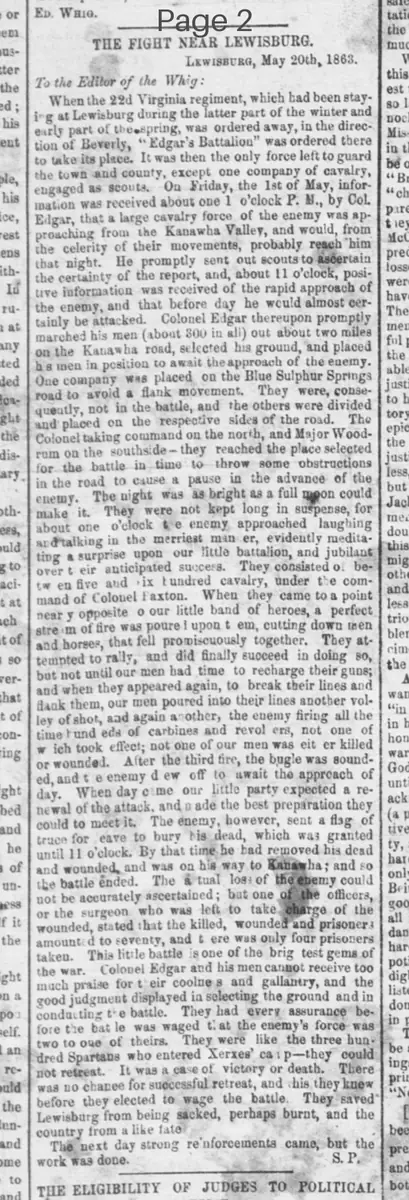
THE FIGHT NEAR LEWISBURG.
LEWISBURG, May 20th, 1863.
To the Editor of the Whig:
When the 22d Virginia regiment, which had been staying at Lewisburg during the latter part of the winter and early part of the spring, was ordered away, in the direction of Beverly, "Edgar's Battalion" was ordered there to take its place. It was then the only force left to guard the town and county, except one company of cavalry, engaged as scouts. On Friday, the 1st of May, information was received about one o'clock P. M., by Col. Edgar, that a large cavalry force of the enemy was approaching from the Kanawha Valley, and would, from the celerity of their movements, probably reach him that night. He promptly sent out scouts to ascertain the certainty of the report, and, about 11 o'clock, positive information was received of the rapid approach of the enemy, and that before day he would almost certainly be attacked. Colonel Edgar thereupon promptly marched his men (about 300 in all) out about two miles on the Kanawha road, selected his ground, and placed his men in position to await the approach of the enemy. One company was placed on the Blue Sulphur Springs road to avoid a flank movement. They were, consequently, not in the battle, and the others were divided and placed on the respective sides of the road. The Colonel taking command on the north, and Major Woodrum on the south side—they reached the place selected for the battle in time to throw some obstructions in the road to cause a pause in the advance of the enemy. The night was as bright as a full moon could make it. They were not kept long in suspense, for about one o'clock the enemy approached laughing and talking in the merriest manner, evidently meditating a surprise upon our little battalion, and jubilant over their anticipated success—between five and six hundred cavalry, under the command of Colonel Paxton. When they came to a point nearly opposite our little band of heroes, a perfect stream of fire was poured upon them, cutting down men and horses, that fell promiscuously together. They attempted to rally, and did finally succeed in doing so, but not until our men had time to recharge their guns; and when they appeared again, to break their lines and flank them, our men poured into their lines another volley of shot, and again another, the enemy firing all the time hundreds of carbines and revolvers, not one of which took effect; not one of our men was either killed or wounded. After the third fire, the bugle was sounded, and the enemy drew off to await the approach of day. When day came our little party expected a renewal of the attack, and made the best preparation they could to meet it. The enemy, however, sent a flag of truce for leave to bury his dead, which was granted until 11 o'clock. By that time he had removed his dead and wounded, and was on his way to Kanawha; and so the battle ended. The actual loss of the enemy could not be accurately ascertained; but one of the officers, wounded, stated that the killed, wounded and prisoners amounted to seventy, and there was only four prisoners taken. This little battle is one of the brightest gems of the war. Colonel Edgar and his men cannot receive too much praise for the good judgment displayed in selecting the ground and in conducting the battle. Before the battle was waged it was known that the enemy's force was two to one of theirs. They were like the three hundred Spartans who entered Xerxes' camp—they could not retreat. It was a case of victory or death. There was no chance for successful retreat, and this they knew before they elected to wage the battle. They saved Lewisburg from being sacked, perhaps burnt, and the country from a like fate. The next day strong reinforcements came, but the work was done.
S. P.
LEWISBURG, May 20th, 1863.
To the Editor of the Whig:
When the 22d Virginia regiment, which had been staying at Lewisburg during the latter part of the winter and early part of the spring, was ordered away, in the direction of Beverly, "Edgar's Battalion" was ordered there to take its place. It was then the only force left to guard the town and county, except one company of cavalry, engaged as scouts. On Friday, the 1st of May, information was received about one o'clock P. M., by Col. Edgar, that a large cavalry force of the enemy was approaching from the Kanawha Valley, and would, from the celerity of their movements, probably reach him that night. He promptly sent out scouts to ascertain the certainty of the report, and, about 11 o'clock, positive information was received of the rapid approach of the enemy, and that before day he would almost certainly be attacked. Colonel Edgar thereupon promptly marched his men (about 300 in all) out about two miles on the Kanawha road, selected his ground, and placed his men in position to await the approach of the enemy. One company was placed on the Blue Sulphur Springs road to avoid a flank movement. They were, consequently, not in the battle, and the others were divided and placed on the respective sides of the road. The Colonel taking command on the north, and Major Woodrum on the south side—they reached the place selected for the battle in time to throw some obstructions in the road to cause a pause in the advance of the enemy. The night was as bright as a full moon could make it. They were not kept long in suspense, for about one o'clock the enemy approached laughing and talking in the merriest manner, evidently meditating a surprise upon our little battalion, and jubilant over their anticipated success—between five and six hundred cavalry, under the command of Colonel Paxton. When they came to a point nearly opposite our little band of heroes, a perfect stream of fire was poured upon them, cutting down men and horses, that fell promiscuously together. They attempted to rally, and did finally succeed in doing so, but not until our men had time to recharge their guns; and when they appeared again, to break their lines and flank them, our men poured into their lines another volley of shot, and again another, the enemy firing all the time hundreds of carbines and revolvers, not one of which took effect; not one of our men was either killed or wounded. After the third fire, the bugle was sounded, and the enemy drew off to await the approach of day. When day came our little party expected a renewal of the attack, and made the best preparation they could to meet it. The enemy, however, sent a flag of truce for leave to bury his dead, which was granted until 11 o'clock. By that time he had removed his dead and wounded, and was on his way to Kanawha; and so the battle ended. The actual loss of the enemy could not be accurately ascertained; but one of the officers, wounded, stated that the killed, wounded and prisoners amounted to seventy, and there was only four prisoners taken. This little battle is one of the brightest gems of the war. Colonel Edgar and his men cannot receive too much praise for the good judgment displayed in selecting the ground and in conducting the battle. Before the battle was waged it was known that the enemy's force was two to one of theirs. They were like the three hundred Spartans who entered Xerxes' camp—they could not retreat. It was a case of victory or death. There was no chance for successful retreat, and this they knew before they elected to wage the battle. They saved Lewisburg from being sacked, perhaps burnt, and the country from a like fate. The next day strong reinforcements came, but the work was done.
S. P.
What sub-type of article is it?
Military Action
Historical Event
Heroic Act
What themes does it cover?
Bravery Heroism
Triumph
What keywords are associated?
Lewisburg Battle
Civil War Skirmish
Confederate Ambush
Cavalry Engagement
Union Retreat
What entities or persons were involved?
Col. Edgar
Major Woodrum
Colonel Paxton
Where did it happen?
Near Lewisburg On The Kanawha Road
Story Details
Key Persons
Col. Edgar
Major Woodrum
Colonel Paxton
Location
Near Lewisburg On The Kanawha Road
Event Date
May 1, 1863
Story Details
Colonel Edgar's battalion of 300 ambushed an approaching Union cavalry force of 500-600 at night, firing volleys that caused heavy enemy casualties without any Confederate losses; the Union withdrew after three exchanges, burying their dead and retreating to Kanawha.