Thank you for visiting SNEWPapers!
Sign up free
Editorial
May 29, 1811
Alexandria Daily Gazette, Commercial & Political
Alexandria, Virginia
What is this article about?
Timothy Pickering's editorial critiques President Jefferson's 1807 Embargo Act, arguing it was not to protect American vessels from European threats but to aid France's Berlin Decree blockade against Britain, concealing pro-French motives through secrecy and deception.
Merged-components note: Merged continuation of the same editorial address across pages based on text flow.
Clippings
1 of 2
OCR Quality
95%
Excellent
Full Text
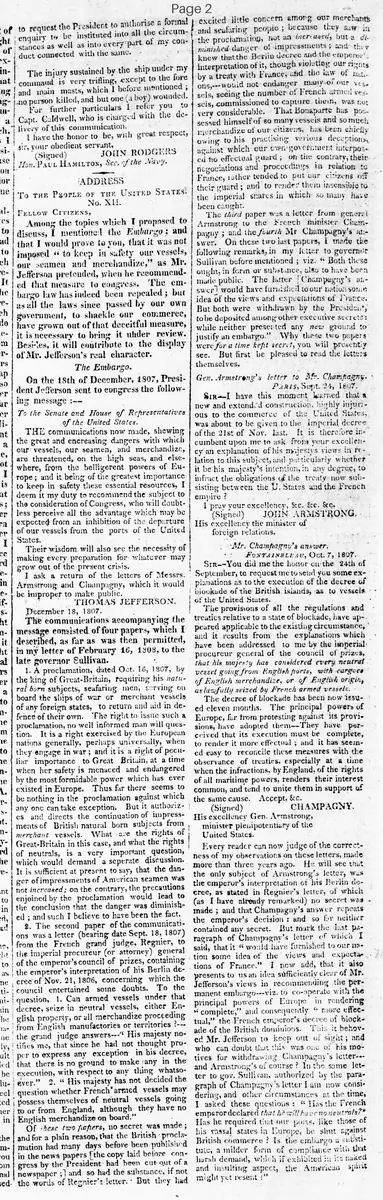
ADDRESS
TO THE PEOPLE OF THE UNITED STATES!
No. XII.
Fellow Citizens,
Among the topics which I proposed to discuss, I mentioned the Embargo; and that I would prove to you, that it was not imposed "to keep in safety our vessels, our seamen and merchandize," as Mr. Jefferson pretended, when he recommended that measure to congress. The embargo law has indeed been repealed; but as all the laws since passed by our own government, to shackle our commerce, have grown out of that deceitful measure, it is necessary to bring it under review. Besides, it will contribute to the display of Mr. Jefferson's real character.
The Embargo.
On the 18th of December, 1807, President Jefferson sent to congress the following message:--
To the Senate and House of Representatives of the United States.
THE communications now made, shewing the great and increasing dangers with which our vessels, our seamen, and merchandize, are threatened, on the high seas, and elsewhere, from the belligerent powers of Europe; and it being of the greatest importance to keep in safety these essential resources, I deem it my duty to recommend the subject to the consideration of Congress, who will doubtless perceive all the advantage which may be expected from an inhibition of the departure of our vessels from the ports of the United States.
Their wisdom will also see the necessity of making every preparation for whatever may grow out of the present crisis.
I ask a return of the letters of Messrs. Armstrong and Champagny, which it would be improper to make public.
THOMAS JEFFERSON.
December 18, 1807.
The communications accompanying the message consisted of four papers, which I described, as far as was then permitted, in my letter of February 16, 1808, to the late governor Sullivan.
1. A proclamation, dated Oct. 16, 1807, by the king of Great-Britain, requiring his natural born subjects, seafaring men, serving on board the ships of war or merchant vessels of any foreign states, to return and aid in defence of their own. The right to issue such a proclamation, no well informed man will question. It is a right exercised by the European nations generally, perhaps universally, when they engage in war; and it is a right of peculiar importance to Great Britain, at a time when her safety is menaced and endangered by the most formidable power which has ever existed in Europe. Thus far there seems to be nothing in the proclamation against which any one can take exception. But it authorizes and directs the continuation of impressments of British natural born subjects from merchant vessels. What are the rights of Great-Britain in this case, and what the rights of neutrals, is a very important question, which would demand a separate discussion. It is sufficient at present to say, that the danger of impressments of American seamen was not increased; on the contrary, the precautions enjoined by the proclamation would lead to the conclusion that the danger was diminished; and such I believe to have been the fact.
2. The second paper of the communications was a letter (bearing date Sept. 18, 1807) from the French grand judge, Regnier, to the imperial procureur (or attorney) general of the emperor's council of prizes, containing the emperor's interpretation of his Berlin decree of Nov. 21, 1806, concerning which the council entertained some doubts. To the question, 1. Can armed vessels under that decree, seize in neutral vessels, either English property, or all merchandize proceeding from English manufactories or territories?-- the grand judge answers--"His majesty notifies me, that since he had not thought proper to express any exception in his decree, that there is no ground to make any in the execution, with respect to any thing whatsoever." 2. "His majesty has not decided the question whether French armed vessels may possess themselves of neutral vessels going to or from England, although they have no English merchandize on board."
Of these two papers, no secret was made; and for a plain reason, that the British proclamation had many days before been published in the news papers [the copy laid before congress by the President had been cut out of a newspaper;] and so had the substance, if not the words of Regnier's letter. But they had excited little concern among our merchants and seafaring people; because they saw in the proclamation, not an increased, but a diminished danger of impressments; and they knew that the Berlin decree and the emperor's interpretation of it, though violating our rights by a treaty with France, and the law of nations,--would not endanger many of our vessels, seeing the number of French armed vessels, commissioned to capture them, was not very considerable. That Bonaparte has possessed himself of so many vessels and so much merchandize of our citizens, has been chiefly owing to his practising various deceptions, against which our own government interposed no effectual guard; on the contrary, their negociations and proceedings in relation to France, rather tended to put our citizens off their guard; and to render them insensible to the imperial snares in which so many have been caught.
The third paper was a letter from general Armstrong to the French minister Champagny; and the fourth Mr Champagny's answer. On these two last papers, I made the following remarks, in my letter to governor Sullivan before mentioned; viz. "Both these ought, in form or substance, also to have been made public. The latter [Champagny's answer] would have furnished to our nation some idea of the views and expectations of France. But both were withdrawn by the President, to be deposited among other executive secrets: while neither presented any new ground to justify an embargo."
Why these two papers were for a time kept secret, you will presently see. But first be pleased to read the letters themselves.
Gen. Armstrong's letter to Mr. Champagny.
Paris, Sept. 24, 1807.
Sir--I have this moment learned that a new and extended construction, highly injurious to the commerce of the United States, was about to be given to the imperial decree of the 21st of Nov. last. It is therefore incumbent upon me to ask from your excellency an explanation of his majesty's views in relation to this subject, and particularly whether it be his majesty's intention, in any degree, to infract the obligations of the treaty now subsisting between the U. States and the French empire?
I pray your excellency, &c. &c. &c.
(Signed)
JOHN ARMSTRONG.
His excellency the minister of foreign relations.
Mr. Champagny's answer.
FONTAINEBLEAU, Oct.7, 1807.
Sir--You did me the honor on the 24th of September, to request me to send you some explanations as to the execution of the decree of blockade of the British islands, as to vessels of the United States.
The provisions of all the regulations and treaties relative to a state of blockade, have appeared applicable to the existing circumstance, and it results from the explanations which have been addressed to me by the imperial procureur general of the council of prizes, that his majesty has considered every neutral vessel going from English ports, with cargoes of English merchandize, or of English origin, as lawfully seized by French armed vessels.
The decree of blockade has been now issued eleven months. The principal powers of Europe, far from protesting against its provisions, have adopted them--They have perceived that its execution must be complete, to render it more effectual; and it has seemed easy to reconcile these measures with the observance of treaties, especially at a time when the infractions, by England, of the rights of all maritime powers, renders their interest common, and tend to unite them in support of the same cause. Accept, &c.
(Signed)
CHAMPAGNY.
His excellency Gen. Armstrong, minister plenipotentiary of the United States.
Every reader can now judge of the correctness of my observations on these letters, made more than three years ago. He will see that the only subject of Armstrong's letter, was the emperor's interpretation of his Berlin decree, as stated in Regnier's letter, of which (as I have already remarked) no secret was made; and that Champagny's answer repeats the emperor's decision: and so far neither contained any secret. But mark the last paragraph of Champagny's letter of which I said, that it "would have furnished to our nation some idea of the views and expectations of France." I now add, that it also presents to us an idea sufficiently clear of Mr. Jefferson's views in recommending the permanent embargo---viz. to co-operate with the principal powers of Europe in rendering "complete," and consequently "more effectual," the French emperor's decree of blockade of the British dominions. This it behooved Mr. Jefferson to keep out of sight; and who can doubt that this was one of his motives for withdrawing Champagny's letter--and Armstrong's of course? In the same letter to gov. Sullivan, authorized by the paragraph of Champagny's letter I am now considering, and other circumstances at the time, I asked these questions: "Has the French emperor declared that he will have no neutrals? Has he required that our ports, like those of his vassal states in Europe, be shut against British commerce? Is the embargo a substitute, a milder form of compliance with that harsh demand, which if exhibited in its naked and insulting aspect, the American spirit might yet resent?"
In saying that neither Armstrong's nor Champagny's letters "presented any new ground to justify an embargo," I meant, and so, I presume, it must have been universally understood, that they presented no new ground to justify an embargo for the interests of the United States. These interests required the publication of those letters, with a suitable commentary by the President, that our citizens might have seen what were the views and expectations of the French government; and resistance to, not compliance with those views was demanded by our interest, our honor and our safety.
That these letters, unconnected with the embargo, required no secrecy, even in Mr. Jefferson's opinion, we now certainly know: for just three months after he had recommended the embargo, he himself communicated them to Congress for the very purpose of being published. But mark how they were communicated—huddled in with a large mass of other papers, relating to British as well as French negotiations and proceedings without the least intimation that he had before presented them to Congress, together with the British proclamation, and Regnier's letter, as the grounds of the embargo! And certainly no person unacquainted with the secret could have suspected that Armstrong and Champagny's letters were used as the principal grounds of the embargo. Why then did Mr. Jefferson withdraw them, saying it would be improper to make them public! For two reasons—to conceal his apparent concurrence with the views of the French emperor—and to wrap up the embargo in mystery, which astonished and confounded the people, and induced their acquiescence in the measure.
For the message was public, and to go out to the people, with the notice, that it would be improper to publish Armstrong's and Champagny's letters, or even to suffer them to remain anywhere but in Mr. Jefferson's own cabinet: whence the natural inference would be that these papers contained the strong reasons for the embargo, but of a nature dangerous to be disclosed. And—doubtless, in regard to his own views, Mr. Jefferson judged correctly.
The publication of these two letters, as grounds of the proposed embargo, might have put the project in jeopardy. For although the implicit confidence of the majority in the wisdom and patriotism of the President, with some other considerations, assured its adoption in Congress; yet for its final success it was necessary that the blind confidence of the people, whose pecuniary interests would be so directly and essentially affected, should also be retained. But the immediate publication of Champagny's letter as the ground of the embargo, might have too clearly indicated, to some sagacious citizens, not members of Congress, and who would discuss the point with more freedom—the real motives of Mr. Jefferson in recommending it; and by its exposure have hazarded, not only the measure itself, but the popularity of its author, before the PASSIONS OF HIS PARTY had been enlisted in his favor. And this stratagem was crowned with a success truly incredible, had not the experiment verified it as a fact. The extraordinary spectacle was exhibited of a nation, with more vessels and property, and a greater proportion of the people engaged in foreign commerce, than any other on the globe, the British excepted, submitting, for upwards of a year, to the total stagnation of that navigation and commerce, without knowing why the immense sacrifice had been required!—A majority of the nation, taught to repose entire confidence in the wisdom and patriotism of the President, were induced to believe his declaration that "great and increasing danger to our vessels, seamen and merchandize," rendered the embargo indispensable. While he knew, and all who read Armstrong's and Champagny's letters will now know, that they exhibited no dangers requiring an embargo. All the increased danger was exhibited in the letter of Regnier, stating the Emperor's decision on the meaning of his Berlin decree; and that every merchant knows was inconsiderable: even as the dust of the balance, compared with the whole of our foreign commerce laid prostrate by the embargo.
The official translation of the 5th article of the Berlin decree is in these words: "The trade in English merchandize is forbidden. All merchandize belonging to England, or coming from its manufactories or colonies, is declared lawful prize." This is the article on which the grand judge Regnier delivered the Emperor's decision before mentioned. This is the decision of which Gen. Armstrong asks of Mr. Champagny an explanation, "particularly whether it be his majesty's intention, in any degree, to infringe [break or violate] the obligations of the treaty now subsisting between the United States and the French empire?" To which Mr. Champagny answers, by a repetition of the Emperor's decision. It was perfectly immaterial to whom the merchandize belonged; tho' to the citizens of the U. States, it was lawful prize, if it consisted of the manufactures or produce of England or her colonies. Now by our treaty with France, ratified by Bonaparte himself, we have a right to load our vessels with English manufactures and produce, not only when these belong to the citizens of the United States, but even when they remain the property of the British; and to capture them because they are British property, is a direct violation of our treaty with France. But treaties and promises have long since ceased to bind the rulers of the Great Nation. Bonaparte and his predecessors the Directory, have been alike perfidious; and this Mr. Jefferson and Mr. Madison perfectly well know.
Mr. Madison's letter of May 22, 1807, to Gen. Armstrong calls the Berlin decree, "a gross infraction of neutral rights." And in a subsequent letter, [February 8, 1808] referring to the emperor's construction (above stated) of his Berlin decree, says, "it violates as well the positive stipulations of the convention of September 30, 1800, our last and only existing treaty with France as the incontestable principles of public law." And yet the French minister Champagny, we have seen has the effrontery to say "It has seemed easy to reconcile these measures in executing the Berlin decree with the observance of treaties!"
But I must again recur to Mr. Jefferson's message. Every reader will bear in mind that the four papers therewith communicated were offered as the sole ground for laying an embargo. He said they "showed the great and increased dangers with which our vessels our seamen and merchandize were threatened on the high seas and elsewhere from the belligerent powers of Europe." I have shown that the terms of the British proclamation manifested a lessening, not an increase of dangers to our seamen; and it had no relation to vessels or merchandize. The other three papers regarded the French; and these, then, if any, must show the "great and increasing dangers" mentioned by Mr. Jefferson. Now take his own opinion of the Berlin decree and of the French emperor's construction of it, as expressed in Mr. Madison's letter to Gen. Armstrong, dated Feb. 8, 1808, in which he says— "the conduct of the French government, in giving this extended construction to its decree, and indeed in issuing one with such an apparent or doubtful import against the rights of the sea, is the more extraordinary, inasmuch as its inability to enforce it on that element exhibited the measure in the light of an empty menace."
So now we see that the Berlin decree and its extended construction which "showed the great and increasing dangers to our vessels, seamen and merchandize" amounted to—What? "An empty menace!" because of the Emperor's inability to enforce the execution of his decree upon the sea. And in his letter to Mr. Erskine, the British minister at Washington, Mr. Madison says, "France was without the means to carry the Berlin decree into effect."
And what opinion, fellow-citizens, can you now form of the "Illustrious Jefferson?" He alarms you with dangers which he knew did not exist; and professing a tender concern for the preservation of our vessels, seamen and merchandize, "these essential resources." recommends an embargo! In this single transaction (if other instances were wanting) you have full evidence of hypocrisy and duplicity, and deceit, and assumed patriotism: assumed as a screen behind which he contrived a scheme dishonorable to the nation, and pregnant with ruin. For nearly all the losses and sufferings of our seamen, merchants and other citizens, with the ruin of many, and the failure of the public revenues, have grown out of the embargo, that fruitful mother of all the plagues by which, in the name of acts of Congress imposing prohibitions and restrictions, our commerce and fisheries have been laid waste.
One plain, but very important inference, remains to be noticed and impressed. As you have now seen Mr. Jefferson's alleged ground of the embargo to be deceitful and false, it will be natural to enquire, What was the reason inducing him to recommend the embargo? As I cannot suppose the worst of men to act without a motive, so Mr. Jefferson must have had some strong one to take so bold a step, as to impose the embargo, such as we have seen it in its intended duration, (which was purposely without limitation) and in its ruinous effect. Read once more Mr. Champagny's letter of Oct. 7, (while you indulge me in some repetitions) and see whether the motives I have detailed be not manifest.
The object of the Berlin decree is plain; it was avowed by Bonaparte, viz. to cut off all trade of his subjects, allies and neutrals, with the British dominions, thinking by that means to ruin the commerce, and destroy the power of Britain Against this monstrous decree, violating our rights by treaty and by the law of nations, General Armstrong complained. In the answer of Mr. Champagny, we are told, "the decree of blockade has been now issued eleven months. The principal powers of Europe, far from protesting against its provisions, have adopted them. They have perceived that its execution must be complete, to render it more effectual, and it has seemed easy to reconcile these measures with the observance of treaties, especially at a time when the infractions by England on the rights of all maritime powers render their interests common, and tend to unite them in support of the same cause."
Here we find the motive for the embargo. the decree; but to render it more effectual 'The principal nations of Europe had adopted "its execution must be complete."---It could not be complete while the U. States carried on their extensive trade equal, if not superior, or, before the fatal embargo, to that of all Europe, the British Islands excepted. The facts to be found in Mr. Jefferson's own official communications to Congress leave us at liberty to form no other conclusion, than this---That he recommended the embargo in order to render the operation of the Berlin decree "complete." Recollect what I have before mentioned (in No. XI.) that in less than three months after the date of Champagny's letter, and in four days after its arrival, with the other dispatches at Washington, Mr. Jefferson recommended the embargo. Four days—(as I had occasion long ago to remark) give little enough time to digest and mature such a plan; and that the people of the U. States would have been shocked at an open proposition to shut their ports against the English commerce, and to abandon all trade, at the command, or invitation of the French emperor; they would not have endured it. The measure could be accomplished only by an Embargo---an indefinite embargo; and that wrapped up in the mystery which I have attempted, and I trust successfully, to unfold.
TIMOTHY PICKERING.
May 20, 1811.
* That the French emperor said "there should be no neutrals" we learnt by the same vessel which brought Armstrong's and Champagny's letters. It was afterwards gravely denied that Bonaparte had said "there should be no neutrals;" that we have since seen, under the hand of general Armstrong our minister at Paris, the emperor's declaration-- "That the Americans should be compelled to take the positive character of either allies or enemies." This solemn declaration of the emperor in his council, it is true, is mentioned by general Armstrong as having been made at a subsequent period: But the previous report that he had said "there should be no neutrals," being precisely the same, and perfectly characteristic of the emperor, I presume no one can doubt that it was his previous declaration which gave rise to the report.
† It was a common artifice of Mr. Jefferson to accompany his communications relative to France, with something British, to divert the attention of Congress, and the people from the former to the latter.
TO THE PEOPLE OF THE UNITED STATES!
No. XII.
Fellow Citizens,
Among the topics which I proposed to discuss, I mentioned the Embargo; and that I would prove to you, that it was not imposed "to keep in safety our vessels, our seamen and merchandize," as Mr. Jefferson pretended, when he recommended that measure to congress. The embargo law has indeed been repealed; but as all the laws since passed by our own government, to shackle our commerce, have grown out of that deceitful measure, it is necessary to bring it under review. Besides, it will contribute to the display of Mr. Jefferson's real character.
The Embargo.
On the 18th of December, 1807, President Jefferson sent to congress the following message:--
To the Senate and House of Representatives of the United States.
THE communications now made, shewing the great and increasing dangers with which our vessels, our seamen, and merchandize, are threatened, on the high seas, and elsewhere, from the belligerent powers of Europe; and it being of the greatest importance to keep in safety these essential resources, I deem it my duty to recommend the subject to the consideration of Congress, who will doubtless perceive all the advantage which may be expected from an inhibition of the departure of our vessels from the ports of the United States.
Their wisdom will also see the necessity of making every preparation for whatever may grow out of the present crisis.
I ask a return of the letters of Messrs. Armstrong and Champagny, which it would be improper to make public.
THOMAS JEFFERSON.
December 18, 1807.
The communications accompanying the message consisted of four papers, which I described, as far as was then permitted, in my letter of February 16, 1808, to the late governor Sullivan.
1. A proclamation, dated Oct. 16, 1807, by the king of Great-Britain, requiring his natural born subjects, seafaring men, serving on board the ships of war or merchant vessels of any foreign states, to return and aid in defence of their own. The right to issue such a proclamation, no well informed man will question. It is a right exercised by the European nations generally, perhaps universally, when they engage in war; and it is a right of peculiar importance to Great Britain, at a time when her safety is menaced and endangered by the most formidable power which has ever existed in Europe. Thus far there seems to be nothing in the proclamation against which any one can take exception. But it authorizes and directs the continuation of impressments of British natural born subjects from merchant vessels. What are the rights of Great-Britain in this case, and what the rights of neutrals, is a very important question, which would demand a separate discussion. It is sufficient at present to say, that the danger of impressments of American seamen was not increased; on the contrary, the precautions enjoined by the proclamation would lead to the conclusion that the danger was diminished; and such I believe to have been the fact.
2. The second paper of the communications was a letter (bearing date Sept. 18, 1807) from the French grand judge, Regnier, to the imperial procureur (or attorney) general of the emperor's council of prizes, containing the emperor's interpretation of his Berlin decree of Nov. 21, 1806, concerning which the council entertained some doubts. To the question, 1. Can armed vessels under that decree, seize in neutral vessels, either English property, or all merchandize proceeding from English manufactories or territories?-- the grand judge answers--"His majesty notifies me, that since he had not thought proper to express any exception in his decree, that there is no ground to make any in the execution, with respect to any thing whatsoever." 2. "His majesty has not decided the question whether French armed vessels may possess themselves of neutral vessels going to or from England, although they have no English merchandize on board."
Of these two papers, no secret was made; and for a plain reason, that the British proclamation had many days before been published in the news papers [the copy laid before congress by the President had been cut out of a newspaper;] and so had the substance, if not the words of Regnier's letter. But they had excited little concern among our merchants and seafaring people; because they saw in the proclamation, not an increased, but a diminished danger of impressments; and they knew that the Berlin decree and the emperor's interpretation of it, though violating our rights by a treaty with France, and the law of nations,--would not endanger many of our vessels, seeing the number of French armed vessels, commissioned to capture them, was not very considerable. That Bonaparte has possessed himself of so many vessels and so much merchandize of our citizens, has been chiefly owing to his practising various deceptions, against which our own government interposed no effectual guard; on the contrary, their negociations and proceedings in relation to France, rather tended to put our citizens off their guard; and to render them insensible to the imperial snares in which so many have been caught.
The third paper was a letter from general Armstrong to the French minister Champagny; and the fourth Mr Champagny's answer. On these two last papers, I made the following remarks, in my letter to governor Sullivan before mentioned; viz. "Both these ought, in form or substance, also to have been made public. The latter [Champagny's answer] would have furnished to our nation some idea of the views and expectations of France. But both were withdrawn by the President, to be deposited among other executive secrets: while neither presented any new ground to justify an embargo."
Why these two papers were for a time kept secret, you will presently see. But first be pleased to read the letters themselves.
Gen. Armstrong's letter to Mr. Champagny.
Paris, Sept. 24, 1807.
Sir--I have this moment learned that a new and extended construction, highly injurious to the commerce of the United States, was about to be given to the imperial decree of the 21st of Nov. last. It is therefore incumbent upon me to ask from your excellency an explanation of his majesty's views in relation to this subject, and particularly whether it be his majesty's intention, in any degree, to infract the obligations of the treaty now subsisting between the U. States and the French empire?
I pray your excellency, &c. &c. &c.
(Signed)
JOHN ARMSTRONG.
His excellency the minister of foreign relations.
Mr. Champagny's answer.
FONTAINEBLEAU, Oct.7, 1807.
Sir--You did me the honor on the 24th of September, to request me to send you some explanations as to the execution of the decree of blockade of the British islands, as to vessels of the United States.
The provisions of all the regulations and treaties relative to a state of blockade, have appeared applicable to the existing circumstance, and it results from the explanations which have been addressed to me by the imperial procureur general of the council of prizes, that his majesty has considered every neutral vessel going from English ports, with cargoes of English merchandize, or of English origin, as lawfully seized by French armed vessels.
The decree of blockade has been now issued eleven months. The principal powers of Europe, far from protesting against its provisions, have adopted them--They have perceived that its execution must be complete, to render it more effectual; and it has seemed easy to reconcile these measures with the observance of treaties, especially at a time when the infractions, by England, of the rights of all maritime powers, renders their interest common, and tend to unite them in support of the same cause. Accept, &c.
(Signed)
CHAMPAGNY.
His excellency Gen. Armstrong, minister plenipotentiary of the United States.
Every reader can now judge of the correctness of my observations on these letters, made more than three years ago. He will see that the only subject of Armstrong's letter, was the emperor's interpretation of his Berlin decree, as stated in Regnier's letter, of which (as I have already remarked) no secret was made; and that Champagny's answer repeats the emperor's decision: and so far neither contained any secret. But mark the last paragraph of Champagny's letter of which I said, that it "would have furnished to our nation some idea of the views and expectations of France." I now add, that it also presents to us an idea sufficiently clear of Mr. Jefferson's views in recommending the permanent embargo---viz. to co-operate with the principal powers of Europe in rendering "complete," and consequently "more effectual," the French emperor's decree of blockade of the British dominions. This it behooved Mr. Jefferson to keep out of sight; and who can doubt that this was one of his motives for withdrawing Champagny's letter--and Armstrong's of course? In the same letter to gov. Sullivan, authorized by the paragraph of Champagny's letter I am now considering, and other circumstances at the time, I asked these questions: "Has the French emperor declared that he will have no neutrals? Has he required that our ports, like those of his vassal states in Europe, be shut against British commerce? Is the embargo a substitute, a milder form of compliance with that harsh demand, which if exhibited in its naked and insulting aspect, the American spirit might yet resent?"
In saying that neither Armstrong's nor Champagny's letters "presented any new ground to justify an embargo," I meant, and so, I presume, it must have been universally understood, that they presented no new ground to justify an embargo for the interests of the United States. These interests required the publication of those letters, with a suitable commentary by the President, that our citizens might have seen what were the views and expectations of the French government; and resistance to, not compliance with those views was demanded by our interest, our honor and our safety.
That these letters, unconnected with the embargo, required no secrecy, even in Mr. Jefferson's opinion, we now certainly know: for just three months after he had recommended the embargo, he himself communicated them to Congress for the very purpose of being published. But mark how they were communicated—huddled in with a large mass of other papers, relating to British as well as French negotiations and proceedings without the least intimation that he had before presented them to Congress, together with the British proclamation, and Regnier's letter, as the grounds of the embargo! And certainly no person unacquainted with the secret could have suspected that Armstrong and Champagny's letters were used as the principal grounds of the embargo. Why then did Mr. Jefferson withdraw them, saying it would be improper to make them public! For two reasons—to conceal his apparent concurrence with the views of the French emperor—and to wrap up the embargo in mystery, which astonished and confounded the people, and induced their acquiescence in the measure.
For the message was public, and to go out to the people, with the notice, that it would be improper to publish Armstrong's and Champagny's letters, or even to suffer them to remain anywhere but in Mr. Jefferson's own cabinet: whence the natural inference would be that these papers contained the strong reasons for the embargo, but of a nature dangerous to be disclosed. And—doubtless, in regard to his own views, Mr. Jefferson judged correctly.
The publication of these two letters, as grounds of the proposed embargo, might have put the project in jeopardy. For although the implicit confidence of the majority in the wisdom and patriotism of the President, with some other considerations, assured its adoption in Congress; yet for its final success it was necessary that the blind confidence of the people, whose pecuniary interests would be so directly and essentially affected, should also be retained. But the immediate publication of Champagny's letter as the ground of the embargo, might have too clearly indicated, to some sagacious citizens, not members of Congress, and who would discuss the point with more freedom—the real motives of Mr. Jefferson in recommending it; and by its exposure have hazarded, not only the measure itself, but the popularity of its author, before the PASSIONS OF HIS PARTY had been enlisted in his favor. And this stratagem was crowned with a success truly incredible, had not the experiment verified it as a fact. The extraordinary spectacle was exhibited of a nation, with more vessels and property, and a greater proportion of the people engaged in foreign commerce, than any other on the globe, the British excepted, submitting, for upwards of a year, to the total stagnation of that navigation and commerce, without knowing why the immense sacrifice had been required!—A majority of the nation, taught to repose entire confidence in the wisdom and patriotism of the President, were induced to believe his declaration that "great and increasing danger to our vessels, seamen and merchandize," rendered the embargo indispensable. While he knew, and all who read Armstrong's and Champagny's letters will now know, that they exhibited no dangers requiring an embargo. All the increased danger was exhibited in the letter of Regnier, stating the Emperor's decision on the meaning of his Berlin decree; and that every merchant knows was inconsiderable: even as the dust of the balance, compared with the whole of our foreign commerce laid prostrate by the embargo.
The official translation of the 5th article of the Berlin decree is in these words: "The trade in English merchandize is forbidden. All merchandize belonging to England, or coming from its manufactories or colonies, is declared lawful prize." This is the article on which the grand judge Regnier delivered the Emperor's decision before mentioned. This is the decision of which Gen. Armstrong asks of Mr. Champagny an explanation, "particularly whether it be his majesty's intention, in any degree, to infringe [break or violate] the obligations of the treaty now subsisting between the United States and the French empire?" To which Mr. Champagny answers, by a repetition of the Emperor's decision. It was perfectly immaterial to whom the merchandize belonged; tho' to the citizens of the U. States, it was lawful prize, if it consisted of the manufactures or produce of England or her colonies. Now by our treaty with France, ratified by Bonaparte himself, we have a right to load our vessels with English manufactures and produce, not only when these belong to the citizens of the United States, but even when they remain the property of the British; and to capture them because they are British property, is a direct violation of our treaty with France. But treaties and promises have long since ceased to bind the rulers of the Great Nation. Bonaparte and his predecessors the Directory, have been alike perfidious; and this Mr. Jefferson and Mr. Madison perfectly well know.
Mr. Madison's letter of May 22, 1807, to Gen. Armstrong calls the Berlin decree, "a gross infraction of neutral rights." And in a subsequent letter, [February 8, 1808] referring to the emperor's construction (above stated) of his Berlin decree, says, "it violates as well the positive stipulations of the convention of September 30, 1800, our last and only existing treaty with France as the incontestable principles of public law." And yet the French minister Champagny, we have seen has the effrontery to say "It has seemed easy to reconcile these measures in executing the Berlin decree with the observance of treaties!"
But I must again recur to Mr. Jefferson's message. Every reader will bear in mind that the four papers therewith communicated were offered as the sole ground for laying an embargo. He said they "showed the great and increased dangers with which our vessels our seamen and merchandize were threatened on the high seas and elsewhere from the belligerent powers of Europe." I have shown that the terms of the British proclamation manifested a lessening, not an increase of dangers to our seamen; and it had no relation to vessels or merchandize. The other three papers regarded the French; and these, then, if any, must show the "great and increasing dangers" mentioned by Mr. Jefferson. Now take his own opinion of the Berlin decree and of the French emperor's construction of it, as expressed in Mr. Madison's letter to Gen. Armstrong, dated Feb. 8, 1808, in which he says— "the conduct of the French government, in giving this extended construction to its decree, and indeed in issuing one with such an apparent or doubtful import against the rights of the sea, is the more extraordinary, inasmuch as its inability to enforce it on that element exhibited the measure in the light of an empty menace."
So now we see that the Berlin decree and its extended construction which "showed the great and increasing dangers to our vessels, seamen and merchandize" amounted to—What? "An empty menace!" because of the Emperor's inability to enforce the execution of his decree upon the sea. And in his letter to Mr. Erskine, the British minister at Washington, Mr. Madison says, "France was without the means to carry the Berlin decree into effect."
And what opinion, fellow-citizens, can you now form of the "Illustrious Jefferson?" He alarms you with dangers which he knew did not exist; and professing a tender concern for the preservation of our vessels, seamen and merchandize, "these essential resources." recommends an embargo! In this single transaction (if other instances were wanting) you have full evidence of hypocrisy and duplicity, and deceit, and assumed patriotism: assumed as a screen behind which he contrived a scheme dishonorable to the nation, and pregnant with ruin. For nearly all the losses and sufferings of our seamen, merchants and other citizens, with the ruin of many, and the failure of the public revenues, have grown out of the embargo, that fruitful mother of all the plagues by which, in the name of acts of Congress imposing prohibitions and restrictions, our commerce and fisheries have been laid waste.
One plain, but very important inference, remains to be noticed and impressed. As you have now seen Mr. Jefferson's alleged ground of the embargo to be deceitful and false, it will be natural to enquire, What was the reason inducing him to recommend the embargo? As I cannot suppose the worst of men to act without a motive, so Mr. Jefferson must have had some strong one to take so bold a step, as to impose the embargo, such as we have seen it in its intended duration, (which was purposely without limitation) and in its ruinous effect. Read once more Mr. Champagny's letter of Oct. 7, (while you indulge me in some repetitions) and see whether the motives I have detailed be not manifest.
The object of the Berlin decree is plain; it was avowed by Bonaparte, viz. to cut off all trade of his subjects, allies and neutrals, with the British dominions, thinking by that means to ruin the commerce, and destroy the power of Britain Against this monstrous decree, violating our rights by treaty and by the law of nations, General Armstrong complained. In the answer of Mr. Champagny, we are told, "the decree of blockade has been now issued eleven months. The principal powers of Europe, far from protesting against its provisions, have adopted them. They have perceived that its execution must be complete, to render it more effectual, and it has seemed easy to reconcile these measures with the observance of treaties, especially at a time when the infractions by England on the rights of all maritime powers render their interests common, and tend to unite them in support of the same cause."
Here we find the motive for the embargo. the decree; but to render it more effectual 'The principal nations of Europe had adopted "its execution must be complete."---It could not be complete while the U. States carried on their extensive trade equal, if not superior, or, before the fatal embargo, to that of all Europe, the British Islands excepted. The facts to be found in Mr. Jefferson's own official communications to Congress leave us at liberty to form no other conclusion, than this---That he recommended the embargo in order to render the operation of the Berlin decree "complete." Recollect what I have before mentioned (in No. XI.) that in less than three months after the date of Champagny's letter, and in four days after its arrival, with the other dispatches at Washington, Mr. Jefferson recommended the embargo. Four days—(as I had occasion long ago to remark) give little enough time to digest and mature such a plan; and that the people of the U. States would have been shocked at an open proposition to shut their ports against the English commerce, and to abandon all trade, at the command, or invitation of the French emperor; they would not have endured it. The measure could be accomplished only by an Embargo---an indefinite embargo; and that wrapped up in the mystery which I have attempted, and I trust successfully, to unfold.
TIMOTHY PICKERING.
May 20, 1811.
* That the French emperor said "there should be no neutrals" we learnt by the same vessel which brought Armstrong's and Champagny's letters. It was afterwards gravely denied that Bonaparte had said "there should be no neutrals;" that we have since seen, under the hand of general Armstrong our minister at Paris, the emperor's declaration-- "That the Americans should be compelled to take the positive character of either allies or enemies." This solemn declaration of the emperor in his council, it is true, is mentioned by general Armstrong as having been made at a subsequent period: But the previous report that he had said "there should be no neutrals," being precisely the same, and perfectly characteristic of the emperor, I presume no one can doubt that it was his previous declaration which gave rise to the report.
† It was a common artifice of Mr. Jefferson to accompany his communications relative to France, with something British, to divert the attention of Congress, and the people from the former to the latter.
What sub-type of article is it?
Foreign Affairs
Economic Policy
Partisan Politics
What keywords are associated?
Embargo Act
Jefferson Deception
French Blockade
Berlin Decree
Neutral Rights
British Impressment
American Commerce
What entities or persons were involved?
Thomas Jefferson
Timothy Pickering
Napoleon Bonaparte
John Armstrong
Champagny
James Madison
King Of Great Britain
Editorial Details
Primary Topic
Critique Of Jefferson's Embargo As Support For French Blockade Against Britain
Stance / Tone
Strongly Critical Of Jefferson's Deception And Pro French Bias
Key Figures
Thomas Jefferson
Timothy Pickering
Napoleon Bonaparte
John Armstrong
Champagny
James Madison
King Of Great Britain
Key Arguments
Jefferson's Embargo Was Not To Protect American Commerce But To Aid France's Berlin Decree
British Proclamation Reduced Impressment Dangers, Not Increased Them
French Decrees Violated Us Treaty Rights But Posed Minimal Threat
Jefferson Concealed Armstrong Champagny Letters To Hide Pro French Motives
Embargo Submission By Americans Was Due To Blind Trust In Jefferson
Publication Of Letters Could Have Jeopardized The Embargo's Adoption