Thank you for visiting SNEWPapers!
Sign up free
Editorial
April 18, 1810
Norfolk Gazette And Publick Ledger
Norfolk, Virginia
What is this article about?
An editorial criticizes the British ministry for clinging to power despite losing parliamentary confidence on key issues, retaining Lord Chatham despite censure, and failing to control lavish government expenditure, calling for their dismissal to the sovereign.
Clipping
OCR Quality
98%
Excellent
Full Text
March 8.
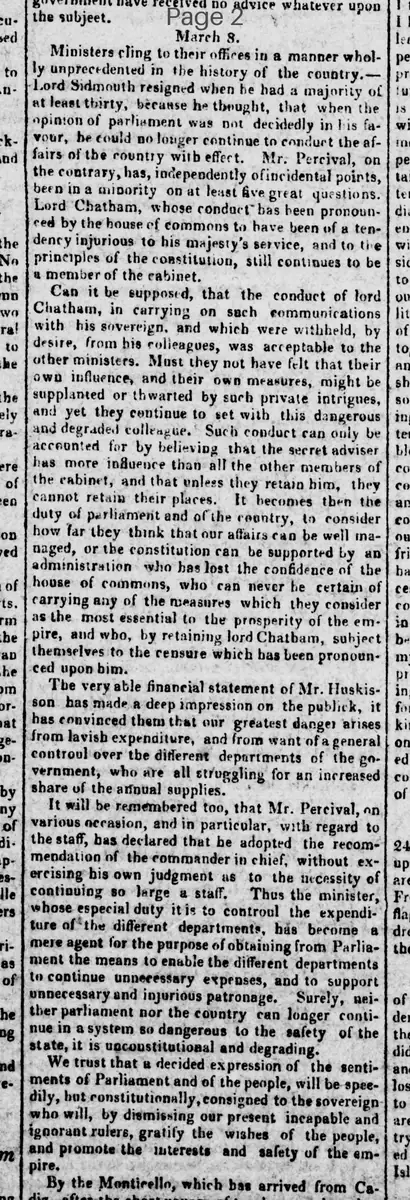
Ministers cling to their offices in a manner wholly unprecedented in the history of the country. Lord Sidmouth resigned when he had a majority of at least thirty, because he thought, that when the opinion of parliament was not decidedly in his favour, he could no longer continue to conduct the affairs of the country with effect. Mr. Percival, on the contrary, has, independently of incidental points, been in a minority on at least five great questions. Lord Chatham, whose conduct has been pronounced by the house of commons to have been of a tendency injurious to his majesty's service, and to the principles of the constitution, still continues to be a member of the cabinet.
Can it be supposed, that the conduct of lord Chatham, in carrying on such communications with his sovereign, and which were withheld, by desire, from his colleagues, was acceptable to the other ministers. Must they not have felt that their own influence, and their own measures, might be supplanted or thwarted by such private intrigues, and yet they continue to act with this dangerous and degraded colleague. Such conduct can only be accounted for by believing that the secret adviser has more influence than all the other members of the cabinet, and that unless they retain him, they cannot retain their places. It becomes then the duty of parliament and of the country, to consider how far they think that our affairs can be well managed, or the constitution can be supported by an administration who has lost the confidence of the house of commons, who can never be certain of carrying any of the measures which they consider as the most essential to the prosperity of the empire, and who, by retaining lord Chatham, subject themselves to the censure which has been pronounced upon him.
The very able financial statement of Mr. Huskisson has made a deep impression on the public, it has convinced them that our greatest danger arises from lavish expenditure, and from want of a general controul over the different departments of the government, who are all struggling for an increased share of the annual supplies.
It will be remembered too, that Mr. Percival, on various occasions, and in particular, with regard to the staff, has declared that he adopted the recommendation of the commander in chief, without exercising his own judgment as to the necessity of continuing so large a staff. Thus the minister, whose especial duty it is to controul the expenditure of the different departments, has become a mere agent for the purpose of obtaining from Parliament the means to enable the different departments to continue unnecessary expenses, and to support unnecessary and injurious patronage. Surely, neither parliament nor the country can longer continue in a system so dangerous to the safety of the state, it is unconstitutional and degrading.
We trust that a decided expression of the sentiments of Parliament and of the people, will be speedily, but constitutionally, conveyed to the sovereign who will, by dismissing our present incapable and ignorant rulers, gratify the wishes of the people, and promote the interests and safety of the empire.
Ministers cling to their offices in a manner wholly unprecedented in the history of the country. Lord Sidmouth resigned when he had a majority of at least thirty, because he thought, that when the opinion of parliament was not decidedly in his favour, he could no longer continue to conduct the affairs of the country with effect. Mr. Percival, on the contrary, has, independently of incidental points, been in a minority on at least five great questions. Lord Chatham, whose conduct has been pronounced by the house of commons to have been of a tendency injurious to his majesty's service, and to the principles of the constitution, still continues to be a member of the cabinet.
Can it be supposed, that the conduct of lord Chatham, in carrying on such communications with his sovereign, and which were withheld, by desire, from his colleagues, was acceptable to the other ministers. Must they not have felt that their own influence, and their own measures, might be supplanted or thwarted by such private intrigues, and yet they continue to act with this dangerous and degraded colleague. Such conduct can only be accounted for by believing that the secret adviser has more influence than all the other members of the cabinet, and that unless they retain him, they cannot retain their places. It becomes then the duty of parliament and of the country, to consider how far they think that our affairs can be well managed, or the constitution can be supported by an administration who has lost the confidence of the house of commons, who can never be certain of carrying any of the measures which they consider as the most essential to the prosperity of the empire, and who, by retaining lord Chatham, subject themselves to the censure which has been pronounced upon him.
The very able financial statement of Mr. Huskisson has made a deep impression on the public, it has convinced them that our greatest danger arises from lavish expenditure, and from want of a general controul over the different departments of the government, who are all struggling for an increased share of the annual supplies.
It will be remembered too, that Mr. Percival, on various occasions, and in particular, with regard to the staff, has declared that he adopted the recommendation of the commander in chief, without exercising his own judgment as to the necessity of continuing so large a staff. Thus the minister, whose especial duty it is to controul the expenditure of the different departments, has become a mere agent for the purpose of obtaining from Parliament the means to enable the different departments to continue unnecessary expenses, and to support unnecessary and injurious patronage. Surely, neither parliament nor the country can longer continue in a system so dangerous to the safety of the state, it is unconstitutional and degrading.
We trust that a decided expression of the sentiments of Parliament and of the people, will be speedily, but constitutionally, conveyed to the sovereign who will, by dismissing our present incapable and ignorant rulers, gratify the wishes of the people, and promote the interests and safety of the empire.
What sub-type of article is it?
Partisan Politics
Economic Policy
Constitutional
What keywords are associated?
Ministerial Crisis
Lord Chatham
Government Expenditure
Parliamentary Confidence
Financial Control
Cabinet Intrigue
Spencer Perceval
What entities or persons were involved?
Lord Sidmouth
Mr. Percival
Lord Chatham
Mr. Huskisson
Commander In Chief
Sovereign
Editorial Details
Primary Topic
Criticism Of Ministerial Retention And Government Expenditure
Stance / Tone
Strongly Critical Of The Administration
Key Figures
Lord Sidmouth
Mr. Percival
Lord Chatham
Mr. Huskisson
Commander In Chief
Sovereign
Key Arguments
Ministers Cling To Offices Despite Parliamentary Minorities, Unlike Lord Sidmouth
Lord Chatham Remains In Cabinet Despite House Of Commons Censure For Injurious Conduct
Other Ministers Tolerate Chatham Due To His Secret Influence With The Sovereign
Administration Has Lost Confidence Of The House Of Commons
Mr. Huskisson's Financial Statement Highlights Dangers Of Lavish Expenditure And Lack Of Control
Mr. Percival Fails To Control Departmental Spending, Acting As Mere Agent For Unnecessary Expenses
System Is Unconstitutional, Degrading, And Dangerous To The State
Call For Parliament And People To Urge Sovereign To Dismiss Incapable Rulers