Thank you for visiting SNEWPapers!
Sign up free
Phenix Gazette
Alexandria, Virginia
What is this article about?
Political commentary from Washington on Feb. 19, 1831, detailing emerging divisions in Congress: Mr. Tazewell's motion challenges Mr. Rhind's treaty authority; inquiries into Secretary Eaton's funds; Calhoun allies shifting against Van Buren administration, weakening Jackson's support.
Clipping
OCR Quality
Full Text
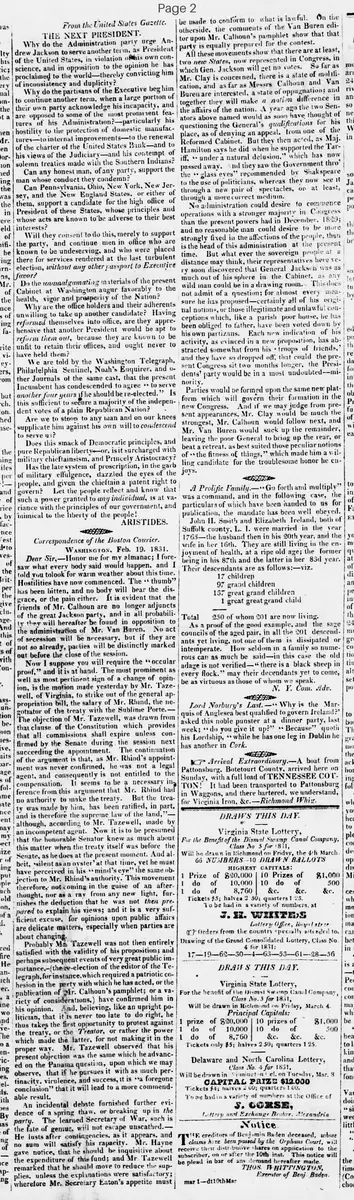
WASHINGTON, Feb. 19, 1831.
Dear Sir,—Honor me for my almanac; I foresaw what every body said would happen, and I told you to look for warm weather about this time. Hostilities have now commenced. The "thumb" has been bitten, and no body will bear the disgrace, or the pain either. It is evident that the friends of Mr. Calhoun are no longer adjuncts of the great Jackson party, and in all probability they will hereafter be found in opposition to the administration of Mr. Van Buren. No act of secession will be necessary, but if they are not so already, parties will be distinctly marked out before the close of the session.
Now I suppose you will require the "occular proof," and it is at hand. The most prominent as well as most pertinent sign of a change of opinion, is the motion made yesterday by Mr. Tazewell, of Virginia, to strike out of the general appropriation bill, the salary of Mr. Rhind, the negotiator of the treaty with the Sublime Porte.—The objection of Mr. Tazewell, was drawn from that clause of the Constitution which provides that all commissions shall expire unless confirmed by the Senate during the session next succeeding the appointment." The continuation of the argument is that, as Mr. Rhind's appointment was never confirmed, he was not a legal agent, and consequently is not entitled to the compensation. It seems to be a necessary inference from this argument that Mr. Rhind had no authority to make the treaty. But the treaty was made by him, has been ratified, in part, and is therefore the supreme law of the land," although, according to Mr. Tazewell, made by an incompetent agent. Now it is to be presumed that the honorable Senator knew as much about this matter when the treaty itself was before the Senate, as he does at the present moment. And albeit, silent as an oyster at that time, yet he must have perceived in his "mind's eye" the same objection to Mr. Rhind's authority. This movement therefore, not coming in the guise of an after-thought, nor as a ray from any new light, furnishes the deduction that he was not then prepared to explain his views; and it is a very sufficient excuse, for opinions upon public affairs are delicate matters, especially when parties are about changing.
Probably Mr. Tazewell was not then entirely satisfied with the validity of his proposition; and perhaps subsequent events of very great public importance—(the re-election of the editor of the Telegraph, for instance, which required a patriotic co- hesion in the party with which he has acted, or the publication of Mr. Calhoun's pamphlet; or a va- riety of considerations,) have confirmed him in his opinion. And, believing, like an upright po- litician, that it is never too late to do right, he thus takes the first opportunity to protest against the treaty, or the Treaty-maker, or rather the power which made the latter, for not making it in the proper way. Mr. Tazewell observed that his present objection was the same which he advanced on the Panama question, upon which we may observe, that if he pursues it with as much per- tinacity, virulence, and success, it is a foregone conclusion that it will lead to a more commend- able result.
An incidental debate furnished further evi- dence of a spring thaw, or breaking up in the party. The learned Secretary of War, such is the fate of genius, will not escape unscathed.— He lusts after contingencies, as it appears, and no sum will satisfy his rapacity. Mr. Hayne gave notice, that he should be inquisitive about the expenditure of this fund; and Mr. Tazewell remarked that he should move to reduce the sup- plies, unless the explanations were satisfactory; wherefore Mr. Secretary Eaton's appetite must be made to conform to what is lawful. On the other side, the comments of the Van Buren edi- tor upon Mr. Calhoun's pamphlet show that that party is equally prepared for the contest.
two new States, now represented in Congress. in which Gen. Jackson will get no votes. So far as Mr. Clay is concerned, there is a state of mollifi- cation, and as far as Messrs Calhoun and Van Buren are interested, a state of oppugnation; and together they will make a national difference in the affairs of the nation. A year ago the two Sen- ators above named would as soon have thought of questioning the General's qualifications for his place, as of denying an appeal from one of the Reformed Cabinet." But they then acted, as Maj. Hamilton says he did when he supported the Tar- iff, "under a natural delusion," which has now passed away. And they saw the Government thro the "glass eyes" recommended by Shakspeare to the use of politicians, whereas they now see it through a new pair of spectacles, or, at least, through a more correct medium.
No administration could desire to commence operations with a stronger majority in Congress than the present powers had in December, 1829; and no reasonable man could desire to be more strongly fixed in the affections of the people, than is the head of this administration at the present time. But whatever the sovereign people at a distance may think, their representatives here ve- ry soon discovered that General Jackson was as much out of his sphere in the Cabinet, as any wild man could be in a drawing room.—This does not admit of a question; for almost every mea- sure he has proposed—certainly all of his origi- nal notions, or those illegitimate and unlawful con- ceptions which, like a parish poor house, he has been obliged to father, have been voted down by his own partisans. Each new indication of his activity, as evinced in a new proposition, has ab- stracted somewhat from his troops of friends, and they have so dropped off, that could the pre- sent Congress sit two months longer, the Presi- dent's party would be in a most undoubted—mi- nority.
Parties would be formed upon the same new plat- form which will govern their formation in the new Congress. And if we may judge from pre- sent appearances, Mr. Clay would be much the strongest, Mr. Calhoun would follow next, and Mr. Van Buren would suck up the remainder, leaving the poor General to bring up the rear, or beat a retreat, as best suited those peculiar notions of "the fitness of things," which made him a wil- ling candidate for the troublesome honor he en- joys.
What sub-type of article is it?
What keywords are associated?
What entities or persons were involved?
Where did it happen?
Domestic News Details
Primary Location
Washington
Event Date
Feb. 19, 1831
Key Persons
Outcome
political realignment with calhoun's supporters opposing the van buren administration; motions to strike mr. rhind's salary from appropriation bill and inquire into secretary eaton's expenditures; parties forming distinctly before session's end.
Event Details
Letter reports on congressional debates signaling split in Jackson party, including Mr. Tazewell's motion to deny salary to Mr. Rhind due to unconfirmed appointment and invalid treaty negotiation; discussions on Secretary Eaton's contingent fund; broader commentary on declining support for Jackson and emerging oppositions led by Clay and Calhoun against Van Buren.