Thank you for visiting SNEWPapers!
Sign up free
Montgomery County Sentinel
Rockville, Gaithersburg, Montgomery County, Maryland
What is this article about?
The U.S. Senate concluded a debate by adopting Democratic resolutions on slavery and territorial power, affirming states' rights, equality in territories, and congressional limits, with votes around 2:1. Details include per-resolution votes and amendments. A note mentions ongoing recriminations among New York abolition leaders over Seward's defeat.
Clipping
OCR Quality
Full Text
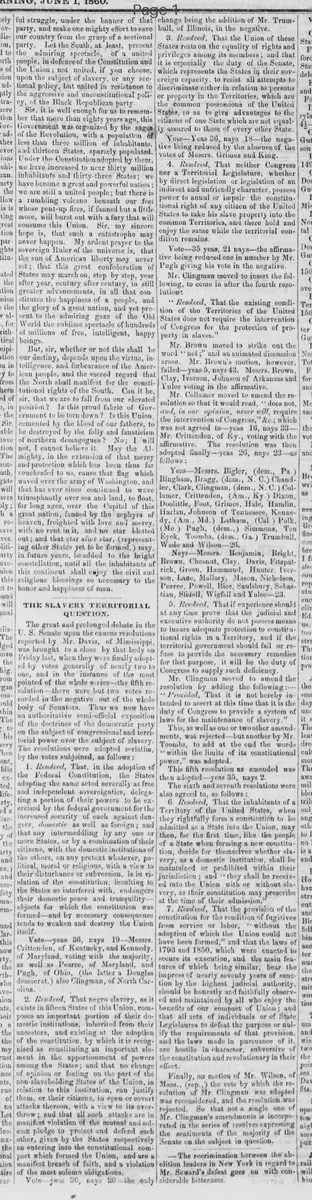
The great and prolonged debate in the U. S. Senate upon the caucus resolutions reported by Mr. Davis, of Mississippi, was brought to a close by that body on Friday last, when they were finally adopted by votes generally of nearly two to one, and in the instance of the most pointed of the whole series—the fifth resolution—there were but two votes recorded in the negative out of the whole body of Senators. Thus we now have an authoritative semi-official exposition of the doctrines of the democratic party on the subject of congressional and territorial power over the subject of slavery.
The resolutions were adopted seriatim, by the votes subjoined, as follows:
1. Resolved, That, in the adoption of the Federal Constitution, the States adopting the same acted severally as free and independent sovereignties, delegating a portion of their powers to be exercised by the federal government for the increased security of each against dangers, domestic as well as foreign; and that any intermeddling by any one or more States, or by a combination of their citizens, with the domestic institutions of the others, on any pretext whatever, political, moral or religious, with a view to their disturbance or subversion, is in violation of the constitution, insulting to the States so interfered with, endangers their domestic peace and tranquility—objects for which the constitution was formed—and by necessary consequence tends to weaken and destroy the Union itself.
Vote—yeas 36, nays 19—Messrs. Crittenden, of Kentucky, and Kennedy, of Maryland, voting with the majority, as well as Pearce, of Maryland, and Pugh, of Ohio, (the latter a Douglas democrat,) also Clingman, of North Carolina.
2. Resolved, That negro slavery, as it exists in fifteen States of this Union, comprises an important portion of their domestic institutions, inherited from their ancestors, and existing at the adoption of the constitution, by which it is recognized as constituting an important element in the apportionment of powers among the States; and that no change of opinion or feeling on the part of the non-slaveholding States of the Union, in relation to this institution, can justify them, or their citizens, in open or covert attacks thereon, with a view to its overthrow; and that all such attacks are in manifest violation of the mutual and solemn pledge to protect and defend each other, given by the States respectively on entering into the constitutional compact which formed the Union, and are a manifest breach of faith, and a violation of the most solemn obligations.
Vote—yeas 30, nays 21—the only change being the addition of Mr. Trumbull, of Illinois, in the negative.
3. Resolved, That the Union of these States rests on the equality of rights and privileges among its members; and that it is especially the duty of the Senate, which represents the States in their sovereign capacity, to resist all attempts to discriminate either in relation to persons or property in the Territories, which are the common possessions of the United States, so as to give advantages to the citizens of one State which are not equally assured to those of every other State.
Vote—Yeas 36, nays 18—the negative being reduced by the absence of the votes of Messrs. Grimes and King.
4. Resolved, That neither Congress nor a Territorial Legislature, whether by direct legislation or legislation of an indirect and unfriendly character, possess power to annul or impair the constitutional right of any citizen of the United States to take his slave property into the common Territories, and there hold and enjoy the same while the territorial condition remains.
Vote—35 yeas, 21 nays—the affirmative being reduced one in number by Mr. Pugh giving his vote in the negative.
Mr. Clingman moved to insert the following, to come in after the fourth resolution:
"Resolved, That the existing condition of the Territories of the United States does not require the intervention of Congress for the protection of property in slaves."
Mr. Brown moved to strike out the word "not;" and an animated discussion arose. Mr. Brown's motion, however failed—yeas 5, nays 43. Messrs. Brown, Clay, Iverson, Johnson of Arkansas and Yulee voting in the affirmative.
Mr. Collamer moved to amend the resolution so that it would read, "does not, and, in our opinion, never will, require the intervention of Congress," &c.; which was not agreed to—yeas 16, nays 33—Mr. Crittenden, of Ky., voting with the affirmative. The resolution was then adopted finally—yeas 26, nays 23—as follows:
Yeas—Messrs. Bigler, (dem., Pa) Bingham, Bragg, (dem., N. C.) Chandler, Clark, Clingman, (dem., N. C.) Collamer, Crittenden, (Am., Ky.) Dixon, Doolittle, Foot, Grimes, Hale, Hamlin, Harlan, Johnson of Tennessee, Kennedy, (Am., Md.) Latham, (Cal) Polk, (Mo.) Pugh, (dem.,) Simmons, Ten Eyck, Toombs, (dem., Ga.) Trumbull, Wade and Wilson—26.
Nays—Messrs. Benjamin, Bright, Brown, Chesnut, Clay, Davis, Fitzpatrick, Green, Hammond, Hunter, Iverson, Lane, Mallory, Mason, Nicholson, Pearce, Powell, Rice, Saulsbury, Sebastian, Slidell, Wigfall and Yulee—23.
5. Resolved, That if experience should at any time prove that the judicial and executive authority do not possess means to insure adequate protection to constitutional rights in a Territory, and if the territorial government should fail or refuse to provide the necessary remedies for that purpose, it will be the duty of Congress to supply such deficiency.
Mr. Clingman moved to amend the resolution by adding the following:-
"Provided, That it is not hereby intended to assert at this time that it is the duty of Congress to provide a system of laws for the maintenance of slavery."
This, as well as one or two other amendments, was rejected—but another by Mr. Toombs, to add at the end the words "within the limits of its constitutional power," was adopted.
This fifth resolution as amended was then adopted—yeas 35, nays 2
The sixth and seventh resolutions were also agreed to, as follows:
6. Resolved, That the inhabitants of a Territory of the United States, when they rightfully form a constitution to be admitted as a State into the Union, may then, for the first time, like the people of a State when forming a new constitution, decide for themselves whether slavery, as a domestic institution, shall be maintained or prohibited within their jurisdiction; and "they shall be received into the Union with or without slavery, as their constitution may prescribe at the time of their admission."
7. Resolved, That the provision of the constitution for the rendition of fugitives from service or labor, "without the adoption of which the Union could not have been formed," and that the laws of 1793 and 1850, which were enacted to secure its execution, and the main features of which being similar, bear the impress of nearly seventy years of sanction by the highest judicial authority, should be honestly and faithfully observed and maintained by all who enjoy the benefits of our compact of Union: and that all acts of individuals or of State Legislatures to defeat the purpose or nullify the requirements of that provision, and the laws made in pursuance of it, are hostile in character, subversive of the constitution and revolutionary in their effect.
Finally, on motion of Mr. Wilson, of Mass., (rep.,) the vote by which the resolution of Mr. Clingman was adopted was reconsidered, and the resolution was rejected. So that not a single one of Mr. Clingman's amendments is incorporated in the series of resolves expressing the sentiments of the majority of the Senate on the subject in question.
—The recrimination between the abolition leaders in New York in regard to Mr. Seward's defeat goes on with considerable bitterness.
What sub-type of article is it?
What themes does it cover?
What keywords are associated?
What entities or persons were involved?
Where did it happen?
Story Details
Key Persons
Location
U. S. Senate
Event Date
Friday Last
Story Details
The U.S. Senate adopted a series of resolutions reported by Mr. Davis affirming states' rights over domestic institutions including slavery, equality in territories, limits on congressional power to interfere with slave property, and duties regarding fugitive slaves, with detailed votes and rejected amendments by Mr. Clingman. A separate note describes bitter recriminations among New York abolition leaders over Mr. Seward's defeat.