Thank you for visiting SNEWPapers!
Sign up free
Story
June 22, 1855
The Liberator
Boston, Suffolk County, Massachusetts
What is this article about?
Editorial criticizing Massachusetts' Personal Liberty Bill for nullifying the Fugitive Slave Law, predicting Southern retaliatory measures like trade restrictions, and hoping for a reaction against fanaticism in the state.
Clipping
OCR Quality
98%
Excellent
Full Text
Our Country is the World, our Countrymen are all Mankind.
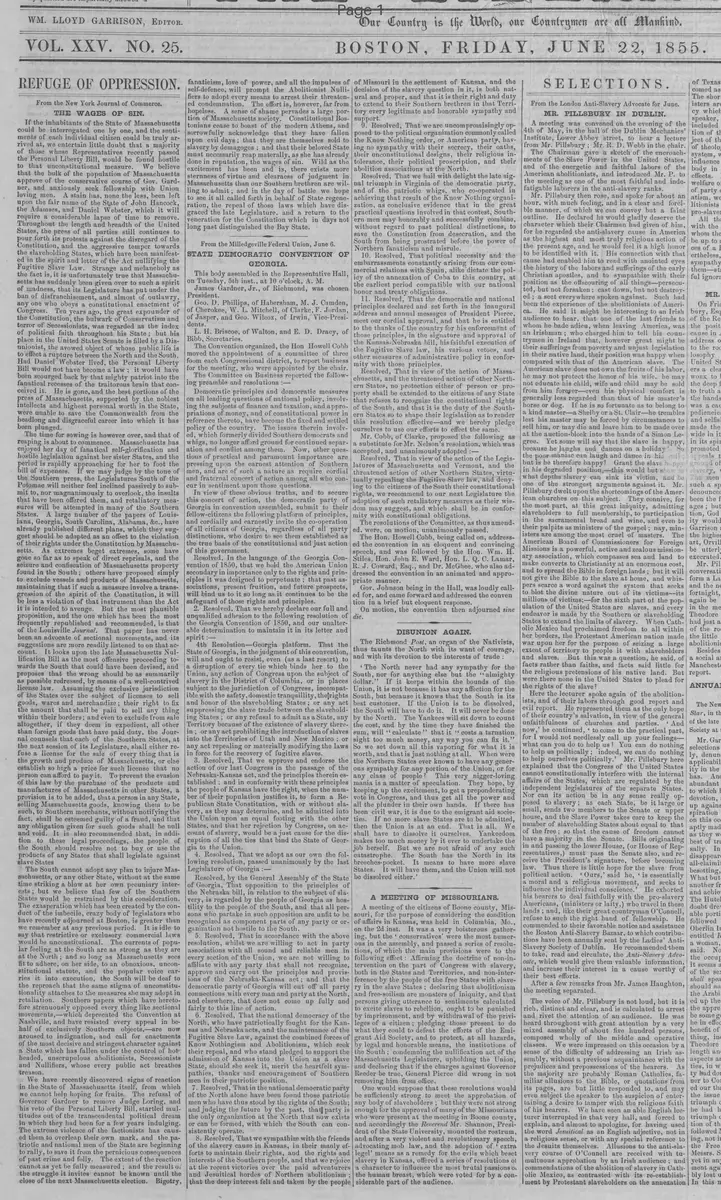
BOSTON, FRIDAY, JUNE 22, 1855.
REFUGE OF OPPRESSION.
From the New York Journal of Commerce.
THE WAGES OF SIN.
If the inhabitants of the State of Massachusetts could be interrogated one by one, and the sentiments of each individual citizen could be truly arrived at, we entertain little doubt that a majority of those whose Representatives recently passed the Personal Liberty Bill, would be found hostile to that unconstitutional measure. We believe that the bulk of the population of Massachusetts approve of the conservative course of Gov. Gardner, and anxiously seek fellowship with Union loving men. A stain has, none the less, been left upon the fair name of the State of John Hancock, the Adamses, and Daniel Webster, which it will require a considerable lapse of time to remove.
Throughout the length and breadth of the United States, the press of all parties still continues to pour forth its protests against the disregard of the Constitution, and the aggressive temper towards the slaveholding States, which have been manifested in the spirit and letter of the Act nullifying the Fugitive Slave Law. Strange and melancholy as the fact is, it is unfortunately true that Massachusetts has suddenly been given over to such a spirit of madness, that its Legislature has put under the ban of disfranchisement, and almost of outlawry, any one who obeys a constitutional enactment of Congress. Ten years ago, the great expounder of the Constitution, the bulwark of Conservatism and terror of Secessionists, was regarded as the index of political faith throughout his State; but his place in the United States Senate is filled by a Disunionist, the avowed object of whose public life is to effect a rupture between the North and the South.
Had Daniel Webster lived, the Personal Liberty Bill would not have become a law; it would have been scourged back by that mighty patriot into the fanatical recesses of the traitorous brain that conceived it. He is gone, and the best portions of the press of Massachusetts, supported by the noblest intellects and highest personal worth in the State, were unable to save the Commonwealth from the headlong and disgraceful career into which it has been plunged.
The time for sowing is however over, and that of reaping is about to commence. Massachusetts has enjoyed her day of fanatical self-glorification and hostile legislation against her sister States, and the period is rapidly approaching for her to foot the bill of expenses. If we may judge by the tone of the Southern press, the Legislatures South of the Potomac will neither feel inclined passively to submit to, nor magnanimously to overlook, the insults that have been offered them, and retaliatory measures will be attempted in many of the Southern States. A large number of the papers of Louisiana, Georgia, South Carolina, Alabama, &c., have already published different plans, which they suggest should be adopted as an offset to the violation of their rights under the Constitution by Massachusetts. As extremes beget extremes, some have gone so far as to speak of direct reprisals, and the seizure and confiscation of Massachusetts property found in the South; others have proposed simply to exclude vessels and products of Massachusetts, maintaining that if such a measure involve a transgression of the spirit of the Constitution, it will be less a violation of that instrument than the Act it is intended to avenge. But the most plausible proposition, and the one which has been the most frequently republished and recommended, is that of the Louisville Journal. That paper has never been an advocate of sectional movements, and its suggestions are more readily listened to on that account. It looks upon the late Massachusetts Nullification Bill as the most offensive proceeding towards the South that could have been devised, and proposes that the wrong should be as summarily as possible redressed, by means of a well-contrived license law. Assuming the exclusive jurisdiction of the States over the subject of licenses to sell goods, wares and merchandize; their right to fix the amount that shall be paid to sell any thing within their borders; and even to exclude from sale altogether, if they deem it expedient, all other than foreign goods that have paid duty, the Journal counsels that each of the Southern States, at the next session of its Legislature, shall either refuse a license for the sale of every thing that is the growth and produce of Massachusetts, or else establish so high a price for such license that no person can afford to pay it. To prevent the evasion of this law by the purchase of the products and manufactures of Massachusetts in other States, a provision is to be added, that a person in any State, selling Massachusetts goods, knowing them to be such, to Southern merchants, without notifying the fact, shall be esteemed guilty of a fraud, and that any obligation given for such goods shall be null and void. It is also recommended that, in addition to these legal proceedings, the people of the South should resolve not to buy or use the products of any States that shall legislate against slave States.
The South cannot adopt any plan to injure Massachusetts, or any other State, without at the same time striking a blow at her own pecuniary interests; but we believe that few of the Southern States would be restrained by this consideration. The exasperation which has been created by the conduct of the imbecile, crazy body of legislators who have recently adjourned at Boston, is greater than we remember at any previous period. It is idle to say that restrictive or exclusory commercial laws would be unconstitutional. The currents of popular feeling at the South are as strong as they are at the North; and so long as Massachusetts sees fit to adhere, on her side, to an obnoxious, unconstitutional statute, and the popular voice carries it into execution, the South will be deaf to the reproach that the same stigma of unconstitutionality attaches to the measures she may adopt in retaliation. Southern papers which have heretofore strenuously opposed every thing like sectional movements,—which deprecated the Convention at Nashville, and have resisted every appeal in behalf of exclusively Southern objects,—are now aroused to indignation, and call for enactments of the most decisive and stringent character against a State which has fallen under the control of hot headed, unscrupulous abolitionists, Secessionists and Nullifiers, whose every public act breathes treason.
We have recently discovered signs of reaction in the State of Massachusetts itself, from which we cannot help hoping for fruits. The refusal of Governor Gardner to remove Judge Loring, and his veto of the Personal Liberty Bill, startled multitudes out of the transcendental political dream in which they had been for a few years indulging. The extreme violence of the factionists has caused them to overleap their own mark, and the patriotic and national men of the State are beginning to rally, to save it from the pernicious consequences of past crime and folly. The extent of the reaction cannot as yet be fully measured: and the result of the struggle it invites cannot be known until the close of the next Massachusetts election. Bigotry, fanaticism, love of power, and all the impulses of self-defence, will prompt the Abolitionist Nullifiers to adopt every means to arrest their threatened condemnation. The effort is, however, far from hopeless. A sense of shame pervades a large portion of Massachusetts society. Constitutional Bostonians cease to boast of the modern Athens, and sorrowfully acknowledge that they have fallen upon evil days; that they are themselves sold to slavery by demagogues: and that their beloved State must necessarily reap materially, as she has already done in reputation, the wages of sin. Wild as the excitement has been and is, there exists more sternness of virtue and clearness of judgment in Massachusetts than our Southern brethren are willing to admit; and in the day of battle we hope to see it all called forth in behalf of State regeneration, the repeal of those laws which have disgraced the late Legislature, and a return to the veneration for the Constitution which in days not long past distinguished the Bay State.
BOSTON, FRIDAY, JUNE 22, 1855.
REFUGE OF OPPRESSION.
From the New York Journal of Commerce.
THE WAGES OF SIN.
If the inhabitants of the State of Massachusetts could be interrogated one by one, and the sentiments of each individual citizen could be truly arrived at, we entertain little doubt that a majority of those whose Representatives recently passed the Personal Liberty Bill, would be found hostile to that unconstitutional measure. We believe that the bulk of the population of Massachusetts approve of the conservative course of Gov. Gardner, and anxiously seek fellowship with Union loving men. A stain has, none the less, been left upon the fair name of the State of John Hancock, the Adamses, and Daniel Webster, which it will require a considerable lapse of time to remove.
Throughout the length and breadth of the United States, the press of all parties still continues to pour forth its protests against the disregard of the Constitution, and the aggressive temper towards the slaveholding States, which have been manifested in the spirit and letter of the Act nullifying the Fugitive Slave Law. Strange and melancholy as the fact is, it is unfortunately true that Massachusetts has suddenly been given over to such a spirit of madness, that its Legislature has put under the ban of disfranchisement, and almost of outlawry, any one who obeys a constitutional enactment of Congress. Ten years ago, the great expounder of the Constitution, the bulwark of Conservatism and terror of Secessionists, was regarded as the index of political faith throughout his State; but his place in the United States Senate is filled by a Disunionist, the avowed object of whose public life is to effect a rupture between the North and the South.
Had Daniel Webster lived, the Personal Liberty Bill would not have become a law; it would have been scourged back by that mighty patriot into the fanatical recesses of the traitorous brain that conceived it. He is gone, and the best portions of the press of Massachusetts, supported by the noblest intellects and highest personal worth in the State, were unable to save the Commonwealth from the headlong and disgraceful career into which it has been plunged.
The time for sowing is however over, and that of reaping is about to commence. Massachusetts has enjoyed her day of fanatical self-glorification and hostile legislation against her sister States, and the period is rapidly approaching for her to foot the bill of expenses. If we may judge by the tone of the Southern press, the Legislatures South of the Potomac will neither feel inclined passively to submit to, nor magnanimously to overlook, the insults that have been offered them, and retaliatory measures will be attempted in many of the Southern States. A large number of the papers of Louisiana, Georgia, South Carolina, Alabama, &c., have already published different plans, which they suggest should be adopted as an offset to the violation of their rights under the Constitution by Massachusetts. As extremes beget extremes, some have gone so far as to speak of direct reprisals, and the seizure and confiscation of Massachusetts property found in the South; others have proposed simply to exclude vessels and products of Massachusetts, maintaining that if such a measure involve a transgression of the spirit of the Constitution, it will be less a violation of that instrument than the Act it is intended to avenge. But the most plausible proposition, and the one which has been the most frequently republished and recommended, is that of the Louisville Journal. That paper has never been an advocate of sectional movements, and its suggestions are more readily listened to on that account. It looks upon the late Massachusetts Nullification Bill as the most offensive proceeding towards the South that could have been devised, and proposes that the wrong should be as summarily as possible redressed, by means of a well-contrived license law. Assuming the exclusive jurisdiction of the States over the subject of licenses to sell goods, wares and merchandize; their right to fix the amount that shall be paid to sell any thing within their borders; and even to exclude from sale altogether, if they deem it expedient, all other than foreign goods that have paid duty, the Journal counsels that each of the Southern States, at the next session of its Legislature, shall either refuse a license for the sale of every thing that is the growth and produce of Massachusetts, or else establish so high a price for such license that no person can afford to pay it. To prevent the evasion of this law by the purchase of the products and manufactures of Massachusetts in other States, a provision is to be added, that a person in any State, selling Massachusetts goods, knowing them to be such, to Southern merchants, without notifying the fact, shall be esteemed guilty of a fraud, and that any obligation given for such goods shall be null and void. It is also recommended that, in addition to these legal proceedings, the people of the South should resolve not to buy or use the products of any States that shall legislate against slave States.
The South cannot adopt any plan to injure Massachusetts, or any other State, without at the same time striking a blow at her own pecuniary interests; but we believe that few of the Southern States would be restrained by this consideration. The exasperation which has been created by the conduct of the imbecile, crazy body of legislators who have recently adjourned at Boston, is greater than we remember at any previous period. It is idle to say that restrictive or exclusory commercial laws would be unconstitutional. The currents of popular feeling at the South are as strong as they are at the North; and so long as Massachusetts sees fit to adhere, on her side, to an obnoxious, unconstitutional statute, and the popular voice carries it into execution, the South will be deaf to the reproach that the same stigma of unconstitutionality attaches to the measures she may adopt in retaliation. Southern papers which have heretofore strenuously opposed every thing like sectional movements,—which deprecated the Convention at Nashville, and have resisted every appeal in behalf of exclusively Southern objects,—are now aroused to indignation, and call for enactments of the most decisive and stringent character against a State which has fallen under the control of hot headed, unscrupulous abolitionists, Secessionists and Nullifiers, whose every public act breathes treason.
We have recently discovered signs of reaction in the State of Massachusetts itself, from which we cannot help hoping for fruits. The refusal of Governor Gardner to remove Judge Loring, and his veto of the Personal Liberty Bill, startled multitudes out of the transcendental political dream in which they had been for a few years indulging. The extreme violence of the factionists has caused them to overleap their own mark, and the patriotic and national men of the State are beginning to rally, to save it from the pernicious consequences of past crime and folly. The extent of the reaction cannot as yet be fully measured: and the result of the struggle it invites cannot be known until the close of the next Massachusetts election. Bigotry, fanaticism, love of power, and all the impulses of self-defence, will prompt the Abolitionist Nullifiers to adopt every means to arrest their threatened condemnation. The effort is, however, far from hopeless. A sense of shame pervades a large portion of Massachusetts society. Constitutional Bostonians cease to boast of the modern Athens, and sorrowfully acknowledge that they have fallen upon evil days; that they are themselves sold to slavery by demagogues: and that their beloved State must necessarily reap materially, as she has already done in reputation, the wages of sin. Wild as the excitement has been and is, there exists more sternness of virtue and clearness of judgment in Massachusetts than our Southern brethren are willing to admit; and in the day of battle we hope to see it all called forth in behalf of State regeneration, the repeal of those laws which have disgraced the late Legislature, and a return to the veneration for the Constitution which in days not long past distinguished the Bay State.
What sub-type of article is it?
Historical Event
What themes does it cover?
Justice
Tragedy
Misfortune
What keywords are associated?
Personal Liberty Bill
Fugitive Slave Law
Massachusetts Legislature
Southern Retaliation
Daniel Webster
Sectional Tension
Louisville Journal
What entities or persons were involved?
Daniel Webster
Gov. Gardner
Judge Loring
John Hancock
Adamses
Where did it happen?
Massachusetts, United States, Southern States
Story Details
Key Persons
Daniel Webster
Gov. Gardner
Judge Loring
John Hancock
Adamses
Location
Massachusetts, United States, Southern States
Event Date
1855
Story Details
Critique of Massachusetts' Personal Liberty Bill nullifying the Fugitive Slave Law, lamenting its passage without Daniel Webster's influence, predicting Southern retaliatory trade measures as proposed by the Louisville Journal, and noting signs of reaction against fanaticism in the state.