Thank you for visiting SNEWPapers!
Sign up free
Story
June 26, 1908
Middlebury Register
Middlebury, Addison County, Vermont
What is this article about?
The 1908 Republican National Convention in Chicago nominates William H. Taft of Ohio for president with 702 votes on the first ballot, made unanimous, and James S. Sherman of New York for vice president with 816 votes. Enthusiastic demonstrations occur, especially for Theodore Roosevelt. The platform endorses Roosevelt's policies and addresses tariffs, currency, and antitrust laws.
Clipping
OCR Quality
95%
Excellent
Full Text
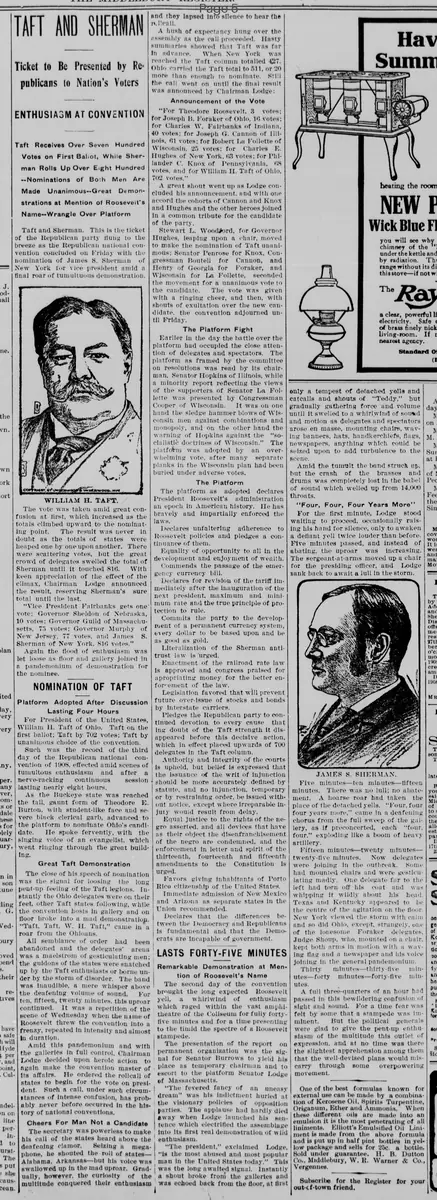
TAFT AND SHERMAN
Ticket to Be Presented by Republicans to Nation's Voters
ENTHUSIASM AT CONVENTION
Taft Receives Over Seven Hundred Votes on First Ballot, While Sherman Rolls Up Over Eight Hundred—Nominations of Both Men Are Made Unanimous—Great Demonstrations at Mention of Roosevelt's Name—Wrangle Over Platform
Taft and Sherman. This is the ticket of the Republican party flung to the breeze as the Republican national convention concluded on Friday with the nomination of James S. Sherman of New York for vice president amid a final roar of tumultuous demonstration.
WILLIAM H. TAFT.
The vote was taken amid great confusion at first, which increased as the totals climbed upward to the nominating point. The result was never in doubt as the totals of states were heaped one by one upon another. There were scattering votes, but the great crowd of delegates swelled the total of Sherman until it touched 816. With keen appreciation of the effect of the climax, Chairman Lodge announced the result, reserving Sherman's sure total until the last.
"Vice President Fairbanks gets one vote; Governor Sheldon of Nebraska, 10 votes; Governor Guild of Massachusetts, 75 votes; Governor Murphy of New Jersey, 77 votes, and James S. Sherman of New York, 816 votes."
Again the flood of enthusiasm was let loose as floor and gallery joined in a pandemonium of demonstration for the nominee.
NOMINATION OF TAFT
Platform Adopted After Discussion Lasting Four Hours
For President of the United States, William H. Taft of Ohio. Taft on the first ballot: Taft by 702 votes; Taft by unanimous choice of the convention.
Such was the record of the third day of the Republican national convention of 1908, effected amid scenes of tumultuous enthusiasm and after nerve-racking continuous session lasting nearly eight hours.
As the Buckeye state was reached the tall, gaunt form of Theodore E. Burton, with student-like face and severe black clerical garb, advanced to the platform to nominate Ohio's candidate.
He spoke fervently, with the singing voice of an evangelist, which went ringing through the great building.
Great Taft Demonstration
The close of his speech of nomination was the signal for loosing the long pent-up feeling of the Taft legions. Instantly the Ohio delegates were on their feet, other Taft states following, while the convention hosts in gallery and on floor broke into a mad demonstration.
"Taft, Taft, W. H. Taft," came in a roar from the Ohioans.
All semblance of order had been abandoned and the delegates' arena was a maelstrom of gesticulating men; the guidons of the states were snatched up by the Taft enthusiasts or borne under by the storm of disorder. The band was inaudible, a mere whisper above the deafening volume of sound.
For ten, fifteen, twenty minutes, this uproar continued. It was a repetition of the scene of Wednesday when the name of Roosevelt threw the convention into a frenzy, repeated in intensity and almost in duration.
Amid this pandemonium and with the galleries in full control, Chairman Lodge decided upon heroic action to again make the convention master of its affairs. He ordered the rollcall of states to begin for the vote on president.
Such a call, under such circumstances of intense confusion, has probably never before occurred in the history of national conventions.
Cheers For Man Not a Candidate
The secretary was powerless to make his call of the states heard above the deafening clamor. Seizing a megaphone, he shouted the roll of states—Alabama, Arkansas—but his voice was swallowed up in the mad uproar. Gradually, however, the curiosity of the multitude conquered their enthusiasm and they lapsed into silence to hear the rollcall.
A hush of expectancy hung over the assembly as the call proceeded. Hasty summaries showed that Taft was far in advance.
When New York was reached the Taft column totalled 427.
Ohio carried the Taft total to 511, or 20 more than enough to nominate. Still the call went on until the final result was announced by Chairman Lodge:
Announcement of the Vote
"For Theodore Roosevelt, 3 votes; for Joseph B. Foraker of Ohio, 16 votes; for Charles W. Fairbanks of Indiana, 40 votes; for Joseph G. Cannon of Illinois, 61 votes; for Robert La Follette of Wisconsin, 25 votes; for Charles E. Hughes of New York, 63 votes; for Philander C. Knox of Pennsylvania, 68 votes, and for William H. Taft of Ohio, 702 votes."
A great shout went up as Lodge concluded his announcement, and with one accord the cohorts of Cannon and Knox and Hughes and the other heroes joined in a common tribute for the candidate.
Stewart L. Woodford, for Governor Hughes, leaping upon a chair, moved to make the nomination of Taft unanimous; Senator Penrose for Knox, Congressman Boutell for Cannon, and Henry of Georgia for Foraker, and Wisconsin for La Follette, seconded the movement for a unanimous vote to the candidate. The vote was given with a ringing cheer, and then, with shouts of exultation over the new candidate, the convention adjourned until Friday.
The Platform Fight
Earlier in the day the battle over the platform had occupied the close attention of delegates and spectators. The platform as framed by the committee on resolutions was read by its chairman, Senator Hopkins of Illinois, while a minority report reflecting the views of the supporters of Senator La Follette was presented by Congressman Cooper of Wisconsin. It was on one hand the sledge hammer blows of Wisconsin men against combinations and monopoly, and on the other hand the warning of Hopkins against the "socialistic doctrines of Wisconsin."
The platform was adopted by an overwhelming vote, after many separate planks in the Wisconsin plan had been buried under adverse votes.
The Platform
The platform as adopted declares President Roosevelt's administration an epoch in American history. He has bravely and impartially enforced the laws.
Declares unfaltering adherence to Roosevelt policies and pledges a continuance of them.
Equality of opportunity to all in the development and enjoyment of wealth.
Commends the passage of the emergency currency bill.
Declares for revision of the tariff immediately after the inauguration of the next president, maximum and minimum rate and the true principle of protection to rule.
Commits the party to the development of a permanent currency system, every dollar to be based upon and be as good as gold.
Literalization of the Sherman anti-trust law is urged.
Enactment of the railroad rate law is approved and congress praised for appropriating money for the better enforcement of the law.
Legislation favored that will prevent future over-issue of stocks and bonds by Interstate carriers.
Pledges the Republican party to continued devotion to every cause that casting doubt of the Taft strength it disappeared before this decisive action, which in effect placed upwards of 700 delegates in the Taft column.
Authority and integrity of the courts is upheld, but belief is expressed that the issuance of the writ of injunction should be more accurately defined by statute, and no injunction, temporary or by restraining order, be issued without notice, except where irreparable injury would result from delay.
Equal justice to the rights of the negro asserted, and all devices that have as their object the disenfranchisement of the negro are condemned, and the enforcement in letter and spirit of the thirteenth, fourteenth and fifteenth amendments to the Constitution is urged.
Favors giving inhabitants of Porto Rico citizenship of the United States.
Immediate admission of New Mexico and Arizona as separate states in the Union recommended.
Declares that the differences between the Democracy and Republicans is fundamental and that the Democrats are incapable of government.
LASTS FORTY-FIVE MINUTES
Remarkable Demonstration at Mention of Roosevelt's Name
The second day of the convention brought the long expected Roosevelt yell, a whirlwind of enthusiasm which raged within the vast amphitheatre of the Coliseum for fully forty-five minutes and for a time presenting to the timid the spectre of a Roosevelt stampede.
The presentation of the report on permanent organization was the signal for Senator Burrows to yield his place as temporary chairman and to escort to the platform Senator Lodge of Massachusetts.
"The fevered fancy of an uneasy dream" was his indictment hurled at the visionary policies of opposition parties. The applause had hardly died away when Lodge launched his sentence which electrified the assemblage into its first real demonstration of wild enthusiasm.
"The president," exclaimed Lodge, "is the most abused and most popular man in the United States today." This was the long awaited signal. Instantly a shout broke from the galleries and was echoed back from the floor, at first only a tempest of detached yells and catcalls and shouts of "Teddy," but gradually gathering force and volume until it swelled to a whirlwind of sound and motion as delegates and spectators arose en masse, mounting chairs, waving banners, hats, handkerchiefs, flags, newspapers, anything which could be seized upon to add turbulence to the scene.
Amid the tumult the band struck up, but the crash of the brasses and drums was completely lost in the babel of sound which welled up from 14,000 throats.
"Four, Four, Four Years More"
For the first minute, Lodge stood waiting to proceed, occasionally raising his hand for silence, only to awaken a defiant yell twice louder than before.
Five minutes passed, and instead of abating, the uproar was increasing.
The sergeant-at-arms moved up a chair for the presiding officer, and Lodge sank back to await a lull in the storm.
Five minutes—ten minutes—fifteen minutes. There was no lull; no abatement. A hoarse roar had taken the place of the detached yells. "Four, four, four years more," came in a deafening chorus from the full sweep of the gallery, as if preconcerted, each "four, four," exploding like a boom of heavy artillery.
Fifteen minutes—twenty minutes—twenty-five minutes.
Now delegates were joining in the outbreak. Some had mounted chairs and were gesticulating madly. One delegate far to the left had torn off his coat and was whipping it wildly about his head.
Texas and Kentucky appeared to be the centre of the agitation on the floor.
New York viewed the storm with calm and so did Ohio, except, strangely, one of the lonesome Foraker delegates, Judge Shoup, who, mounted on a chair, kept both arms in motion with a waving flag and a newspaper and his voice joining in the general pandemonium.
Thirty minutes—thirty-five minutes—forty minutes—forty-five minutes.
A full three-quarters of an hour had passed in this bewildering confusion of sight and sound. For a time fear was felt by some that a stampede was imminent. But the political generals were glad to give the pent-up enthusiasm of the multitude this outlet of expression, and at no time was there the slightest apprehension among them that the well-devised plans would miscarry through some overpowering movement.
JAMES S. SHERMAN.
Ticket to Be Presented by Republicans to Nation's Voters
ENTHUSIASM AT CONVENTION
Taft Receives Over Seven Hundred Votes on First Ballot, While Sherman Rolls Up Over Eight Hundred—Nominations of Both Men Are Made Unanimous—Great Demonstrations at Mention of Roosevelt's Name—Wrangle Over Platform
Taft and Sherman. This is the ticket of the Republican party flung to the breeze as the Republican national convention concluded on Friday with the nomination of James S. Sherman of New York for vice president amid a final roar of tumultuous demonstration.
WILLIAM H. TAFT.
The vote was taken amid great confusion at first, which increased as the totals climbed upward to the nominating point. The result was never in doubt as the totals of states were heaped one by one upon another. There were scattering votes, but the great crowd of delegates swelled the total of Sherman until it touched 816. With keen appreciation of the effect of the climax, Chairman Lodge announced the result, reserving Sherman's sure total until the last.
"Vice President Fairbanks gets one vote; Governor Sheldon of Nebraska, 10 votes; Governor Guild of Massachusetts, 75 votes; Governor Murphy of New Jersey, 77 votes, and James S. Sherman of New York, 816 votes."
Again the flood of enthusiasm was let loose as floor and gallery joined in a pandemonium of demonstration for the nominee.
NOMINATION OF TAFT
Platform Adopted After Discussion Lasting Four Hours
For President of the United States, William H. Taft of Ohio. Taft on the first ballot: Taft by 702 votes; Taft by unanimous choice of the convention.
Such was the record of the third day of the Republican national convention of 1908, effected amid scenes of tumultuous enthusiasm and after nerve-racking continuous session lasting nearly eight hours.
As the Buckeye state was reached the tall, gaunt form of Theodore E. Burton, with student-like face and severe black clerical garb, advanced to the platform to nominate Ohio's candidate.
He spoke fervently, with the singing voice of an evangelist, which went ringing through the great building.
Great Taft Demonstration
The close of his speech of nomination was the signal for loosing the long pent-up feeling of the Taft legions. Instantly the Ohio delegates were on their feet, other Taft states following, while the convention hosts in gallery and on floor broke into a mad demonstration.
"Taft, Taft, W. H. Taft," came in a roar from the Ohioans.
All semblance of order had been abandoned and the delegates' arena was a maelstrom of gesticulating men; the guidons of the states were snatched up by the Taft enthusiasts or borne under by the storm of disorder. The band was inaudible, a mere whisper above the deafening volume of sound.
For ten, fifteen, twenty minutes, this uproar continued. It was a repetition of the scene of Wednesday when the name of Roosevelt threw the convention into a frenzy, repeated in intensity and almost in duration.
Amid this pandemonium and with the galleries in full control, Chairman Lodge decided upon heroic action to again make the convention master of its affairs. He ordered the rollcall of states to begin for the vote on president.
Such a call, under such circumstances of intense confusion, has probably never before occurred in the history of national conventions.
Cheers For Man Not a Candidate
The secretary was powerless to make his call of the states heard above the deafening clamor. Seizing a megaphone, he shouted the roll of states—Alabama, Arkansas—but his voice was swallowed up in the mad uproar. Gradually, however, the curiosity of the multitude conquered their enthusiasm and they lapsed into silence to hear the rollcall.
A hush of expectancy hung over the assembly as the call proceeded. Hasty summaries showed that Taft was far in advance.
When New York was reached the Taft column totalled 427.
Ohio carried the Taft total to 511, or 20 more than enough to nominate. Still the call went on until the final result was announced by Chairman Lodge:
Announcement of the Vote
"For Theodore Roosevelt, 3 votes; for Joseph B. Foraker of Ohio, 16 votes; for Charles W. Fairbanks of Indiana, 40 votes; for Joseph G. Cannon of Illinois, 61 votes; for Robert La Follette of Wisconsin, 25 votes; for Charles E. Hughes of New York, 63 votes; for Philander C. Knox of Pennsylvania, 68 votes, and for William H. Taft of Ohio, 702 votes."
A great shout went up as Lodge concluded his announcement, and with one accord the cohorts of Cannon and Knox and Hughes and the other heroes joined in a common tribute for the candidate.
Stewart L. Woodford, for Governor Hughes, leaping upon a chair, moved to make the nomination of Taft unanimous; Senator Penrose for Knox, Congressman Boutell for Cannon, and Henry of Georgia for Foraker, and Wisconsin for La Follette, seconded the movement for a unanimous vote to the candidate. The vote was given with a ringing cheer, and then, with shouts of exultation over the new candidate, the convention adjourned until Friday.
The Platform Fight
Earlier in the day the battle over the platform had occupied the close attention of delegates and spectators. The platform as framed by the committee on resolutions was read by its chairman, Senator Hopkins of Illinois, while a minority report reflecting the views of the supporters of Senator La Follette was presented by Congressman Cooper of Wisconsin. It was on one hand the sledge hammer blows of Wisconsin men against combinations and monopoly, and on the other hand the warning of Hopkins against the "socialistic doctrines of Wisconsin."
The platform was adopted by an overwhelming vote, after many separate planks in the Wisconsin plan had been buried under adverse votes.
The Platform
The platform as adopted declares President Roosevelt's administration an epoch in American history. He has bravely and impartially enforced the laws.
Declares unfaltering adherence to Roosevelt policies and pledges a continuance of them.
Equality of opportunity to all in the development and enjoyment of wealth.
Commends the passage of the emergency currency bill.
Declares for revision of the tariff immediately after the inauguration of the next president, maximum and minimum rate and the true principle of protection to rule.
Commits the party to the development of a permanent currency system, every dollar to be based upon and be as good as gold.
Literalization of the Sherman anti-trust law is urged.
Enactment of the railroad rate law is approved and congress praised for appropriating money for the better enforcement of the law.
Legislation favored that will prevent future over-issue of stocks and bonds by Interstate carriers.
Pledges the Republican party to continued devotion to every cause that casting doubt of the Taft strength it disappeared before this decisive action, which in effect placed upwards of 700 delegates in the Taft column.
Authority and integrity of the courts is upheld, but belief is expressed that the issuance of the writ of injunction should be more accurately defined by statute, and no injunction, temporary or by restraining order, be issued without notice, except where irreparable injury would result from delay.
Equal justice to the rights of the negro asserted, and all devices that have as their object the disenfranchisement of the negro are condemned, and the enforcement in letter and spirit of the thirteenth, fourteenth and fifteenth amendments to the Constitution is urged.
Favors giving inhabitants of Porto Rico citizenship of the United States.
Immediate admission of New Mexico and Arizona as separate states in the Union recommended.
Declares that the differences between the Democracy and Republicans is fundamental and that the Democrats are incapable of government.
LASTS FORTY-FIVE MINUTES
Remarkable Demonstration at Mention of Roosevelt's Name
The second day of the convention brought the long expected Roosevelt yell, a whirlwind of enthusiasm which raged within the vast amphitheatre of the Coliseum for fully forty-five minutes and for a time presenting to the timid the spectre of a Roosevelt stampede.
The presentation of the report on permanent organization was the signal for Senator Burrows to yield his place as temporary chairman and to escort to the platform Senator Lodge of Massachusetts.
"The fevered fancy of an uneasy dream" was his indictment hurled at the visionary policies of opposition parties. The applause had hardly died away when Lodge launched his sentence which electrified the assemblage into its first real demonstration of wild enthusiasm.
"The president," exclaimed Lodge, "is the most abused and most popular man in the United States today." This was the long awaited signal. Instantly a shout broke from the galleries and was echoed back from the floor, at first only a tempest of detached yells and catcalls and shouts of "Teddy," but gradually gathering force and volume until it swelled to a whirlwind of sound and motion as delegates and spectators arose en masse, mounting chairs, waving banners, hats, handkerchiefs, flags, newspapers, anything which could be seized upon to add turbulence to the scene.
Amid the tumult the band struck up, but the crash of the brasses and drums was completely lost in the babel of sound which welled up from 14,000 throats.
"Four, Four, Four Years More"
For the first minute, Lodge stood waiting to proceed, occasionally raising his hand for silence, only to awaken a defiant yell twice louder than before.
Five minutes passed, and instead of abating, the uproar was increasing.
The sergeant-at-arms moved up a chair for the presiding officer, and Lodge sank back to await a lull in the storm.
Five minutes—ten minutes—fifteen minutes. There was no lull; no abatement. A hoarse roar had taken the place of the detached yells. "Four, four, four years more," came in a deafening chorus from the full sweep of the gallery, as if preconcerted, each "four, four," exploding like a boom of heavy artillery.
Fifteen minutes—twenty minutes—twenty-five minutes.
Now delegates were joining in the outbreak. Some had mounted chairs and were gesticulating madly. One delegate far to the left had torn off his coat and was whipping it wildly about his head.
Texas and Kentucky appeared to be the centre of the agitation on the floor.
New York viewed the storm with calm and so did Ohio, except, strangely, one of the lonesome Foraker delegates, Judge Shoup, who, mounted on a chair, kept both arms in motion with a waving flag and a newspaper and his voice joining in the general pandemonium.
Thirty minutes—thirty-five minutes—forty minutes—forty-five minutes.
A full three-quarters of an hour had passed in this bewildering confusion of sight and sound. For a time fear was felt by some that a stampede was imminent. But the political generals were glad to give the pent-up enthusiasm of the multitude this outlet of expression, and at no time was there the slightest apprehension among them that the well-devised plans would miscarry through some overpowering movement.
JAMES S. SHERMAN.
What sub-type of article is it?
Historical Event
Biography
What themes does it cover?
Triumph
What keywords are associated?
Republican Convention
Taft Nomination
Sherman Nomination
Roosevelt Demonstration
Platform Adoption
1908 Election
What entities or persons were involved?
William H. Taft
James S. Sherman
Theodore Roosevelt
Henry Cabot Lodge
Theodore E. Burton
Joseph B. Foraker
Charles W. Fairbanks
Joseph G. Cannon
Robert La Follette
Charles E. Hughes
Philander C. Knox
Where did it happen?
Chicago Coliseum
Story Details
Key Persons
William H. Taft
James S. Sherman
Theodore Roosevelt
Henry Cabot Lodge
Theodore E. Burton
Joseph B. Foraker
Charles W. Fairbanks
Joseph G. Cannon
Robert La Follette
Charles E. Hughes
Philander C. Knox
Location
Chicago Coliseum
Event Date
1908
Story Details
The Republican National Convention nominates Taft for president with overwhelming support and enthusiasm, adopts a platform endorsing Roosevelt's policies, and nominates Sherman for vice president amid demonstrations.