Thank you for visiting SNEWPapers!
Sign up free
Rock Island Daily Argus
Rock Island, Rock Island County County, Illinois
What is this article about?
In Washington on Jan. 26, the House debated new rules limiting filibusters, with digressions on free silver coinage and eulogies to Grover Cleveland. Reed and Burrows criticized the rules. In the Senate, Dolph denounced a Prohibitionist article on Alaska liquor licensing.
Clipping
OCR Quality
Full Text
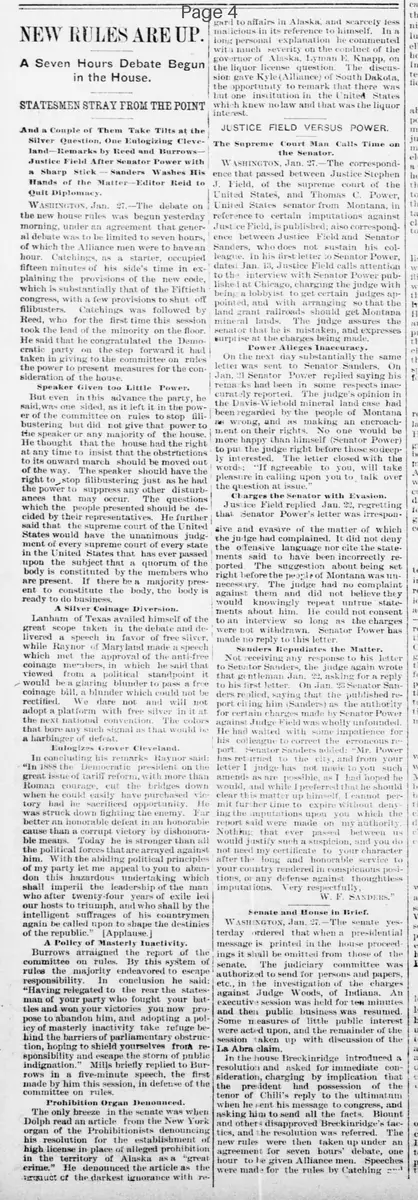
A Seven Hours Debate Begun in the House.
STATESMEN STRAY FROM THE POINT
And a Couple of Them Take Tilts at the Silver Question, One Eulogizing Cleveland—Remarks by Reed and Burrows—Justice Field After Senator Power with a Sharp Stick—Sanders Washes His Hands of the Matter—Editor Reid to Quit Diplomacy.
WASHINGTON, Jan. 26.—The debate on the new house rules was begun yesterday morning, under an agreement that general debate was to be limited to seven hours, of which the Alliance men were to have an hour. Catchings, as a starter, occupied fifteen minutes of his side's time in explaining the provisions of the new code, which is substantially that of the Fiftieth congress, with a few provisions to shut off filibusters. Catchings was followed by Reed, who for the first time this session took the lead of the minority on the floor. He said that he congratulated the Democratic party on the step forward it had taken in giving to the committee on rules the power to present measures for the consideration of the house.
Speaker Given too Little Power.
But even in this advance the party, he said, was one sided, as it left it in the power of the committee on rules to stop filibustering but did not give that power to the speaker or any majority of the house. He thought that the house had the right at any time to insist that the obstructions to its onward march should be moved out of the way. The speaker should have the right to stop filibustering just as he had the power to suppress any other disturbances that may occur. The questions which the people presented should be decided by their representatives. He further said that the supreme court of the United States would have the unanimous judgment of every supreme court of every state in the United States that has ever passed upon the subject that a quorum of the body is constituted by the members who are present. If there be a majority present to constitute the body, the body is ready to do business.
A Silver Coinage Diversion.
Lanham of Texas availed himself of the great scope taken in the debate and delivered a speech in favor of free silver, while Raynor of Maryland made a speech which met the approval of the anti-free coinage members, in which he said that viewed from a political standpoint it would be a glaring blunder to pass a free coinage bill, a blunder which could not be rectified. We dare not and will not adopt a platform with free silver in it at the next national convention. The colors that bore any such signal as that would be a harbinger of defeat.
Eulogizes Grover Cleveland.
In concluding his remarks Raynor said: "In '84 the Democratic president on the great issue of tariff reform, with more than Roman courage, cut the bridges down when he could easily have purchased victory had he sacrificed opportunity. He was struck down fighting the enemy. Far better an honorable defeat in an honorable cause than a corrupt victory by dishonorable means. Today he is stronger than all the political forces that are arrayed against him. With the abiding political principles of my party let me appeal to you to abandon this hazardous undertaking which shall imperil the leadership of the man who after twenty-four years of exile led our hosts to triumph, and who shall by the intelligent suffrages of his countrymen again be called upon to shape the destinies of the republic." [Applause.]
A Policy of Masterly Inactivity.
Burrows arraigned the report of the committee on rules. By this system of rules the majority endeavored to escape responsibility. In conclusion he said: "Having relegated to the rear the statesman of your party who fought your battles and won your victories you now propose to abandon him, and adopting a policy of masterly inactivity take refuge behind the barriers of parliamentary obstruction, hoping to shield yourselves from responsibility and escape the storm of public indignation." Mills briefly replied to Burrows in a five-minute speech, the first made by him this session, in defense of the committee on rules.
Prohibition Organ Denounced.
The only breeze in the senate was when Dolph read an article from the New York organ of the Prohibitionists denouncing his resolution for the establishment of high license in place of alleged prohibition in the territory of Alaska as a "great crime." He denounced the article as the product of the darkest ignorance with regard to affairs in Alaska, and scarcely less malicious in its reference to himself. In a long personal explanation he commented with much severity on the conduct of the governor of Alaska, Lyman E. Knapp, on the liquor license question. The discussion gave Kyle (Alliance) of South Dakota, the opportunity to remark that there was but one institution in the United States which knew no law and that was the liquor interest.
What sub-type of article is it?
What themes does it cover?
What keywords are associated?
What entities or persons were involved?
Where did it happen?
Story Details
Key Persons
Location
Washington
Event Date
Jan. 26
Story Details
House debate on new rules to limit filibusters, with speeches by Reed criticizing lack of speaker power, Lanham advocating free silver, Raynor opposing it and praising Cleveland's leadership, Burrows accusing majority of evading responsibility, and Mills defending the rules. Senate discussion where Dolph denounces Prohibitionist article on Alaska liquor licensing and criticizes Governor Knapp.