Thank you for visiting SNEWPapers!
Sign up free
Keowee Courier
Walhalla, Pickens, Oconee County, Pickens County, South Carolina
What is this article about?
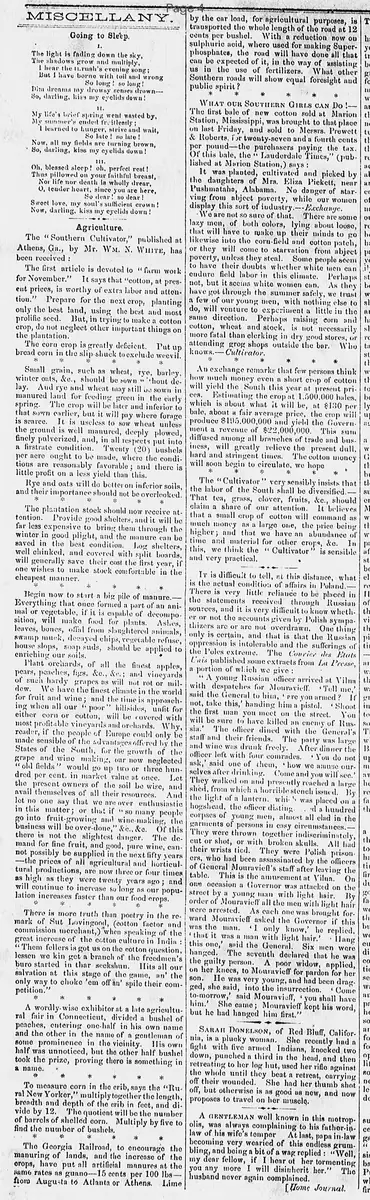
The Southern Cultivator advises on November farm work in the South: prioritize cotton on best land, store deficient corn against weevils, sow small grains promptly, care for livestock, build manure piles, and plant orchards and vineyards on poor soils for profit. Includes tips on measuring corn and Georgia Railroad fertilizer rates.
Clipping
OCR Quality
Full Text
The "Southern Cultivator," published at
Athens, Ga., by Mr. WM. N. WHITE, has
been received :
The first article is devoted to "farm work
for November." It says that "cotton, at present
prices, is worthy of extra labor and attention."
Prepare for the next crop, planting
only the best land, using the best and most
prolific seed. But, in trying to make a cotton
crop, do not neglect other important things on
the plantation.
The corn crop is greatly deficient. Put up
bread corn in the slip-shuck to exclude weevil.
Small grain, such as wheat, rye, barley,
winter oats, &c., should be sown without delay.
And rye and wheat may still be sown in
manured land for feeding green in the early
spring. The crop will be later and inferior to
that sown earlier, but it will pay where forage
is scarce. It is useless to sow wheat unless
the ground is well manured, deeply plowed,
infinitely pulverized, and, in all respects put into
a first-rate condition. Twenty (20) bushels
per acre ought to be made, where the conditions
are reasonably favorable; and there is
little profit on a less yield than this.
Rye and oats will do better on inferior soils.
and their importance should not be overlooked.
The plantation stock should now receive attention.
Provide good shelters, and it will be
far less expensive to bring them through the
winter in good plight, and the manure can be
saved in the best condition. Log shelters,
well chinked, and covered with split boards.
will generally save their cost the first year, if
one wishes to make stock comfortable in the
cheapest manner.
Begin now to start a big pile of manure.—
Everything that once formed a part of an animal
or vegetable, if it is capable of decomposition,
will make food for plants. Ashes,
leaves, bones, offal from slaughtered animals,
swamp muck, decayed chips, vegetable refuse.
house slops, soap suds, should be applied to
enriching our soils.
Plant orchards, of all the finest apples,
pears, peaches, figs, &c., &c.: and vineyards
of such hardy grapes as will not rot or mildew.
We have the finest climate in the world
for fruit and wine; and the time is approaching
when all our "poor" hillsides, unfit for
either corn or cotton, will be covered with
most profitable vineyards and orchards. Why,
reader, if the people of Europe could only be
made sensible of the advantages offered by the
States of the South, for the growth of the
grape and wine making, our now neglected
"old fields" would go up two or three hundred
per cent. in market value at once. Let
the present owners of the soil be wise, and
avail themselves of all their resources. And
let no one say that we are over enthusiastic
in this matter; or that if "so many people
go into fruit-growing and wine-making, the
business will be over-done." &c., &c. Of this
there is not the slightest danger. The demand
for fine fruit, and good, pure wine, cannot
possibly be supplied in the next fifty years
—the prices of all agricultural and horticultural
productions, are now three or four times
as high as they were twenty years ago; and
will continue to increase so long as our population
increases faster than our food crops.
There is more truth than poetry in the remark
of Sut Lovingood, (cotton factor and
commission merchant,) when speaking of the
great increase of the cotton culture in India :
"Them fellers is got us on the cotton question,
lessen we kin get a branch of the freedmen's
bureau started in thar seckshun. It's all our
salvation at this stuge of the game, an' the
only way to choke 'em off an' spile their competition."
A worldly-wise exhibitor at a late agricultural
fair in Connecticut, divided a bushel of
peaches, entering one-half in his own name
and the other in the name of a gentleman of
some prominence in the vicinity. His own
half was unnoticed, but the other half bushel
took the prize, proving there is something in
a name.
To measure corn in the crib, says the "Rural
New Yorker," multiply together the length,
breadth and depth of the crib in feet, and divide
by 12. The quotient will be the number
of barrels of shelled corn. Multiply by five to
find the number of bushels.
The Georgia Railroad, to encourage the
manuring of lands, and the increase of the
crops, have put all artificial manures at the
same rates as guano—15 cents per 100 lbs.—
from Augusta to Atlanta or Athens. Lime
by the car load, for agricultural purposes, is
transported the whole length of the road at 12
cents per bushel. With a reduction now on
sulphuric acid, where used for making Super-
phosphates, the road will have done all that
can be expected of it, in the way of assisting
us in the use of fertilizers. What other
Southern roads will show equal foresight and
public spirit?
What sub-type of article is it?
What keywords are associated?
What entities or persons were involved?
Where did it happen?
Domestic News Details
Primary Location
Southern United States
Event Date
November
Key Persons
Event Details
The Southern Cultivator provides advice on November farm activities including cotton preparation, corn storage, sowing small grains, livestock care, manure accumulation, and planting fruit orchards and vineyards. It highlights the potential for profitable fruit and wine production on poor soils, shares anecdotes on cotton competition and fair exhibitions, offers a method to measure corn, and notes Georgia Railroad's fertilizer transport rates.