Thank you for visiting SNEWPapers!
Sign up free
New York Tribune
New York, New York County, New York
What is this article about?
Biographical account of poet John Howard Payne's involvement with Cherokee leader John Ross during their 1830s forced removal from Georgia, including a captivity incident where Payne's authorship of 'Home, Sweet Home' led to their release; he later joined their migration west and left lost historical manuscripts.
Clipping
OCR Quality
Full Text
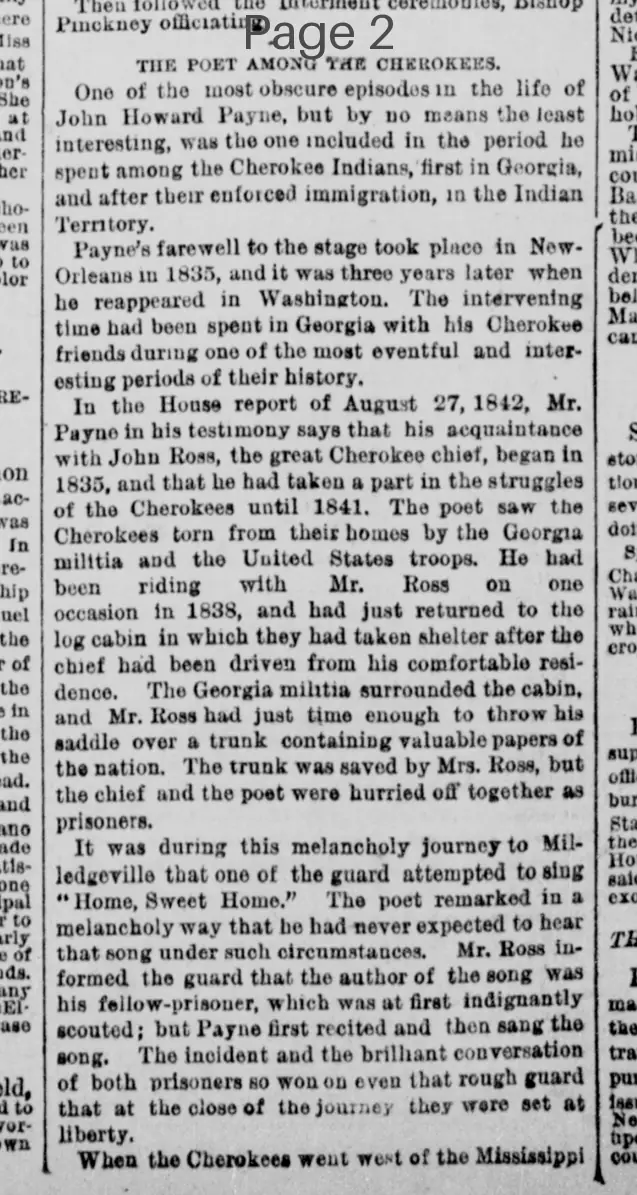
One of the most obscure episodes in the life of John Howard Payne, but by no means the least interesting, was the one included in the period he spent among the Cherokee Indians, first in Georgia, and after their enforced immigration, in the Indian Territory. Payne's farewell to the stage took place in New-Orleans in 1835, and it was three years later when he reappeared in Washington. The intervening time had been spent in Georgia with his Cherokee friends during one of the most eventful and interesting periods of their history.
In the House report of August 27, 1842, Mr. Payne in his testimony says that his acquaintance with John Ross, the great Cherokee chief, began in 1835, and that he had taken a part in the struggles of the Cherokees until 1841. The poet saw the Cherokees torn from their homes by the Georgia militia and the United States troops. He had been riding with Mr. Ross on one occasion in 1838, and had just returned to the log cabin in which they had taken shelter after the chief had been driven from his comfortable residence. The Georgia militia surrounded the cabin, and Mr. Ross had just time enough to throw his saddle over a trunk containing valuable papers of the nation. The trunk was saved by Mrs. Ross, but the chief and the poet were hurried off together as prisoners.
It was during this melancholy journey to Milledgeville that one of the guard attempted to sing "Home, Sweet Home." The poet remarked in a melancholy way that he had never expected to hear that song under such circumstances. Mr. Ross informed the guard that the author of the song was his fellow-prisoner, which was at first indignantly scouted; but Payne first recited and then sang the song. The incident and the brilliant conversation of both prisoners so won on even that rough guard that at the close of the journey they were set at liberty.
When the Cherokees went west of the Mississippi John Howard Payne went with them, and the friendship of Ross and the poet terminated only with their lives. They finally parted in New-York just before Payne started for Tunis. On his death-bed in Washington, in 1866, John Ross gave a gentleman a letter to Professor Henry, the Secretary of the Smithsonian Institution, asking for the Howard Payne manuscripts, which contained an interesting account of many of the more eventful scenes in Cherokee history. Payne had informed Ross of the existence of these manuscripts, and that they were deposited in the Smithsonian Institution, and had authorized him to obtain them. They could not be found, however, although a diligent search was made. What became of the unpublished fragments of history is an interesting question which will probably never be solved.
What sub-type of article is it?
What themes does it cover?
What keywords are associated?
What entities or persons were involved?
Where did it happen?
Story Details
Key Persons
Location
Georgia, Indian Territory, Milledgeville
Event Date
1835 1841
Story Details
John Howard Payne befriended Cherokee chief John Ross in 1835 and participated in their struggles until 1841, witnessing their forced removal from Georgia in 1838. Captured together by Georgia militia, Payne revealed himself as the author of 'Home, Sweet Home' during the journey to Milledgeville, impressing the guards and securing their release. Payne accompanied the Cherokees to Indian Territory and later documented events in manuscripts now lost.