Thank you for visiting SNEWPapers!
Sign up free
The Evening Telegraph
Philadelphia, Philadelphia County, Pennsylvania
What is this article about?
On this morning, an immense congregation gathered at Philadelphia's Catholic Cathedral for the re-interment of Bishops Michael Egan and Henry Conwell into a vault under the main altar. The event featured a pontifical requiem mass led by Bishop James F. Wood, attended by numerous bishops and clergy, and a sermon by Bishop P. N. Lynch on the solemnity and historical tradition of episcopal burials.
Clipping
OCR Quality
Full Text
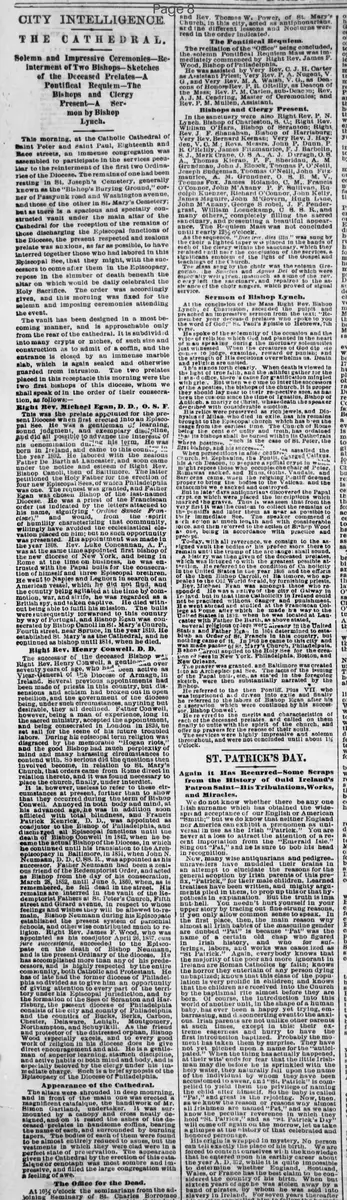
THE CATHEDRAL.
Solemn and Impressive Ceremonies--Re-Interment of Two Bishops--Sketches of the Deceased Prelates--A Pontifical Requiem--The Bishops and Clergy Present--A Sermon by Bishop Lynch.
This morning, at the Catholic Cathedral of Saints Peter and Paul, Eighteenth and Race streets, an immense congregation was assembled to participate in the services peculiar to the reinterment of the first two Ordinaries of the Diocese. The remains of one had been resting in St. Joseph's Cemetery, generally known as the "Bishop's Burying-Ground," corner of Passyunk road and Washington avenue, and those of the other in St. Mary's Cemetery; but as there is a spacious and specially constructed vault under the main altar of the Cathedral for the reception of the remains of those discharging the Episcopal functions of the Diocese, the present respected and zealous prelate was anxious, as far as possible, to have interred together those who had labored in this Episcopal See, that they might, with the successors to come after them in the Episcopacy, repose in the slumber of death beneath the altar on which would be daily celebrated the Holy Sacrifice. The order was accordingly given, and this morning was fixed for the solemn and imposing ceremonies attending the event.
The vault has been designed in a most becoming manner, and is approachable only from the rear of the cathedral. It is subdivided into many crypts or niches, of such size and construction as to admit of a coffin, and the entrance is closed by an immense marble slab, which is again sealed and otherwise guarded from intrusion. The two prelates placed in this receptacle this morning were the two first bishops of this diocese, whom we shall speak of in the order of their consecration, as follows:--
Right Rev. Michael Egan, D. D., O. S. F.
This was the prelate appointed for the present Diocese when first erected into an Episcopal See. He was a gentleman of learning, sound judgment, and exemplary discipline, and did all possible to advance the interests of the Church in Philadelphia. He was born in Ireland, and came to this country in the year 1790, and was stationed as pastor at Lancaster, under Father De Barth, and soon came under the notice and esteem of Right Rev. Bishop Carroll, then of Baltimore. In 1808, he petitioned the Holy Father for the erection of four new Episcopal Sees, of which Philadelphia was one. The request was granted, and Father Egan was appointed the first Bishop of the Diocese. He was a priest of the Franciscan order, as indicated by the letters O. S. F. attached to his name, signifying Ordine Sancti Francisci. Out of humility characterizing that community, and would, from the spirit of self-abnegation placed on him; but no such opportunity was presented. His appointment was made in the year 1808. Rev. Luke Concannon, A. P., was at the same time appointed first bishop of the new diocese of New York, and being in Rome at the time on business, he was entrusted with the Papal bulls for the consecration of himself and three Episcopal brethren. He went to Naples and Leghorn in search of an American vessel, which he did not find, and the country being agitated at the time by commotion, war, and strife, he was regarded as a British spy, and taken captive. He died without being able to fulfill his mission. The bulls were subsequently forwarded to this country by way of Portugal, and Bishop Egan was consecrated by Bishop Carroll in St. Mary's Church, Fourth street, near Spruce, in the year 1810. He established St. Mary's as the Cathedral, and he continued as bishop until 1814, when he died.
Right Rev. Henry Conwell, D. D.
Right Rev. Henry Conwell, a gentleman over seventy years who had been active as Vicar-General of the Diocese of Armagh, in Ireland. Several previous appointments had been made of priests in this country, but dissensions and schism had broken out in open rebellion, and the government of the diocese being, under such circumstances, anything but desirable, they all declined. Father Conwell, however, being a man of experience, long in the sacred ministry, accepted the appointment, and being consecrated in London in 1820, he set sail for the scene of his future troubled labors. During his episcopal term religion was disgraced by the memorable "Hogan riots," and the good Bishop had much perplexity of mind and many harassing circumstances to contend with. So serious did the questions then involved become, in relation to St. Mary's Church, that orders came from Rome direct in relation thereto, and it was found necessary to place the church, finally, under interdict. It is, however, useless to refer to these circumstances at present, further than to show that they occurred during the term of Bishop Conwell. Annoyed in both body and mind, at his advanced age, he was in addition soon afflicted with total blindness, and Francis Patrick Kenrick, D. D., was appointed as coadjutor to the Bishop of Philadelphia, and discharged all Episcopal functions until the death of Bishop Conwell in 1842, when he became the actual Bishop of the Diocese, in which he continued until his translation to the Arch-episcopacy in Baltimore, in 1851, when John N. Neumann, D. D., C. SS. R., was appointed as his successor. Father Neumann had been a zealous friend of the Redemptorist Order, and acted as Bishop from the day of his consecration, March 28, 1852, until June 5, 1860, when, as is remembered, he fell dead in the street. His remains are interred in the vault of the Redemptorist Fathers at St. Peter's Church, Fifth street and Girard avenue, in respect to whose feelings and wishes they will be allowed to remain. Bishop Neumann during his Episcopate established the present system of parochial schools, and otherwise contributed much to religion. Right Rev. James F. Wood, who was appointed as his coadjutor April 26, 1857, cum jure successionis, succeeded to the Episcopate on the death of Bishop Neumann, and is the present Ordinary of the diocese. He has accomplished more than any of his predecessors, and is highly respected by the entire community, both Catholic and Protestant. He has of late had the former diocese of Philadelphia so divided as to give him an opportunity of giving attention to every part of the territory under his Episcopal jurisdiction, and by the formation of the Sees of Scranton and Harrisburg, the present diocese of Philadelphia consists of the city and county of Philadelphia and the counties of Bucks, Berks, Carbon, Chester, Delaware, Lehigh, Montgomery, Northampton, and Schuylkill. As the friend and protector of the distressed orphan, Bishop Wood especially excels, and to every good work of religion in his diocese does he give direct encouragement and aid. He is a gentleman of superior learning, staunch discipline, and active habits both of mind and body, and is especially beloved by the clergy under his immediate charge. Such is a brief synopsis of the Episcopacy of the Diocese of Philadelphia.
Appearance of the Cathedral.
The altars were shrouded in deep mourning and in front of the main one was erected a magnificent catafalque, the handiwork of Mr. Simon Gartland, undertaker. It was surmounted by a canopy and cross neatly designed, and on it rested the ashes of the deceased prelates in handsome coffins, bearing the name of each, and surrounded by burning tapers. The bodies of each of them were found to be almost entirely reduced to ashes, but the vestments in which they were clad were in a perfect state of preservation. The appearance given the Cathedral by the erection of this catafalque or cenotaph was most sombre and impressive, and filled the large congregation with a feeling of awe.
The Office for the Dead,
Bimininary at Glen Buala Delaware county
and Rev. Thomas W. Power, of St. Mary's Church, in this city, acted as antiphonarians. And the different lessons and Nocturns were read in the order indicated.
The Pontifical Requiem.
The recitation of the "Office" being concluded, the solemn Pontifical Requiem Mass was immediately commenced by Right Rev. James F. Wood, Bishop of Philadelphia. He was assisted by Very Rev. C. J. H. Carter as Assistant Priest; Very Rev. P. A. Nugent, V. G., and Very Rev. M. A. Walsh, V. G., as Deacons of Honor; Rev. P. R. O'Reilly, as Deacon of the Mass; Rev. P. M. Carlen, sub-Deacon; Rev. A. J. M. Cendring, Master of Ceremonies; and Rev. P. M. Mullen, Assistant.
Bishops and Clergy Present.
In the sanctuary were also Right Rev. P. N. Lynch, Bishop of Charleston, S. C.; Right Rev. William O'Hara, Bishop of Scranton; Right Rev. J. F. Shanahan, Bishop of Harrisburg; Very Rev. Bernard Keenan; Very Rev. J. Hayden, V. G. M.; Revs. Messrs. John P. Dunn, P. R. O'Reilly, James Fitzmaurice, F. J. Barbelin, S. J., Mark Crane, O. S. A., A. J. Dirragh, O. S. A., Thomas Kieran, P. F. Sheridan, A. M. Grundman, John J. Elcock, Thomas P. O'Neill, Joseph Budgeman, Thomas O'Neill, John Fitzmaurice, A. M. Grundner, O. S. B. M. V., Thomas Fox, James Rolando, C. M., Francis O'Connor, John M'Anany, P. F. Sullivan, Rudolph Kuenzer, Richard O'Connor, John Kelly, James Maguire, John M'Govern, Hugh Lane, John M'Anany, George S. Robel, J. F. Pendergrast, William Loenckamp, C. S. S. R., and many others, completely filling the sacred sanctuary, and presenting a beautiful appearance. The Requiem Mass was not concluded until nearly 12 o'clock.
As the sequence, "Dies irae, dies illa," was sung by the choir a lighted taper was placed in the hands of each of the clergy within the sanctuary, which they retained until near the conclusion of the services, a significant emblem of the light of the Gospel and teachings of the Church.
The Mass sung by the choir was the solemn Gregorian, the Sanctus and Agnus Dei of which were especially well given, inasmuch as some of the clergy left the sanctuary and repaired to the assistance of the choir singers, which proved of signal service.
Sermon by Bishop Lynch.
At the conclusion of the Mass, Right Rev. Bishop Lynch, of Charleston, ascended the pulpit and preached an impressive sermon from the text: "Remember your deceased prelates who spoke to you the word of God:" St. Paul's Epistle to Hebrews, 7th verse.
He spoke of the solemnity of the occasion and the voice of religion which God had planted in the heart of man speaking during the mortuary solemnities just witnessed. When the creatures of God die death comes to judge, examine, reward or punish; and the strength of His decisions overwhelms us. Death and religion are united. This stands forth clearly. When death is viewed in the light of true faith, and the faithful gather for the last sad office, there's cause for gratification mingled with grief. But when we come to inter the successors of the Apostles, the bishops of the church, it is proper they should lay near to their respective sees, as has been the custom since the time of Ignatius, Bishop of Antioch, a martyr of Christ, whose death the speaker described with considerable emotion. His relics were preserved as rich jewels, and Dionysius of Milan, who died in exile, has his remains brought to the Episcopal church which has been the usage from the earliest time. The Church of Rome being the centre of unity and truth, has ordained that its bishops shall be buried within its Cathedrals where possible. Such is the case of St. Peter, the first bishop, and his successors. When persecutions assailed, the Christian emperors prepared a special crypt in which might repose those who occupied the chair of Peter. Rome was sacked, and Huns, Goths, Vandals, and Saracens came, when the reigning Pontiff deemed proper to bring the bodies to the Vatican, and the catacombs were sacked and destroyed. But in late days antiquarians discovered the Papal crypt, on which were placed the inscriptions which marked the graves. Thus it was seen that from the very first it was the custom to collect the remains of the pontiffs and inter them as near as possible to their immediate See. The speaker commended such custom at much length and with considerable force, and then referred to the action of Bishop Wood as one, being in accordance with practice and precept.
To-day, with all reverence, we consign to the assigned vault the bodies of his predecessors there to remain until the trump of the archangel shall sound. A history was then given of the deceased prelates, which was listened to with the greatest possible attention. He referred to the condition of Catholicity in the United States in the year 1808 and the efforts of the then Bishop Carroll, of Baltimore, who appealed to the Old World for aid, by furnishing priests. Rev. Michael Egan was amongst those who responded. He was a native of the city of Galway in Ireland, but in that time Catholicity in Ireland could not be practised without danger and punishment. He went abroad and studied at the Franciscan College at Rome, after which he made his way to the United States in 1802, when he was located at Lancaster with Father De Barth, as above stated. Several religious orders were already in the United States and Father Egan in 1801 determined to establish an Order of St. Francis in this country, but nothing came of it. In 1805 he came to this city and was made pastor of St. Mary's Church, Philadelphia. Bishop Carroll applied to the Holy See for the creation of Sees in New York, Philadelphia, Boston, and New Orleans. The prayer was granted, and Baltimore was created into an Archiepiscopal See. The facts of the issuing of the Papal bulls, etc., as stated in the foregoing sketch, were then substantially narrated by the Bishop. He referred to the then Pontiff, Pius VII., who was imprisoned and driven into exile and finally he referred to the labors of Bishop Egan after his consecration which were continued by his successor, Bishop Conwell. He referred to the merits and characteristics of each of the deceased prelates, and called on them finally to unite with the spirit of the church, and offer up prayers for the repose of their souls.
The services were highly impressive and solemn throughout, and were not concluded until about 1 o'clock.
What sub-type of article is it?
What themes does it cover?
What keywords are associated?
What entities or persons were involved?
Where did it happen?
Story Details
Key Persons
Location
Catholic Cathedral Of Saints Peter And Paul, Eighteenth And Race Streets, Philadelphia
Story Details
Solemn re-interment ceremony of the first two bishops of the Philadelphia Diocese, Michael Egan and Henry Conwell, in a vault under the cathedral's main altar. Includes biographies of the deceased prelates, descriptions of the pontifical requiem mass, attending clergy, and an impressive sermon by Bishop Lynch emphasizing the tradition of burying bishops near their sees.