Thank you for visiting SNEWPapers!
Sign up free
Letter to Editor
July 14, 1857
Mineral Point Tribune
Mineral Point, Iowa County, Wisconsin
What is this article about?
This opinion piece argues that the U.S. Constitution does not authorize or sanction slavery, refuting Chief Justice Taney's Dred Scott decision claims. It notes the absence of slavery terms, framers' intent via Madison's notes, and emphasizes personal rights over property in humans.
Clipping
OCR Quality
98%
Excellent
Full Text
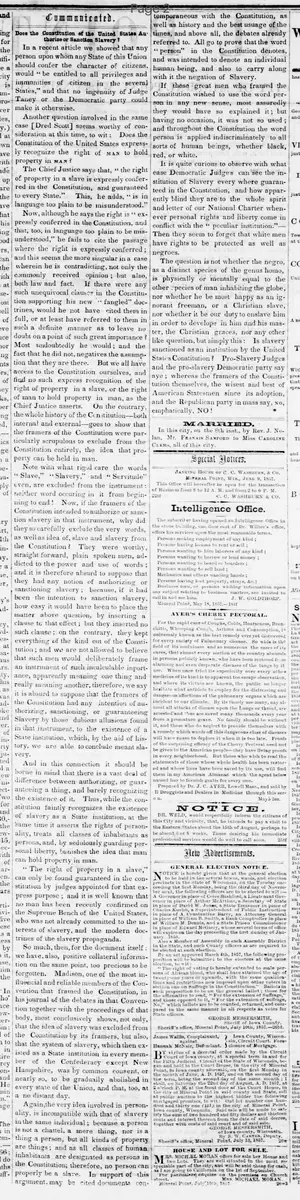
Communicated
Does the Constitution of the United States Authorize or Sanction Slavery
In a recent article we showed that any person upon whom any State of this Union should confer the character of citizens, would " be entitled to all privileges and immunities of citizen in the several States," and that no ingenuity of Judge Taney or the Democratic party could make it otherwise.
Another question involved in the same case [Dred Scott] seems worthy of consideration at this time, to wit : Does the Constitution of the United States expressly recognize the right of man to hold property in Man?
The Chief Justice says that, " the right of property in a slave is expressly conferred in the Constitution, and guaranteed to every State." This, he adds, " is in language too plain to be misunderstood."
Now, although he says the right is " expressly conferred in the Constitution, and that, too, in language too plain to be misunderstood," he fails to cite the passage where the right is expressly conferred; and this seems the more singular in a case wherein he is contradicting, not only the commonly received opinion; but also, both law and fact. If there were any such unequivocal clauses in the Constitution supporting his new " fangled" doctrines, would he not have cited them in full, or at least have referred to them in such a definite manner as to leave no doubt on a point of such great importance? Most undoubtedly he would; and the fact that he did not, negatives the assumption that they are there. But we all have access to the Constitution ourselves, and find no such express recognition of the right of property in a slave, or the right of man to hold property in man, as the Chief Justice asserts. On the contrary, the whole history of the Constitution-both internal and external-goes to show that the framers of the Constitution were particularly scrupulous to exclude from the Constitution entirely, the idea that property can be held in man.
Note with what rigid care the words " Slave," "Slavery," and "Servitude" even, are excluded from the instrument: neither word occurring in it from beginning to end! Now, if the framers of the Constitution intended to authorize or sanction slavery in that instrument, why did they so carefully exclude the very words, as well as idea of, slave and slavery from the Constitution? They were worthy, straight forward, plain spoken men, addicted to the power and use of words; and it is therefore absurd to suppose that they had any notion of authorizing or sanctioning slavery; because, if it had been the intention to sanction slavery, how easy it would have been to place the matter above question, by inserting a clause to that effect; but they inserted no such clause; on the contrary, they kept everything of the kind out of the Constitution; and we are not allowed to believe that such men would deliberately frame an instrument of such incalculable importance, apparently meaning one thing and really meaning another, therefore, we say it is absurd to suppose that the framers of the Constitution had any intention of authorizing, sanctioning, or guaranteeing Slavery by those dubious allusions found in that instrument. to the existence of a State institution. which, by the aid of history, we are able to conclude meant slavery.
And in this connection it should be borne in mind that there is a vast deal of difference between authorizing, or guaranteeing a thing, and barely recognizing the existence of it. Thus, while the constitution faintly recognizes the existence of slavery as a State institution, at the same time it asserts the rights of personality, treats all classes of inhabitants as persons, and, by sedulously guarding personal liberty, banishes the idea that man can hold property in man.
" The right of property in a slave," can only be found guaranteed in the constitution by judges appointed for that express purpose; and it is well known that no man has been recently confirmed on the Supreme Bench of the United States, who was not already committed to the interests of slavery, and the modern doctrines of the slavery propaganda.
So much, then, for the document itself : we have, also, positive collateral information on the same point, too precious to be forgotten. Madison, one of the most influential and reliable members of the Convention that framed the Constitution, in his journal of the debates in that Convention together with the proceedings of that body, most conclusively shows, not only, that the idea of slavery was excluded from the Constitution by its framers, but also, that the system of slavery. which then existed as a State institution in every member of the Confederacy except New Hampshire, was by common consent, or nearly so, to be gradually abolished in every state of the Union, and that, too, at a no distant day.
Again, the very idea involved in personality, is incompatible with that of slavery in the same individual: because a person is not a chattel, a mere thing, nor is a thing a person, but all kinds of property are things; and as all classes of human inhabitants are designated as persons in the Constitution; therefore, no person can properly be a slave. In support of this argument. may be cited documents contemporaneous with the Constitution, as well as history and the best usage of the times, and above all, the debates already referred to. All go to prove that the word " person" in the Constitution denotes, and was intended to denote an individual human being, and also to carry along with it the negation of Slavery.
If those great men who framed the Constitution wished to use the word person in any new sense, most assuredly they would have so explained it; but having no occasion, it was not so used; and throughout the Constitution the word person is applied indiscriminately to all sorts of human beings, whether black, red. or white.
It is quite curious to observe with what ease Democratic Judges can 'see the institution of Slavery guaranteed every where in the Constitution, and how apparently blind they are to the whole spirit and letter of our National Charter whenever personal rights and liberty come in conflict with the " peculiar institution." Then they seem to forget that white men have rights to be protected as well as negroes.
The question is not whether the negro, as a distinct species of the genus homo, is physically or mentally equal to the other species of man inhabiting the globe, nor whether he be most happy as an ignorant freeman, or a Christian slave. nor whether it be our duty to enslave him in order to develope in him and his master, the Christian graces, nor any other like question, but simply this: Is slavery sanctioned as an institution by the United States Constitution? Pro-Slavery Judges and the pro-slavery Democratic party say aye; whereas the framers of the Constitution themselves, the wisest and best of American Statesmen since its adoption, and the Republican party in mass say, No, emphatically, NO!
Does the Constitution of the United States Authorize or Sanction Slavery
In a recent article we showed that any person upon whom any State of this Union should confer the character of citizens, would " be entitled to all privileges and immunities of citizen in the several States," and that no ingenuity of Judge Taney or the Democratic party could make it otherwise.
Another question involved in the same case [Dred Scott] seems worthy of consideration at this time, to wit : Does the Constitution of the United States expressly recognize the right of man to hold property in Man?
The Chief Justice says that, " the right of property in a slave is expressly conferred in the Constitution, and guaranteed to every State." This, he adds, " is in language too plain to be misunderstood."
Now, although he says the right is " expressly conferred in the Constitution, and that, too, in language too plain to be misunderstood," he fails to cite the passage where the right is expressly conferred; and this seems the more singular in a case wherein he is contradicting, not only the commonly received opinion; but also, both law and fact. If there were any such unequivocal clauses in the Constitution supporting his new " fangled" doctrines, would he not have cited them in full, or at least have referred to them in such a definite manner as to leave no doubt on a point of such great importance? Most undoubtedly he would; and the fact that he did not, negatives the assumption that they are there. But we all have access to the Constitution ourselves, and find no such express recognition of the right of property in a slave, or the right of man to hold property in man, as the Chief Justice asserts. On the contrary, the whole history of the Constitution-both internal and external-goes to show that the framers of the Constitution were particularly scrupulous to exclude from the Constitution entirely, the idea that property can be held in man.
Note with what rigid care the words " Slave," "Slavery," and "Servitude" even, are excluded from the instrument: neither word occurring in it from beginning to end! Now, if the framers of the Constitution intended to authorize or sanction slavery in that instrument, why did they so carefully exclude the very words, as well as idea of, slave and slavery from the Constitution? They were worthy, straight forward, plain spoken men, addicted to the power and use of words; and it is therefore absurd to suppose that they had any notion of authorizing or sanctioning slavery; because, if it had been the intention to sanction slavery, how easy it would have been to place the matter above question, by inserting a clause to that effect; but they inserted no such clause; on the contrary, they kept everything of the kind out of the Constitution; and we are not allowed to believe that such men would deliberately frame an instrument of such incalculable importance, apparently meaning one thing and really meaning another, therefore, we say it is absurd to suppose that the framers of the Constitution had any intention of authorizing, sanctioning, or guaranteeing Slavery by those dubious allusions found in that instrument. to the existence of a State institution. which, by the aid of history, we are able to conclude meant slavery.
And in this connection it should be borne in mind that there is a vast deal of difference between authorizing, or guaranteeing a thing, and barely recognizing the existence of it. Thus, while the constitution faintly recognizes the existence of slavery as a State institution, at the same time it asserts the rights of personality, treats all classes of inhabitants as persons, and, by sedulously guarding personal liberty, banishes the idea that man can hold property in man.
" The right of property in a slave," can only be found guaranteed in the constitution by judges appointed for that express purpose; and it is well known that no man has been recently confirmed on the Supreme Bench of the United States, who was not already committed to the interests of slavery, and the modern doctrines of the slavery propaganda.
So much, then, for the document itself : we have, also, positive collateral information on the same point, too precious to be forgotten. Madison, one of the most influential and reliable members of the Convention that framed the Constitution, in his journal of the debates in that Convention together with the proceedings of that body, most conclusively shows, not only, that the idea of slavery was excluded from the Constitution by its framers, but also, that the system of slavery. which then existed as a State institution in every member of the Confederacy except New Hampshire, was by common consent, or nearly so, to be gradually abolished in every state of the Union, and that, too, at a no distant day.
Again, the very idea involved in personality, is incompatible with that of slavery in the same individual: because a person is not a chattel, a mere thing, nor is a thing a person, but all kinds of property are things; and as all classes of human inhabitants are designated as persons in the Constitution; therefore, no person can properly be a slave. In support of this argument. may be cited documents contemporaneous with the Constitution, as well as history and the best usage of the times, and above all, the debates already referred to. All go to prove that the word " person" in the Constitution denotes, and was intended to denote an individual human being, and also to carry along with it the negation of Slavery.
If those great men who framed the Constitution wished to use the word person in any new sense, most assuredly they would have so explained it; but having no occasion, it was not so used; and throughout the Constitution the word person is applied indiscriminately to all sorts of human beings, whether black, red. or white.
It is quite curious to observe with what ease Democratic Judges can 'see the institution of Slavery guaranteed every where in the Constitution, and how apparently blind they are to the whole spirit and letter of our National Charter whenever personal rights and liberty come in conflict with the " peculiar institution." Then they seem to forget that white men have rights to be protected as well as negroes.
The question is not whether the negro, as a distinct species of the genus homo, is physically or mentally equal to the other species of man inhabiting the globe, nor whether he be most happy as an ignorant freeman, or a Christian slave. nor whether it be our duty to enslave him in order to develope in him and his master, the Christian graces, nor any other like question, but simply this: Is slavery sanctioned as an institution by the United States Constitution? Pro-Slavery Judges and the pro-slavery Democratic party say aye; whereas the framers of the Constitution themselves, the wisest and best of American Statesmen since its adoption, and the Republican party in mass say, No, emphatically, NO!
What sub-type of article is it?
Persuasive
Historical
Political
What themes does it cover?
Slavery Abolition
Constitutional Rights
Politics
What keywords are associated?
Constitution
Slavery
Dred Scott
Taney
Madison
Abolition
Personal Rights
Letter to Editor Details
Main Argument
the u.s. constitution does not expressly authorize or sanction slavery, as evidenced by the exclusion of slavery terms, framers' intent documented by madison, and the emphasis on personal rights over property in humans, refuting chief justice taney's dred scott claims.
Notable Details
References Dred Scott Case And Judge Taney
Cites Madison's Journal On Constitutional Convention Debates
Highlights Absence Of Words 'Slave', 'Slavery', 'Servitude' In Constitution
Argues 'Person' Denotes Human Beings Incompatible With Slavery