Thank you for visiting SNEWPapers!
Sign up free
Editorial
November 3, 1834
Lynchburg Virginian
Lynchburg, Virginia
What is this article about?
Editorial discusses a purported London article praising Van Buren's tactics to centralize power in the US, critiques it as potential forgery but valuable for study, and warns that Jackson's absolutist actions risk turning the republic into an elective monarchy by undermining congressional and judicial checks.
Clipping
OCR Quality
95%
Excellent
Full Text
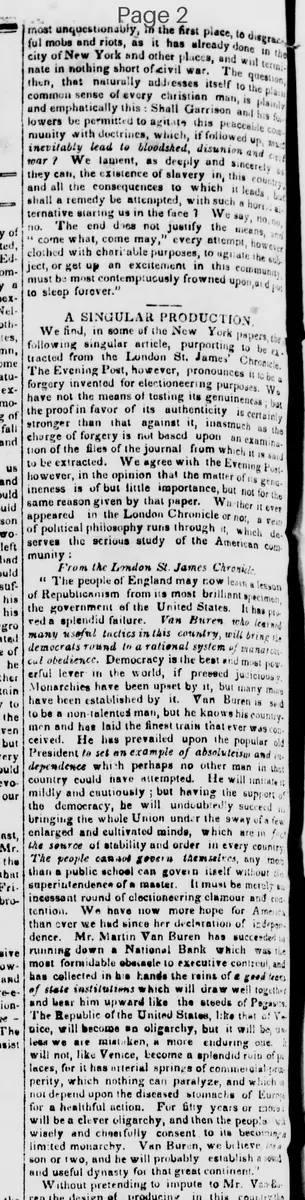
A SINGULAR PRODUCTION.
We find, in some of the New York papers, the following singular article, purporting to be extracted from the London St. James' Chronicle.
The Evening Post, however, pronounces it to be a forgery invented for electioneering purposes—We have not the means of testing its genuineness but the proof in favor of its authenticity is certainly stronger than that against it inasmuch as the charge of forgery is not based upon an inspection of the files of the journal from which it is said to be extracted. We agree with the Evening Post however in the opinion that the matter is of but little importance but not for the same reason given by that paper—Whether it appeared in the London Chronicle or not, a vein of political philosophy runs through it which serves the serious study of the American community:
From the London St. James Chronicle.
"The people of England may now learn a lesson of Republicanism from our most brilliant specimen, the government of the United States. It has produced a splendid failure. Van Buren who learned many useful tactics in this country, will bring the democrats round to a rational system of management. Democracy is the most powerful lever in the world, if pressed judiciously. Monarchies have been upset by it, but many more have been established by it. Van Buren is said to be a non-talented man, but he knows his country men and has laid the finest train that ever was conceived. He has prevailed upon the popular old President to set an example of absolutism and independence which perhaps no other man in that country could have attempted. He will imitate it mildly and cautiously; but having the support of the democracy, he will undoubtedly succeed in bringing the whole Union under the sway of a few enlarged and cultivated minds, which are in fact the source of stability and order in every country. The people cannot govern themselves, any more than a public school can govern itself without the superintendence of a master. It must be merely an incessant round of electioneering clamour and contention. We have now more hope for America than ever we had since her declaration of independence. Mr. Martin Van Buren has succeeded in running down a National Bank which was the most formidable obstacle to executive control, and has collected in his hands the reins of a good team of state institutions which will draw well together and bear him upward like the steeds of Pegasus. The Republic of the United States, like that of Venice, will become an oligarchy, but it will be, unless we are mistaken, a more enduring one. It will not, like Venice, become a splendid ruin of palaces, for it has material springs of commercial prosperity, which nothing can paralyze, and which do not depend upon the diseased stomachs of Europe for a healthful action. For fifty years or more, it will be a clever oligarchy, and then the people will wisely and cheerfully consent to its becoming a limited monarchy. Van Buren, we believe is a Mason or two, and he will probably establish a sound and useful dynasty for that great continent."
Without pretending to impute to Mr. Van Buren the design of producing in this country the changes, and the remote consequences of those changes, so boldly predicted by the London editor, we hazard nothing in asserting, that if the ideas of Executive "absolutism and independence," advanced and practically enforced by the present incumbent of the Presidential office be sanctioned and sustained by the people, our government is, to all intents and purposes, an elective monarchy," every thing but the name. What else is it, when the President takes upon himself the responsibility of disposing of the public money as he pleases, without even consulting Congress, in whose care & custody the national treasury is placed by the constitution? What else is it, when he sits in judgment on the decisions of the Supreme Court, and executes or fails to execute them, agreeably to his understanding of their constitutional bearings? What else is it, when he claims unlimited control over all the Executive offices of the country, whereby he divests their incumbents of the least shadow of responsibility for their acts, and that too without augmenting his own? And, what is it, when one of his subordinates abruptly refuses to permit an investigation, by an authorized committee of the representatives of the people, into the abuses of his department, relying for his justification upon the untenable assumption, that, for his official conduct he is responsible alone to the President and to the people—to the people, not through their representatives, be it recollected, (the only mode in which responsibility can be rendered effectual)—but to the people in their aggregate capacity, who can of course in this way neither discover his delinquencies, nor try him for their perpetration, nor punish him if he be guilty! If such be the theory of our institutions, and the rights and powers of the Chief Magistrate and his subordinates, there is no such thing as real responsibility in any part of our system, save in the representative branch. It is all a delusion and a cheat.
It is the duty, then, as well as the highest interest of the American people to look well to the consequences of permitting their personal predilections for any man, however great may have been his services to the Republic, to blind them to the necessary and infallible results of his political doctrines. The blossom may be beautiful to the eye, but the fruit will be poisonous to the touch.
We find, in some of the New York papers, the following singular article, purporting to be extracted from the London St. James' Chronicle.
The Evening Post, however, pronounces it to be a forgery invented for electioneering purposes—We have not the means of testing its genuineness but the proof in favor of its authenticity is certainly stronger than that against it inasmuch as the charge of forgery is not based upon an inspection of the files of the journal from which it is said to be extracted. We agree with the Evening Post however in the opinion that the matter is of but little importance but not for the same reason given by that paper—Whether it appeared in the London Chronicle or not, a vein of political philosophy runs through it which serves the serious study of the American community:
From the London St. James Chronicle.
"The people of England may now learn a lesson of Republicanism from our most brilliant specimen, the government of the United States. It has produced a splendid failure. Van Buren who learned many useful tactics in this country, will bring the democrats round to a rational system of management. Democracy is the most powerful lever in the world, if pressed judiciously. Monarchies have been upset by it, but many more have been established by it. Van Buren is said to be a non-talented man, but he knows his country men and has laid the finest train that ever was conceived. He has prevailed upon the popular old President to set an example of absolutism and independence which perhaps no other man in that country could have attempted. He will imitate it mildly and cautiously; but having the support of the democracy, he will undoubtedly succeed in bringing the whole Union under the sway of a few enlarged and cultivated minds, which are in fact the source of stability and order in every country. The people cannot govern themselves, any more than a public school can govern itself without the superintendence of a master. It must be merely an incessant round of electioneering clamour and contention. We have now more hope for America than ever we had since her declaration of independence. Mr. Martin Van Buren has succeeded in running down a National Bank which was the most formidable obstacle to executive control, and has collected in his hands the reins of a good team of state institutions which will draw well together and bear him upward like the steeds of Pegasus. The Republic of the United States, like that of Venice, will become an oligarchy, but it will be, unless we are mistaken, a more enduring one. It will not, like Venice, become a splendid ruin of palaces, for it has material springs of commercial prosperity, which nothing can paralyze, and which do not depend upon the diseased stomachs of Europe for a healthful action. For fifty years or more, it will be a clever oligarchy, and then the people will wisely and cheerfully consent to its becoming a limited monarchy. Van Buren, we believe is a Mason or two, and he will probably establish a sound and useful dynasty for that great continent."
Without pretending to impute to Mr. Van Buren the design of producing in this country the changes, and the remote consequences of those changes, so boldly predicted by the London editor, we hazard nothing in asserting, that if the ideas of Executive "absolutism and independence," advanced and practically enforced by the present incumbent of the Presidential office be sanctioned and sustained by the people, our government is, to all intents and purposes, an elective monarchy," every thing but the name. What else is it, when the President takes upon himself the responsibility of disposing of the public money as he pleases, without even consulting Congress, in whose care & custody the national treasury is placed by the constitution? What else is it, when he sits in judgment on the decisions of the Supreme Court, and executes or fails to execute them, agreeably to his understanding of their constitutional bearings? What else is it, when he claims unlimited control over all the Executive offices of the country, whereby he divests their incumbents of the least shadow of responsibility for their acts, and that too without augmenting his own? And, what is it, when one of his subordinates abruptly refuses to permit an investigation, by an authorized committee of the representatives of the people, into the abuses of his department, relying for his justification upon the untenable assumption, that, for his official conduct he is responsible alone to the President and to the people—to the people, not through their representatives, be it recollected, (the only mode in which responsibility can be rendered effectual)—but to the people in their aggregate capacity, who can of course in this way neither discover his delinquencies, nor try him for their perpetration, nor punish him if he be guilty! If such be the theory of our institutions, and the rights and powers of the Chief Magistrate and his subordinates, there is no such thing as real responsibility in any part of our system, save in the representative branch. It is all a delusion and a cheat.
It is the duty, then, as well as the highest interest of the American people to look well to the consequences of permitting their personal predilections for any man, however great may have been his services to the Republic, to blind them to the necessary and infallible results of his political doctrines. The blossom may be beautiful to the eye, but the fruit will be poisonous to the touch.
What sub-type of article is it?
Constitutional
Partisan Politics
What keywords are associated?
Executive Absolutism
Elective Monarchy
Van Buren
Jackson
National Bank
Democracy
Political Philosophy
What entities or persons were involved?
Martin Van Buren
President Jackson
London St. James Chronicle
Evening Post
Supreme Court
Congress
Editorial Details
Primary Topic
Critique Of Executive Absolutism And Warnings Against Elective Monarchy
Stance / Tone
Cautionary And Critical Of Presidential Overreach
Key Figures
Martin Van Buren
President Jackson
London St. James Chronicle
Evening Post
Supreme Court
Congress
Key Arguments
President's Disposal Of Public Money Without Consulting Congress Violates Constitution
President Judges And Selectively Executes Supreme Court Decisions
Unlimited Presidential Control Over Executive Offices Removes Responsibility From Officials
Subordinates Refuse Investigations By Claiming Responsibility Only To President And People Directly
Permitting Personal Predilections To Blind People To Political Doctrines' Results Endangers Republican Government