Thank you for visiting SNEWPapers!
Sign up free
The Daily News Of The Virgin Islands
Charlotte Amalie, Saint Thomas County, Virgin Islands
What is this article about?
Article explains reasons why mature fruit trees fail to bear fruit, including flower types, pollination issues, overcrowding, poor spacing, water competition from weeds, and scale insect infestations. Recommends proper spacing for trees like avocados, mangos, citrus, and coconuts, and insect control in St. Croix and St. Thomas.
Merged-components note: Merged continuation of fruit trees agriculture story from page 5 to page 6.
Clippings
1 of 2
OCR Quality
Full Text
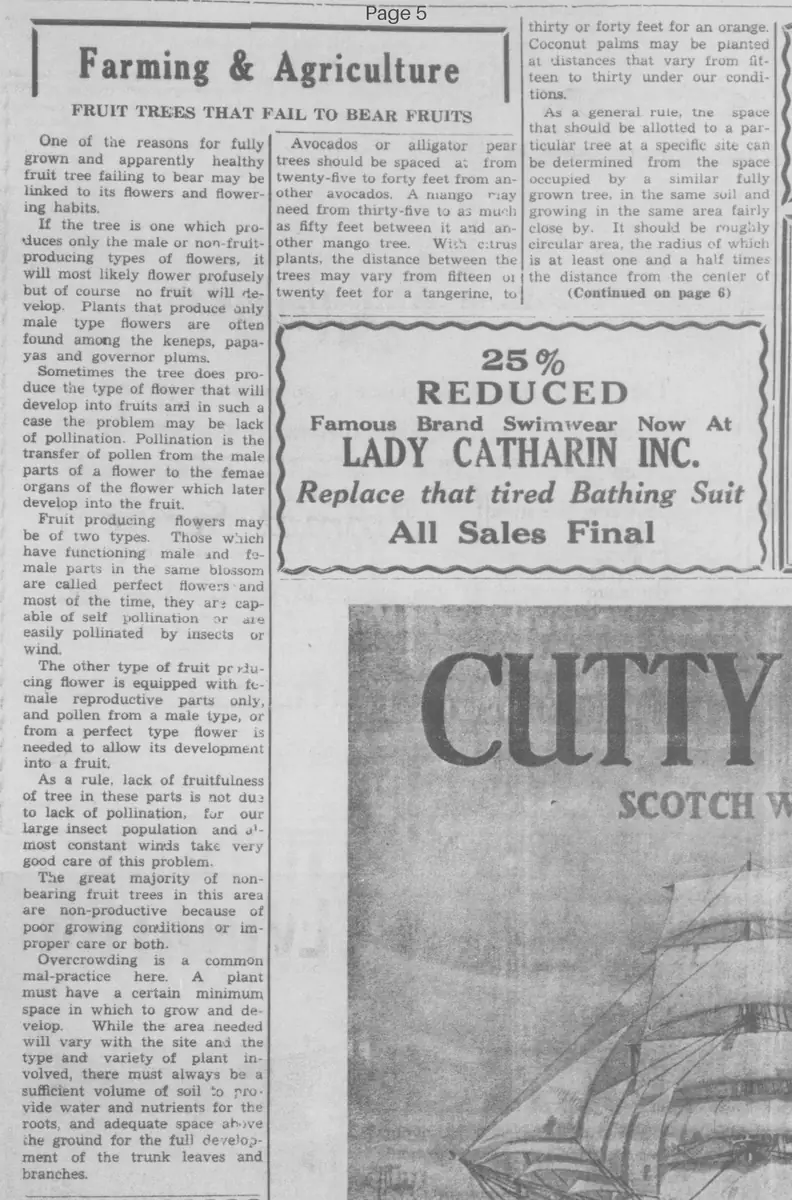
FRUIT TREES THAT FAIL TO BEAR FRUITS
One of the reasons for fully grown and apparently healthy fruit tree failing to bear may be linked to its flowers and flowering habits.
If the tree is one which produces only the male or non-fruit-producing types of flowers, it will most likely flower profusely but of course no fruit will develop. Plants that produce only male type flowers are often found among the keneps, papayas and governor plums.
Sometimes the tree does produce the type of flower that will develop into fruits and in such a case the problem may be lack of pollination. Pollination is the transfer of pollen from the male parts of a flower to the female organs of the flower which later develop into the fruit.
Fruit producing flowers may be of two types.
Those which have functioning male and female parts in the same blossom are called perfect flowers and most of the time, they are capable of self pollination or are easily pollinated by insects or wind.
The other type of fruit producing flower is equipped with female reproductive parts only, and pollen from a male type, or from a perfect type flower is needed to allow its development into a fruit.
As a rule, lack of fruitfulness of tree in these parts is not due to lack of pollination, for our large insect population and almost constant winds take very good care of this problem.
The great majority of non-bearing fruit trees in this area are non-productive because of poor growing conditions or improper care or both.
Overcrowding is a common mal-practice here. A plant must have a certain minimum space in which to grow and develop.
While the area needed will vary with the site and the type and variety of plant involved, there must always be a sufficient volume of soil to provide water and nutrients for the roots, and adequate space above the ground for the full development of the trunk, leaves and branches.
Avocados or alligator pear trees should be spaced at from twenty-five to forty feet from another avocados.
A mango may need from thirty-five to as much as fifty feet between it and another mango tree. With citrus plants, the distance between the trees may vary from fifteen or twenty feet for a tangerine, to thirty or forty feet for an orange.
Coconut palms may be planted at distances that vary from fifteen to thirty under our conditions.
As a general rule, the space that should be allotted to a particular tree at a specific site can be determined from the space occupied by a similar fully grown tree, in the same soil and growing in the same area fairly close by.
It should be roughly circular area, the radius of which is at least one and a half times the distance from the center of (Continued on page 6)
(Continued from page 5)
the mature tree to the outer fringe of the longest branches.
A healthy normal tree will entirely fill the soil area underneath its branches with feeding roots and most trees send out feeding roots much farther than this, especially if the soil is shallow.
If an unfruitful tree has enough space and has no pollination problems it may be suffering from lack of sufficient water to grow and mature a crop of fruit. A heavy growth of grass and weeds could easily rob a tree of the water it needed for a crop. Any plant or plants growing within the area of soil in which the roots of a tree are feeding will use up moisture and nutrient that should go to the tree.
A tree that is covered with a sooty-black deposit on the leaves and stems is certain to be heavily infested with scale insects. These scale insects or "lice", as they are sometimes called here, are seen as little brown, green or grayish white spots on the under sides of the leaves and stems. The black "soot" is a harmless fungus that grows in a substance given off by the scales. The scales directly damage the tree by sucking the sap.
Insecticides to control these scale insects may be obtained in both towns of St. Croix and from the insular agricultural station in St. Thomas. Control of the scale insects eliminates the fungus and gives the tree a better chance to produce a crop.
What sub-type of article is it?
What keywords are associated?
Where did it happen?
Story Details
Location
St. Croix And St. Thomas
Story Details
Explains causes of fruit trees not bearing: male-only flowers in keneps, papayas, governor plums; pollination needs for perfect and female flowers; rare in area due to insects and wind; mainly poor conditions like overcrowding, improper spacing (avocados 25-40 ft, mangos 35-50 ft, citrus 15-40 ft, coconuts 15-30 ft), water competition from weeds, scale insects causing sooty mold; recommends insecticides from local sources.