Thank you for visiting SNEWPapers!
Sign up free
Letter to Editor
December 31, 1842
Republican Herald
Providence, Providence County, Rhode Island
What is this article about?
William Ennis publicly refutes accusations from the Journal editor, defending his support for President Tyler's caution during Rhode Island's Dorr Rebellion, his advocacy for suffrage reform and equal representation, and his participation in Democratic conventions, emphasizing principled actions over personal gain.
Clipping
OCR Quality
98%
Excellent
Full Text
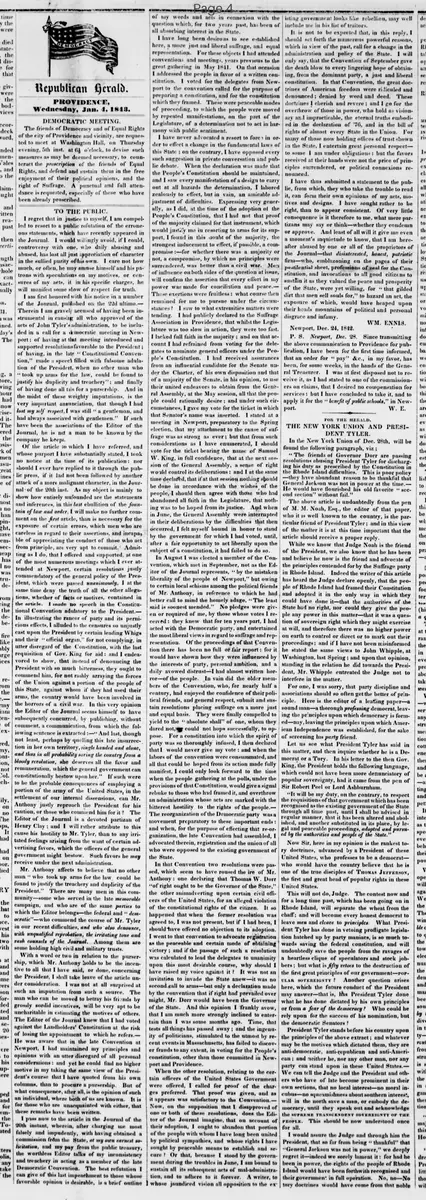
TO THE PUBLIC
I regret that in justice to myself, I am compelled to resort to a public refutation of the erroneous statements, which have recently appeared in the Journal. I would willingly avoid, if I could, controversy with one, who daily abusing and abused, has lost all just appreciation of character in the sullied purity of his own. I care not how much, or often, he may amuse himself and his patrons with speculations on my motives, or censures of my acts, if in his specific charges, he will manifest some show of respect for truth.
I am first honored with his notice in a number of the Journal, published on the 22d ultimo.—Therein I am gravely accused of having been instrumental in causing all who approved of the acts of John Tyler's administration, to be included in a call for a democratic meeting in Newport; of having at that meeting introduced and supported resolutions favorable to the President; of having, in the late "Constitutional Convention," made a speech filled with fulsome adulation of the President, when no other man who "took up arms for the law, could be found to justify his duplicity and treachery"; and finally of having done all this for a pursership. And in the midst of these weighty imputations, is the very important annunciation, that though I had lost my self-respect, I was still "a gentleman, and had always associated with gentlemen." If such have been the associations of the Editor of the Journal, he is not a man to be known by the company he keeps.
Of the article to which I have referred, and whose purport I have substantially stated, I took no notice at the time of its publication: nor should I ever have replied to it through the public press, if it had not been followed by another attack of a more malignant character, in the Journal of the 20th inst. As my object is mainly to show how entirely unfounded are the statements and inferences, in this last ebullition of the fountain of law and order, I will make no further comment on the first article, than is necessary for the exposure of certain errors, which men who are careless in regard to their assertions, and incapable of appreciating the conduct of those who act from principle, are very apt to commit. Admitting as I do, that I offered and supported, at one of the most numerous meetings which I ever attended at Newport, certain resolutions justly commendatory of the general policy of the President, which were passed unanimously, I at the same time deny the truth of all the other allegations, whether of facts or motives, contained in the article. I made no speech in the Constitutional Convention adulatory to the President.— In illustrating the rancor of party and its pernicious effects, I alluded to the censures so unjustly cast upon the President by certain leading Whigs and their "official organ," for not complying, in utter disregard of the Constitution, with the last requisition of Gov. King for aid: and I endeavored to show, that instead of denouncing the President with so much bitterness, they ought to commend him, for not rashly arraying the forces of the Union against a portion of the people of this State, against whom if they had used their arms, the country would have been involved in the horrors of a civil war. In this very opinion the Editor of the Journal seems himself to have subsequently concurred, by publishing, without comment, a communication, from which the following sentence is extracted: "And last, though not least, perhaps by quelling this late insurrection in her own territory, single handed and alone, and thus in all probability saving the country from a bloody revolution, she deserves all the favor and remuneration, which the general government can constitutionally bestow upon her." If such were to be the probable consequences of employing a portion of the army of the United States, in the settlement of our internal dissensions, can Mr. Anthony justly reproach the President for his caution, or those who commend him for it? The Editor of the Journal is a devoted partizan of Henry Clay; and I will rather attribute to this cause his hostility to Mr. Tyler, than to any irritated feelings arising from the want of certain advertising favors, which the officers of the general government might bestow. Such favors he may receive under the next administration.
Mr. Anthony affects to believe that no other man "who took up arms for the law could be found to justify the treachery and duplicity of the President." There are many men in this community—some who served in the late memorable campaign, and who are of the same parties to which the Editor belongs—the federal and "democratic"—who commend the course of Mr. Tyler in our recent difficulties, and who also denounce, with unqualified reprobation, the irritating tone and rash counsels of the Journal. Among them are some holding high civil and military trusts.
With a word or two in relation to the pursership, which Mr. Anthony holds to be the incentive to all that I have said, or done, concerning the President. I shall take leave of the article under consideration. I was not at all surprised at such an imputation from such a source. The man who can be moved to betray his friends by grossly sordid incentives, will be very apt to be uncharitable in estimating the motives of others.
The Editor of the Journal knew that I had voted against the Landholders' Constitution at the risk of losing the appointment to which he refers.— He was aware that in the late Convention at Newport, I had maintained my principles and opinions with an utter disregard of all personal considerations: and yet he could find no higher motive in my taking the same view of the President's course that I have quoted from his own columns, than to procure a pursership. But of what consequence, after all, is the opinion of such an individual, where both of us are known. It is for those who are unacquainted with either, that these remarks have been written.
I pass now to the article in the Journal of the 20th instant, wherein, after charging me most falsely and impudently, with having obtained a commission from the State, at my own earnest solicitation, and my pay from the public treasury, the worthless Editor talks of my inconsistency and treachery in acting as a member of the late Democratic Convention. The best refutation I can give of this last impeachment to those whose favorable opinion is desirable, is a brief outline of my words and acts in connexion with the question which, for two years past, has been of all absorbing interest in the State.
I have long been desirous to see established here, a more just and liberal suffrage, and equal representation. For these objects I had attended conventions and meetings, years previous to the great gathering in May 1841. On that occasion I addressed the people in favor of a written constitution. I voted for the delegates from Newport to the convention called for the purpose of preparing a constitution, and for the constitution which they framed. These were peaceable modes of proceeding, to which the people were moved by repeated manifestations, on the part of the Legislature, of a determination not to act in harmony with public sentiment.
I have never advocated a resort to force; in order to effect a change in the fundamental laws of this State; on the contrary, I have opposed every such suggestion in private conversation and public debate. When the declaration was made that the People's Constitution should be maintained and I saw every manifestation of a design to carry out at all hazards the determination. I labored zealously to effect, but in vain, an amicable adjustment of difficulties. Expressing very generally, as I did, at the time of the adoption of the People's Constitution, that I had not that proof of the majority claimed for that instrument, which would justify me in resorting to arms for its support, I found in this doubt of the majority, the strongest inducement to effect, if possible, a compromise:—for whether there was a majority or not, a compromise, by which no principles were surrendered, was better than a civil war. Men of influence on both sides of the question at issue, will confirm the assertion that every effort in my power was made for conciliation and peace.—
These exertions were fruitless: what course then remained for me to pursue under the circumstances? I saw to what extremities matters were tending. I had publicly declared to the Suffrage Association in Providence, that whilst the Legislature was too slow in action, they were too fast I lacked full faith in the majority: and on that account I had refrained from voting for the delegates to nominate general officers under the People's Constitution. I had received assurances from an influential candidate for the Senate under the Charter, of his own disposition and that of a majority of the Senate, in his opinion, to use their united endeavors to obtain from the General Assembly, at the May session, all that the people could rationally desire: and under such circumstances, I gave my vote for the ticket in which that Senator's name was inserted. I stated at a meeting in Newport, preparatory to the Spring election, that my attachment to the cause of suffrage was as strong as ever; but that from such considerations as I have enumerated, I should vote for the ticket bearing the name of Samuel W. King, in full confidence, that at the next session of the General Assembly, a sense of right would control its deliberations: and I at the same time declared, that if at that session nothing should be done in accordance with the wishes of the people,—I should then agree with those who had abandoned all faith in the Legislature, that nothing was to be hoped from its justice. And when in June, the General Assembly were interrupted in their deliberations by the difficulties that then occurred. I felt myself bound in honor to stand by the government for which I had voted, until, after a fair opportunity to act liberally upon the subject of a constitution, it had failed to do so.
In August I was elected a member of the Convention, which met in September, not as the Editor of the Journal represents, "by the mistaken liberality of the people of Newport," but owing to certain local schisms among the political friends of Mr. Anthony, in reference to which he had better call to mind the homely adage, "The least said is soonest mended." No pledges were given or required of me, by those whose votes I received: they knew that for ten years past, I had acted with the Democratic party, and entertained the most liberal views in regard to suffrage and representation. Of the proceedings of that Convention there has been no full or fair report: for it would have shown how they were influenced by the interests of party, personal ambition, and a daily avowed distrust—I had almost written horror—of the people. In vain did the older members of the Convention, who, for nearly half a century, had enjoyed the confidence of their political friends, and general respect, submit and sustain resolutions placing suffrage on a more just and equal basis. They were finally compelled to yield to the "absolute shall" of one, whom they dared not, or could not hope successfully, to oppose. For a constitution into which the spirit of party was so thoroughly infused, I then declared that I would never give my vote: and when the labors of the convention were consummated, and all that could be hoped from its action made fully manifest. I could only look forward to the time when the people gathering at the polls, under the provisions of that Constitution, would give a signal rebuke to those who had framed it, and overthrow an administration whose acts are marked with the bitterest hostility to the rights of the people.—
The reorganization of the Democratic party was a movement preparatory to these important ends: and when, for the purpose of effecting that re-organization, the late Convention had assembled, I advocated therein, registration and the union of all who were opposed to the existing government of the State.
In that Convention two resolutions were passed, which seem to have roused the ire of Mr. Anthony: one declaring that Thomas W. Dorr "of right ought to be the Governor of the State." the other animadverting upon certain civil officers of the United States, for an alleged violation of the constitutional rights of the citizen. It so happened that when the former resolution was agreed to. I was not present. but if I had been. I should have offered no objection to its adoption. I went to that convention to advocate registration as the peaceable and certain mode of obtaining victory; and if the passage of such a resolution was calculated to lead the delegates to unanimity upon this most desirable course, why should I have raised my voice against it? It was not an invitation to invade the State anew—it was no second call to arms—but only a declaration made by the convention that if right had prevailed over might, Mr. Dorr would have been the Governor of the State. And this opinion I frankly avow, that I am much more strongly inclined to entertain than I was some months ago. Time, that tests all things has passed away; and the ingenuity of politicians, stimulated to the utmost by recent events in Massachusetts, has failed to discover frauds to any extent, in voting for the People's constitution, other than those committed in Newport and Providence.
When the other resolution, relating to the certain officers of the United States Government were offered, I called for proof of the charges preferred. That proof was given, and as it appears was satisfactory to the Convention.— Now, on the supposition that I disapproved of one or both of these resolutions, does the Editor of the Journal imagine, that on account of their adoption, I ought to abandon that portion of the people with whom I have long been united by political sympathies, and whose rights I have sought by peaceable means to establish and secure? Or that, because I stood by the government during the troubles in June, I am bound to sustain all its subsequent acts of mal-administration, and to adhere to it forever. A writer, to whose jaundiced vision all opposition to the existing government looks like rebellion, may well include me in his list of traitors.
It is not to be expected that, in this reply, I should set forth the numerous powerful reasons, which in view of the past, call for a change in the administration and policy of the State. I will only say, that the Convention of September gave the death blow to every lingering hope of obtaining, from the dominant party, a just and liberal constitution. In that Convention, the great doctrines of American freedom were ridiculed and denounced; denied by word and deed. These doctrines I cherish and revere; and I go for the overthrow of those in power, who hold as visionary and impracticable, the eternal truths embodied in the declaration of '76, and in the bill of rights of almost every State in the Union. For many of those now holding offices of trust shown in the State, I entertain great personal respect—to some I am under obligations: but the favors received at their hands were not the price of principles surrendered, or political connexions renounced.
I have thus submitted a statement to the public, from which, they who take the trouble to read it, can form their own opinions of my acts, motives and designs. I have sought rather to be right, than to appear consistent. Of very little consequence is it therefore to me, what mere partizans may say or think—whether they condemn or approve. And least of all will it give me even a moment's inquietude to know, that I am hereafter abused by one or all of the proprietors of the Journal—that disinterested, honest, patriotic firm—who, emblazoning on the pages of their pestilential sheet, professions of zeal for the Constitution, and invocations to all good citizens to sustain it as they valued the peace and prosperity of the State, were yet willing, for "that gilded dirt that men sell souls for," to hazard an act, the exposure of which, would have heaped upon their heads mountains of political and personal disgrace and infamy.
WM. ENNIS.
Newport, Dec. 24, 1842
P. S. Newport, Dec. 28. Since transmitting the above communication to Providence for publication, I have been for the first time informed, that an order for "pay" &c., in my favor, has been, for some weeks, in the hands of the General Treasurer. I was at first disposed not to receive it, as I had stated to one of the commissioners on claims, that I desired no compensation for services: but I have concluded to take it, and to apply it for the "benefit of public schools," in Newport.
W. E.
I regret that in justice to myself, I am compelled to resort to a public refutation of the erroneous statements, which have recently appeared in the Journal. I would willingly avoid, if I could, controversy with one, who daily abusing and abused, has lost all just appreciation of character in the sullied purity of his own. I care not how much, or often, he may amuse himself and his patrons with speculations on my motives, or censures of my acts, if in his specific charges, he will manifest some show of respect for truth.
I am first honored with his notice in a number of the Journal, published on the 22d ultimo.—Therein I am gravely accused of having been instrumental in causing all who approved of the acts of John Tyler's administration, to be included in a call for a democratic meeting in Newport; of having at that meeting introduced and supported resolutions favorable to the President; of having, in the late "Constitutional Convention," made a speech filled with fulsome adulation of the President, when no other man who "took up arms for the law, could be found to justify his duplicity and treachery"; and finally of having done all this for a pursership. And in the midst of these weighty imputations, is the very important annunciation, that though I had lost my self-respect, I was still "a gentleman, and had always associated with gentlemen." If such have been the associations of the Editor of the Journal, he is not a man to be known by the company he keeps.
Of the article to which I have referred, and whose purport I have substantially stated, I took no notice at the time of its publication: nor should I ever have replied to it through the public press, if it had not been followed by another attack of a more malignant character, in the Journal of the 20th inst. As my object is mainly to show how entirely unfounded are the statements and inferences, in this last ebullition of the fountain of law and order, I will make no further comment on the first article, than is necessary for the exposure of certain errors, which men who are careless in regard to their assertions, and incapable of appreciating the conduct of those who act from principle, are very apt to commit. Admitting as I do, that I offered and supported, at one of the most numerous meetings which I ever attended at Newport, certain resolutions justly commendatory of the general policy of the President, which were passed unanimously, I at the same time deny the truth of all the other allegations, whether of facts or motives, contained in the article. I made no speech in the Constitutional Convention adulatory to the President.— In illustrating the rancor of party and its pernicious effects, I alluded to the censures so unjustly cast upon the President by certain leading Whigs and their "official organ," for not complying, in utter disregard of the Constitution, with the last requisition of Gov. King for aid: and I endeavored to show, that instead of denouncing the President with so much bitterness, they ought to commend him, for not rashly arraying the forces of the Union against a portion of the people of this State, against whom if they had used their arms, the country would have been involved in the horrors of a civil war. In this very opinion the Editor of the Journal seems himself to have subsequently concurred, by publishing, without comment, a communication, from which the following sentence is extracted: "And last, though not least, perhaps by quelling this late insurrection in her own territory, single handed and alone, and thus in all probability saving the country from a bloody revolution, she deserves all the favor and remuneration, which the general government can constitutionally bestow upon her." If such were to be the probable consequences of employing a portion of the army of the United States, in the settlement of our internal dissensions, can Mr. Anthony justly reproach the President for his caution, or those who commend him for it? The Editor of the Journal is a devoted partizan of Henry Clay; and I will rather attribute to this cause his hostility to Mr. Tyler, than to any irritated feelings arising from the want of certain advertising favors, which the officers of the general government might bestow. Such favors he may receive under the next administration.
Mr. Anthony affects to believe that no other man "who took up arms for the law could be found to justify the treachery and duplicity of the President." There are many men in this community—some who served in the late memorable campaign, and who are of the same parties to which the Editor belongs—the federal and "democratic"—who commend the course of Mr. Tyler in our recent difficulties, and who also denounce, with unqualified reprobation, the irritating tone and rash counsels of the Journal. Among them are some holding high civil and military trusts.
With a word or two in relation to the pursership, which Mr. Anthony holds to be the incentive to all that I have said, or done, concerning the President. I shall take leave of the article under consideration. I was not at all surprised at such an imputation from such a source. The man who can be moved to betray his friends by grossly sordid incentives, will be very apt to be uncharitable in estimating the motives of others.
The Editor of the Journal knew that I had voted against the Landholders' Constitution at the risk of losing the appointment to which he refers.— He was aware that in the late Convention at Newport, I had maintained my principles and opinions with an utter disregard of all personal considerations: and yet he could find no higher motive in my taking the same view of the President's course that I have quoted from his own columns, than to procure a pursership. But of what consequence, after all, is the opinion of such an individual, where both of us are known. It is for those who are unacquainted with either, that these remarks have been written.
I pass now to the article in the Journal of the 20th instant, wherein, after charging me most falsely and impudently, with having obtained a commission from the State, at my own earnest solicitation, and my pay from the public treasury, the worthless Editor talks of my inconsistency and treachery in acting as a member of the late Democratic Convention. The best refutation I can give of this last impeachment to those whose favorable opinion is desirable, is a brief outline of my words and acts in connexion with the question which, for two years past, has been of all absorbing interest in the State.
I have long been desirous to see established here, a more just and liberal suffrage, and equal representation. For these objects I had attended conventions and meetings, years previous to the great gathering in May 1841. On that occasion I addressed the people in favor of a written constitution. I voted for the delegates from Newport to the convention called for the purpose of preparing a constitution, and for the constitution which they framed. These were peaceable modes of proceeding, to which the people were moved by repeated manifestations, on the part of the Legislature, of a determination not to act in harmony with public sentiment.
I have never advocated a resort to force; in order to effect a change in the fundamental laws of this State; on the contrary, I have opposed every such suggestion in private conversation and public debate. When the declaration was made that the People's Constitution should be maintained and I saw every manifestation of a design to carry out at all hazards the determination. I labored zealously to effect, but in vain, an amicable adjustment of difficulties. Expressing very generally, as I did, at the time of the adoption of the People's Constitution, that I had not that proof of the majority claimed for that instrument, which would justify me in resorting to arms for its support, I found in this doubt of the majority, the strongest inducement to effect, if possible, a compromise:—for whether there was a majority or not, a compromise, by which no principles were surrendered, was better than a civil war. Men of influence on both sides of the question at issue, will confirm the assertion that every effort in my power was made for conciliation and peace.—
These exertions were fruitless: what course then remained for me to pursue under the circumstances? I saw to what extremities matters were tending. I had publicly declared to the Suffrage Association in Providence, that whilst the Legislature was too slow in action, they were too fast I lacked full faith in the majority: and on that account I had refrained from voting for the delegates to nominate general officers under the People's Constitution. I had received assurances from an influential candidate for the Senate under the Charter, of his own disposition and that of a majority of the Senate, in his opinion, to use their united endeavors to obtain from the General Assembly, at the May session, all that the people could rationally desire: and under such circumstances, I gave my vote for the ticket in which that Senator's name was inserted. I stated at a meeting in Newport, preparatory to the Spring election, that my attachment to the cause of suffrage was as strong as ever; but that from such considerations as I have enumerated, I should vote for the ticket bearing the name of Samuel W. King, in full confidence, that at the next session of the General Assembly, a sense of right would control its deliberations: and I at the same time declared, that if at that session nothing should be done in accordance with the wishes of the people,—I should then agree with those who had abandoned all faith in the Legislature, that nothing was to be hoped from its justice. And when in June, the General Assembly were interrupted in their deliberations by the difficulties that then occurred. I felt myself bound in honor to stand by the government for which I had voted, until, after a fair opportunity to act liberally upon the subject of a constitution, it had failed to do so.
In August I was elected a member of the Convention, which met in September, not as the Editor of the Journal represents, "by the mistaken liberality of the people of Newport," but owing to certain local schisms among the political friends of Mr. Anthony, in reference to which he had better call to mind the homely adage, "The least said is soonest mended." No pledges were given or required of me, by those whose votes I received: they knew that for ten years past, I had acted with the Democratic party, and entertained the most liberal views in regard to suffrage and representation. Of the proceedings of that Convention there has been no full or fair report: for it would have shown how they were influenced by the interests of party, personal ambition, and a daily avowed distrust—I had almost written horror—of the people. In vain did the older members of the Convention, who, for nearly half a century, had enjoyed the confidence of their political friends, and general respect, submit and sustain resolutions placing suffrage on a more just and equal basis. They were finally compelled to yield to the "absolute shall" of one, whom they dared not, or could not hope successfully, to oppose. For a constitution into which the spirit of party was so thoroughly infused, I then declared that I would never give my vote: and when the labors of the convention were consummated, and all that could be hoped from its action made fully manifest. I could only look forward to the time when the people gathering at the polls, under the provisions of that Constitution, would give a signal rebuke to those who had framed it, and overthrow an administration whose acts are marked with the bitterest hostility to the rights of the people.—
The reorganization of the Democratic party was a movement preparatory to these important ends: and when, for the purpose of effecting that re-organization, the late Convention had assembled, I advocated therein, registration and the union of all who were opposed to the existing government of the State.
In that Convention two resolutions were passed, which seem to have roused the ire of Mr. Anthony: one declaring that Thomas W. Dorr "of right ought to be the Governor of the State." the other animadverting upon certain civil officers of the United States, for an alleged violation of the constitutional rights of the citizen. It so happened that when the former resolution was agreed to. I was not present. but if I had been. I should have offered no objection to its adoption. I went to that convention to advocate registration as the peaceable and certain mode of obtaining victory; and if the passage of such a resolution was calculated to lead the delegates to unanimity upon this most desirable course, why should I have raised my voice against it? It was not an invitation to invade the State anew—it was no second call to arms—but only a declaration made by the convention that if right had prevailed over might, Mr. Dorr would have been the Governor of the State. And this opinion I frankly avow, that I am much more strongly inclined to entertain than I was some months ago. Time, that tests all things has passed away; and the ingenuity of politicians, stimulated to the utmost by recent events in Massachusetts, has failed to discover frauds to any extent, in voting for the People's constitution, other than those committed in Newport and Providence.
When the other resolution, relating to the certain officers of the United States Government were offered, I called for proof of the charges preferred. That proof was given, and as it appears was satisfactory to the Convention.— Now, on the supposition that I disapproved of one or both of these resolutions, does the Editor of the Journal imagine, that on account of their adoption, I ought to abandon that portion of the people with whom I have long been united by political sympathies, and whose rights I have sought by peaceable means to establish and secure? Or that, because I stood by the government during the troubles in June, I am bound to sustain all its subsequent acts of mal-administration, and to adhere to it forever. A writer, to whose jaundiced vision all opposition to the existing government looks like rebellion, may well include me in his list of traitors.
It is not to be expected that, in this reply, I should set forth the numerous powerful reasons, which in view of the past, call for a change in the administration and policy of the State. I will only say, that the Convention of September gave the death blow to every lingering hope of obtaining, from the dominant party, a just and liberal constitution. In that Convention, the great doctrines of American freedom were ridiculed and denounced; denied by word and deed. These doctrines I cherish and revere; and I go for the overthrow of those in power, who hold as visionary and impracticable, the eternal truths embodied in the declaration of '76, and in the bill of rights of almost every State in the Union. For many of those now holding offices of trust shown in the State, I entertain great personal respect—to some I am under obligations: but the favors received at their hands were not the price of principles surrendered, or political connexions renounced.
I have thus submitted a statement to the public, from which, they who take the trouble to read it, can form their own opinions of my acts, motives and designs. I have sought rather to be right, than to appear consistent. Of very little consequence is it therefore to me, what mere partizans may say or think—whether they condemn or approve. And least of all will it give me even a moment's inquietude to know, that I am hereafter abused by one or all of the proprietors of the Journal—that disinterested, honest, patriotic firm—who, emblazoning on the pages of their pestilential sheet, professions of zeal for the Constitution, and invocations to all good citizens to sustain it as they valued the peace and prosperity of the State, were yet willing, for "that gilded dirt that men sell souls for," to hazard an act, the exposure of which, would have heaped upon their heads mountains of political and personal disgrace and infamy.
WM. ENNIS.
Newport, Dec. 24, 1842
P. S. Newport, Dec. 28. Since transmitting the above communication to Providence for publication, I have been for the first time informed, that an order for "pay" &c., in my favor, has been, for some weeks, in the hands of the General Treasurer. I was at first disposed not to receive it, as I had stated to one of the commissioners on claims, that I desired no compensation for services: but I have concluded to take it, and to apply it for the "benefit of public schools," in Newport.
W. E.
What sub-type of article is it?
Persuasive
Political
Reflective
What themes does it cover?
Constitutional Rights
Politics
What keywords are associated?
Dorr Rebellion
Suffrage Reform
Rhode Island Constitution
John Tyler
Democratic Convention
Thomas Dorr
Political Consistency
What entities or persons were involved?
Wm. Ennis
To The Public
Letter to Editor Details
Author
Wm. Ennis
Recipient
To The Public
Main Argument
ennis refutes the journal editor's accusations of inconsistency and self-interest, defending his principled support for suffrage reform, president tyler's caution, and democratic reorganization in rhode island, while advocating peaceful change over force.
Notable Details
Refutes Claims Of Adulatory Speech In Constitutional Convention
Defends Support For Tyler Against Whig Criticisms
Advocated Compromise During Dorr Rebellion To Avoid Civil War
Elected To September Convention Without Pledges
Supports Dorr As Rightful Governor In Principle
Plans To Donate Military Pay To Public Schools