Thank you for visiting SNEWPapers!
Sign up free
Literary
June 18, 1900
Orleans County Monitor
Barton, Orleans County, Vermont
What is this article about?
Excerpt from 'In His Steps' where Felicia plans and succeeds in training girls for housekeeping at a Chicago settlement. Amid winter poverty, a man is shot stealing coal from a tenement owned by church member Clarence Penrose, prompting his visionary crisis of conscience and commitment to personal Christian service.
Clipping
OCR Quality
98%
Excellent
Full Text
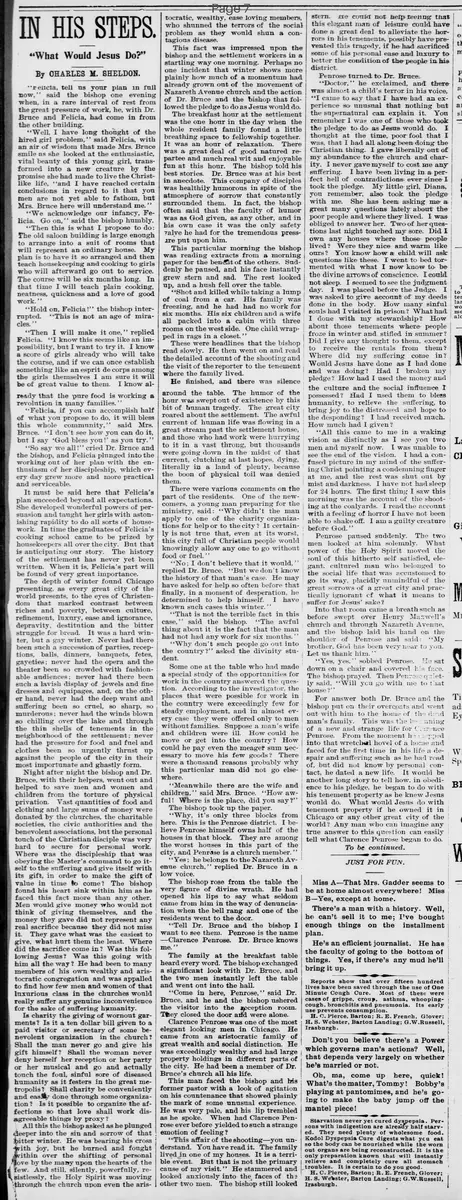
In His Steps
"What Would Jesus Do?"
By
Charles M. Sheldon
...Felicia, tell us your plan in full now," said the bishop one evening when, in a rare interval of rest from the great pressure of work, he, with Dr. Bruce and Felicia, had come in from the other building.
"Well, I have long thought of the hired girl problem," said Felicia, with an air of wisdom that made Mrs. Bruce smile as she looked at the enthusiastic, vital beauty of this young girl, transformed into a new creature by the promise she had made to live the Christ-like life. "And I have reached certain conclusions in regard to it that you men are not yet able to fathom, but Mrs. Bruce here will understand me."
"We acknowledge our infancy, Felicia. Go on," said the bishop humbly.
"Then this is what I propose to do: The old saloon building is large enough to arrange into a suit of rooms that will represent an ordinary house. My plan is to have it so arranged and then teach housekeeping and cooking to girls who will afterward go out to service. The course will be six months long. In that time I will teach plain cooking, neatness, quickness and a love of good work."
"Hold on, Felicia!" the bishop interrupted.
"This is not an age of miracles."
"Then I will make it one," replied Felicia. "I know this seems like an impossibility, but I want to try it. I know a score of girls already who will take the course, and if we can once establish something like an esprit de corps among the girls themselves I am sure it will be of great value to them. I know already that the pure food is working a revolution in many families."
"Felicia, if you can accomplish half of what you propose to do, it will bless this whole community," said Mrs. Bruce. "I don't see how you can do it but I say 'God bless you!' as you try."
"So say we all!" cried Dr. Bruce and the bishop, and Felicia plunged into the working out of her plan with the enthusiasm of her discipleship, which every day grew more and more practical and serviceable.
It must be said here that Felicia's plan succeeded beyond all expectations. She developed wonderful powers of persuasion and taught her girls with astonishing rapidity to do all sorts of housework. In time the graduates of Felicia's cooking school came to be prized by housekeepers all over the city. But that is anticipating our story. The history of the settlement has never yet been written. When it is, Felicia's part will be found of very great importance.
The depth of winter found Chicago presenting, as every great city of the world presents, to the eyes of Christendom that marked contrast between riches and poverty, between culture, refinement, luxury, ease and ignorance, depravity, destitution and the bitter struggle for bread. It was a hard winter, but a gay winter. Never had there been such a succession of parties, receptions, balls, dinners, banquets, fetes, gayeties; never had the opera and the theater been so crowded with fashionable audiences; never had there been such a lavish display of jewels and fine dresses and equipages, and, on the other hand, never had the deep want and suffering been so cruel, so sharp, so murderous; never had the winds blown so chilling over the lake and through the thin shells of tenements in the neighborhood of the settlement; never had the pressure for food and fuel and clothes been so urgently thrust up against the people of the city in their most importunate and ghastly form.
Night after night the bishop and Dr. Bruce, with their helpers, went out and helped to save men and women and children from the torture of physical privation. Vast quantities of food and clothing and large sums of money were donated by the churches, the charitable societies, the civic authorities and the benevolent associations, but the personal touch of the Christian disciple was very hard to secure for personal work. Where was the discipleship that was obeying the Master's command to go itself to the suffering and give itself with its gift, in order to make the gift of value in time to come? The bishop found his heart sink within him as he faced this fact more than any other. Men would give money who would not think of giving themselves, and the money they gave did not represent any real sacrifice because they did not miss it. They gave what was the easiest to give, what hurt them the least. Where did the sacrifice come in? Was this following Jesus? Was this going with him all the way? He had been to many members of his own wealthy and aristocratic congregation and was appalled to find how few men and women of that luxurious class in the churches would really suffer any genuine inconvenience for the sake of suffering humanity. Is charity the giving of worn-out garments? Is it a ten dollar bill given to a paid visitor or secretary of some benevolent organization in the church? Shall the man never go and give his gift himself? Shall the woman never deny herself her reception or her party or her musical and go and actually touch the foul, sinful sore of diseased humanity as it festers in the great metropolis? Shall charity be conveniently and easily done through some organization? Is it possible to organize the affections so that love shall work disagreeable things by proxy?
All this the bishop asked as he plunged deeper into the sin and sorrow of that bitter winter. He was bearing his cross with joy, but he burned and fought within over the shifting of personal love by the many upon the hearts of the few. And still, silently, powerfully, resistlessly, the Holy Spirit was moving through the church upon even the aristocratic, wealthy, ease-loving members, who shunned the terrors of the social problem as they would shun a contagious disease.
This fact was impressed upon the bishop and the settlement workers in a startling way one morning. Perhaps no one incident that winter shows more plainly how much of a momentum had already grown out of the movement of Nazareth Avenue church and the action of Dr. Bruce and the bishop that followed the pledge to do as Jesus would do.
The breakfast hour at the settlement was the one hour in the day when the whole resident family found a little breathing space to fellowship together. It was an hour of relaxation. There was a great deal of good-natured repartee and much real wit and enjoyable fun at this hour. The bishop told his best stories. Dr. Bruce was at his best in anecdote. This company of disciples was healthily humorous in spite of the atmosphere of sorrow that constantly surrounded them. In fact, the bishop often said that the faculty of humor was as God-given as any other, and in his own case it was the only safety valve he had for the tremendous pressure put upon him.
This particular morning the bishop was reading extracts from a morning paper for the benefit of the others. Suddenly he paused, and his face instantly grew stern and sad. The rest looked up, and a hush fell over the table.
"Shot and killed while taking a lump of coal from a car. His family was freezing, and he had had no work for six months. His six children and a wife all packed into a cabin with three rooms on the west side. One child wrapped in rags in a closet."
These were headlines that the bishop read slowly. He then went on and read the detailed account of the shooting and the visit of the reporter to the tenement where the family lived.
He finished, and there was silence around the table. The humor of the hour was swept out of existence by this bit of human tragedy. The great city roared about the settlement. The awful current of human life was flowing in a great stream past the settlement house, and those who had work were hurrying to it in a vast throng, but thousands were going down in the midst of that current, clutching at last hopes, dying, literally in a land of plenty, because the boon of physical toil was denied them.
There were various comments on the part of the residents. One of the newcomers, a young man preparing for the ministry, said: "Why didn't the man apply to one of the charity organizations for help or to the city? It certainly is not true that, even at its worst, this city full of Christian people would knowingly allow any one to go without food or fuel."
"No; I don't believe that it would," replied Dr. Bruce. "But we don't know the history of that man's case. He may have asked for help so often before that finally, in a moment of desperation, he determined to help himself. I have known such cases this winter."
"That is not the terrible fact in this case," said the bishop. "The awful thing about it is the fact that the man had not had any work for six months."
"Why don't such people go out into the country?" asked the divinity student.
Some one at the table who had made a special study of the opportunities for work in the country answered the question. According to the investigator, the places that were possible for work in the country were exceedingly few for steady employment, and in almost every case they were offered only to men without families. Suppose a man's wife and children were ill. How could he move or get into the country? How could he pay even the meager sum necessary to move his few goods? There were a thousand reasons probably why this particular man did not go elsewhere.
"Meanwhile there are the wife and children," said Mrs. Bruce. "How awful! Where is the place, did you say?"
The bishop took up the paper.
"Why, it's only three blocks from here. This is the Penrose district. I believe Penrose himself owns half of the houses in that block. They are among the worst houses in this part of the city, and Penrose is a church member."
"Yes; he belongs to the Nazareth Avenue church," replied Dr. Bruce in a low voice.
The bishop rose from the table the very figure of divine wrath. He had opened his lips to say what seldom came from him in the way of denunciation when the bell rang and one of the residents went to the door.
"Tell Dr. Bruce and the bishop I want to see them. Penrose is the name—Clarence Penrose. Dr. Bruce knows me."
The family at the breakfast table heard every word. The bishop exchanged a significant look with Dr. Bruce, and the two men instantly left the table and went out into the hall.
"Come in here, Penrose," said Dr. Bruce, and he and the bishop ushered the visitor into the reception room.
They closed the door and were alone.
Clarence Penrose was one of the most elegant looking men in Chicago. He came from an aristocratic family of great wealth and social distinction. He was exceedingly wealthy and had large property holdings in different parts of the city. He had been a member of Dr. Bruce's church all his life.
This man faced the bishop and his former pastor with a look of agitation on his countenance that showed plainly the mark of some unusual experience. He was very pale, and his lip trembled as he spoke. When had Clarence Penrose ever before yielded to such a strange emotion of feeling?
"This affair of the shooting—you understand. You have read it. The family lived in one of my houses. It is a terrible event. But that is not the primary cause of my visit." He stammered and looked anxiously into the faces of the other two men. The bishop still looked stern. He could not help feeling that this elegant man of leisure could have done a great deal to alleviate the horrors in his tenements, possibly have prevented this tragedy, if he had sacrificed some of his personal ease and luxury to better the condition of the people in his district.
Penrose turned to Dr. Bruce:
"Doctor," he exclaimed, and there was almost a child's terror in his voice. "I came to say that I have had an experience so unusual that nothing but the supernatural can explain it. You remember I was one of those who took the pledge to do as Jesus would do. I thought at the time, poor fool that I was, that I had all along been doing the Christian thing. I gave liberally out of my abundance to the church and charity. I never gave myself to cost me any suffering. I have been living in a perfect hell of contradictions ever since I took the pledge. My little girl, Diana, you remember, also took the pledge with me. She has been asking me a great many questions lately about the poor people and where they lived. I was obliged to answer her. Two of her questions last night touched my sore. Did I own any houses where those people lived? Were they nice and warm like ours? You know how a child will ask questions like these. I went to bed tormented with what I now know to be the divine arrows of conscience. I could not sleep. I seemed to see the judgment day. I was placed before the Judge. I was asked to give account of my deeds done in the body. How many sinful souls had I visited in prison? What had I done with my stewardship? How about those tenements where people froze in winter and stifled in summer? Did I give any thought to them, except to receive the rentals from them? Where did my suffering come in? Would Jesus have done as I had done and was doing? Had I broken my pledge? How had I used the money and the culture and the social influence I possessed? Had I used them to bless humanity, to relieve the suffering, to bring joy to the distressed and hope to the desponding? I had received much. How much had I given?
"All this came to me in a waking vision as distinctly as I see you two men and myself now. I was unable to see the end of the vision. I had a confused picture in my mind of the suffering Christ pointing a condemning finger at me, and the rest was shut out by mist and darkness. I have not had sleep for 24 hours. The first thing I saw this morning was the account of the shooting at the coal yards. I read the account with a feeling of horror I have not been able to shake off. I am a guilty creature before God."
Penrose paused suddenly. The two men looked at him solemnly. What power of the Holy Spirit moved the soul of this hitherto self-satisfied, elegant, cultured man who belonged to the social life that was accustomed to go its way, placidly unmindful of the great sorrows of a great city and practically ignorant of what it means to suffer for Jesus' sake?
Into that room came a breath such as before swept over Henry Maxwell's church and through Nazareth Avenue, and the bishop laid his hand on the shoulder of Penrose and said: "My brother, God has been very near to you. Let us thank him."
"Yes, yes," sobbed Penrose. He sat down on a chair and covered his face. The bishop prayed. Then Penrose quietly said, "Will you go with me to that house?"
For answer both Dr. Bruce and the bishop put on their overcoats and went out with him to the home of the dead man's family. This was the beginning of a new and strange life for Clarence Penrose. From the moment he stepped into that wretched hovel of a home and faced for the first time in his life a despair and suffering such as he had read of, but did not know by personal contact, he dated a new life. It would be another long story to tell how, in obedience to his pledge, he began to do with his tenement property as he knew Jesus would do. What would Jesus do with tenement property if he owned it in Chicago or any other great city of the world? Any man who can imagine any true answer to this question can easily tell what Clarence Penrose began to do.
To be continued.
"What Would Jesus Do?"
By
Charles M. Sheldon
...Felicia, tell us your plan in full now," said the bishop one evening when, in a rare interval of rest from the great pressure of work, he, with Dr. Bruce and Felicia, had come in from the other building.
"Well, I have long thought of the hired girl problem," said Felicia, with an air of wisdom that made Mrs. Bruce smile as she looked at the enthusiastic, vital beauty of this young girl, transformed into a new creature by the promise she had made to live the Christ-like life. "And I have reached certain conclusions in regard to it that you men are not yet able to fathom, but Mrs. Bruce here will understand me."
"We acknowledge our infancy, Felicia. Go on," said the bishop humbly.
"Then this is what I propose to do: The old saloon building is large enough to arrange into a suit of rooms that will represent an ordinary house. My plan is to have it so arranged and then teach housekeeping and cooking to girls who will afterward go out to service. The course will be six months long. In that time I will teach plain cooking, neatness, quickness and a love of good work."
"Hold on, Felicia!" the bishop interrupted.
"This is not an age of miracles."
"Then I will make it one," replied Felicia. "I know this seems like an impossibility, but I want to try it. I know a score of girls already who will take the course, and if we can once establish something like an esprit de corps among the girls themselves I am sure it will be of great value to them. I know already that the pure food is working a revolution in many families."
"Felicia, if you can accomplish half of what you propose to do, it will bless this whole community," said Mrs. Bruce. "I don't see how you can do it but I say 'God bless you!' as you try."
"So say we all!" cried Dr. Bruce and the bishop, and Felicia plunged into the working out of her plan with the enthusiasm of her discipleship, which every day grew more and more practical and serviceable.
It must be said here that Felicia's plan succeeded beyond all expectations. She developed wonderful powers of persuasion and taught her girls with astonishing rapidity to do all sorts of housework. In time the graduates of Felicia's cooking school came to be prized by housekeepers all over the city. But that is anticipating our story. The history of the settlement has never yet been written. When it is, Felicia's part will be found of very great importance.
The depth of winter found Chicago presenting, as every great city of the world presents, to the eyes of Christendom that marked contrast between riches and poverty, between culture, refinement, luxury, ease and ignorance, depravity, destitution and the bitter struggle for bread. It was a hard winter, but a gay winter. Never had there been such a succession of parties, receptions, balls, dinners, banquets, fetes, gayeties; never had the opera and the theater been so crowded with fashionable audiences; never had there been such a lavish display of jewels and fine dresses and equipages, and, on the other hand, never had the deep want and suffering been so cruel, so sharp, so murderous; never had the winds blown so chilling over the lake and through the thin shells of tenements in the neighborhood of the settlement; never had the pressure for food and fuel and clothes been so urgently thrust up against the people of the city in their most importunate and ghastly form.
Night after night the bishop and Dr. Bruce, with their helpers, went out and helped to save men and women and children from the torture of physical privation. Vast quantities of food and clothing and large sums of money were donated by the churches, the charitable societies, the civic authorities and the benevolent associations, but the personal touch of the Christian disciple was very hard to secure for personal work. Where was the discipleship that was obeying the Master's command to go itself to the suffering and give itself with its gift, in order to make the gift of value in time to come? The bishop found his heart sink within him as he faced this fact more than any other. Men would give money who would not think of giving themselves, and the money they gave did not represent any real sacrifice because they did not miss it. They gave what was the easiest to give, what hurt them the least. Where did the sacrifice come in? Was this following Jesus? Was this going with him all the way? He had been to many members of his own wealthy and aristocratic congregation and was appalled to find how few men and women of that luxurious class in the churches would really suffer any genuine inconvenience for the sake of suffering humanity. Is charity the giving of worn-out garments? Is it a ten dollar bill given to a paid visitor or secretary of some benevolent organization in the church? Shall the man never go and give his gift himself? Shall the woman never deny herself her reception or her party or her musical and go and actually touch the foul, sinful sore of diseased humanity as it festers in the great metropolis? Shall charity be conveniently and easily done through some organization? Is it possible to organize the affections so that love shall work disagreeable things by proxy?
All this the bishop asked as he plunged deeper into the sin and sorrow of that bitter winter. He was bearing his cross with joy, but he burned and fought within over the shifting of personal love by the many upon the hearts of the few. And still, silently, powerfully, resistlessly, the Holy Spirit was moving through the church upon even the aristocratic, wealthy, ease-loving members, who shunned the terrors of the social problem as they would shun a contagious disease.
This fact was impressed upon the bishop and the settlement workers in a startling way one morning. Perhaps no one incident that winter shows more plainly how much of a momentum had already grown out of the movement of Nazareth Avenue church and the action of Dr. Bruce and the bishop that followed the pledge to do as Jesus would do.
The breakfast hour at the settlement was the one hour in the day when the whole resident family found a little breathing space to fellowship together. It was an hour of relaxation. There was a great deal of good-natured repartee and much real wit and enjoyable fun at this hour. The bishop told his best stories. Dr. Bruce was at his best in anecdote. This company of disciples was healthily humorous in spite of the atmosphere of sorrow that constantly surrounded them. In fact, the bishop often said that the faculty of humor was as God-given as any other, and in his own case it was the only safety valve he had for the tremendous pressure put upon him.
This particular morning the bishop was reading extracts from a morning paper for the benefit of the others. Suddenly he paused, and his face instantly grew stern and sad. The rest looked up, and a hush fell over the table.
"Shot and killed while taking a lump of coal from a car. His family was freezing, and he had had no work for six months. His six children and a wife all packed into a cabin with three rooms on the west side. One child wrapped in rags in a closet."
These were headlines that the bishop read slowly. He then went on and read the detailed account of the shooting and the visit of the reporter to the tenement where the family lived.
He finished, and there was silence around the table. The humor of the hour was swept out of existence by this bit of human tragedy. The great city roared about the settlement. The awful current of human life was flowing in a great stream past the settlement house, and those who had work were hurrying to it in a vast throng, but thousands were going down in the midst of that current, clutching at last hopes, dying, literally in a land of plenty, because the boon of physical toil was denied them.
There were various comments on the part of the residents. One of the newcomers, a young man preparing for the ministry, said: "Why didn't the man apply to one of the charity organizations for help or to the city? It certainly is not true that, even at its worst, this city full of Christian people would knowingly allow any one to go without food or fuel."
"No; I don't believe that it would," replied Dr. Bruce. "But we don't know the history of that man's case. He may have asked for help so often before that finally, in a moment of desperation, he determined to help himself. I have known such cases this winter."
"That is not the terrible fact in this case," said the bishop. "The awful thing about it is the fact that the man had not had any work for six months."
"Why don't such people go out into the country?" asked the divinity student.
Some one at the table who had made a special study of the opportunities for work in the country answered the question. According to the investigator, the places that were possible for work in the country were exceedingly few for steady employment, and in almost every case they were offered only to men without families. Suppose a man's wife and children were ill. How could he move or get into the country? How could he pay even the meager sum necessary to move his few goods? There were a thousand reasons probably why this particular man did not go elsewhere.
"Meanwhile there are the wife and children," said Mrs. Bruce. "How awful! Where is the place, did you say?"
The bishop took up the paper.
"Why, it's only three blocks from here. This is the Penrose district. I believe Penrose himself owns half of the houses in that block. They are among the worst houses in this part of the city, and Penrose is a church member."
"Yes; he belongs to the Nazareth Avenue church," replied Dr. Bruce in a low voice.
The bishop rose from the table the very figure of divine wrath. He had opened his lips to say what seldom came from him in the way of denunciation when the bell rang and one of the residents went to the door.
"Tell Dr. Bruce and the bishop I want to see them. Penrose is the name—Clarence Penrose. Dr. Bruce knows me."
The family at the breakfast table heard every word. The bishop exchanged a significant look with Dr. Bruce, and the two men instantly left the table and went out into the hall.
"Come in here, Penrose," said Dr. Bruce, and he and the bishop ushered the visitor into the reception room.
They closed the door and were alone.
Clarence Penrose was one of the most elegant looking men in Chicago. He came from an aristocratic family of great wealth and social distinction. He was exceedingly wealthy and had large property holdings in different parts of the city. He had been a member of Dr. Bruce's church all his life.
This man faced the bishop and his former pastor with a look of agitation on his countenance that showed plainly the mark of some unusual experience. He was very pale, and his lip trembled as he spoke. When had Clarence Penrose ever before yielded to such a strange emotion of feeling?
"This affair of the shooting—you understand. You have read it. The family lived in one of my houses. It is a terrible event. But that is not the primary cause of my visit." He stammered and looked anxiously into the faces of the other two men. The bishop still looked stern. He could not help feeling that this elegant man of leisure could have done a great deal to alleviate the horrors in his tenements, possibly have prevented this tragedy, if he had sacrificed some of his personal ease and luxury to better the condition of the people in his district.
Penrose turned to Dr. Bruce:
"Doctor," he exclaimed, and there was almost a child's terror in his voice. "I came to say that I have had an experience so unusual that nothing but the supernatural can explain it. You remember I was one of those who took the pledge to do as Jesus would do. I thought at the time, poor fool that I was, that I had all along been doing the Christian thing. I gave liberally out of my abundance to the church and charity. I never gave myself to cost me any suffering. I have been living in a perfect hell of contradictions ever since I took the pledge. My little girl, Diana, you remember, also took the pledge with me. She has been asking me a great many questions lately about the poor people and where they lived. I was obliged to answer her. Two of her questions last night touched my sore. Did I own any houses where those people lived? Were they nice and warm like ours? You know how a child will ask questions like these. I went to bed tormented with what I now know to be the divine arrows of conscience. I could not sleep. I seemed to see the judgment day. I was placed before the Judge. I was asked to give account of my deeds done in the body. How many sinful souls had I visited in prison? What had I done with my stewardship? How about those tenements where people froze in winter and stifled in summer? Did I give any thought to them, except to receive the rentals from them? Where did my suffering come in? Would Jesus have done as I had done and was doing? Had I broken my pledge? How had I used the money and the culture and the social influence I possessed? Had I used them to bless humanity, to relieve the suffering, to bring joy to the distressed and hope to the desponding? I had received much. How much had I given?
"All this came to me in a waking vision as distinctly as I see you two men and myself now. I was unable to see the end of the vision. I had a confused picture in my mind of the suffering Christ pointing a condemning finger at me, and the rest was shut out by mist and darkness. I have not had sleep for 24 hours. The first thing I saw this morning was the account of the shooting at the coal yards. I read the account with a feeling of horror I have not been able to shake off. I am a guilty creature before God."
Penrose paused suddenly. The two men looked at him solemnly. What power of the Holy Spirit moved the soul of this hitherto self-satisfied, elegant, cultured man who belonged to the social life that was accustomed to go its way, placidly unmindful of the great sorrows of a great city and practically ignorant of what it means to suffer for Jesus' sake?
Into that room came a breath such as before swept over Henry Maxwell's church and through Nazareth Avenue, and the bishop laid his hand on the shoulder of Penrose and said: "My brother, God has been very near to you. Let us thank him."
"Yes, yes," sobbed Penrose. He sat down on a chair and covered his face. The bishop prayed. Then Penrose quietly said, "Will you go with me to that house?"
For answer both Dr. Bruce and the bishop put on their overcoats and went out with him to the home of the dead man's family. This was the beginning of a new and strange life for Clarence Penrose. From the moment he stepped into that wretched hovel of a home and faced for the first time in his life a despair and suffering such as he had read of, but did not know by personal contact, he dated a new life. It would be another long story to tell how, in obedience to his pledge, he began to do with his tenement property as he knew Jesus would do. What would Jesus do with tenement property if he owned it in Chicago or any other great city of the world? Any man who can imagine any true answer to this question can easily tell what Clarence Penrose began to do.
To be continued.
What sub-type of article is it?
Prose Fiction
Dialogue
What themes does it cover?
Religious
Moral Virtue
Social Manners
What keywords are associated?
Christian Discipleship
Social Reform
Poverty Chicago
Personal Charity
Tenement Housing
Moral Conversion
Hired Girls
Winter Suffering
What entities or persons were involved?
By Charles M. Sheldon
Literary Details
Title
"What Would Jesus Do?"
Author
By Charles M. Sheldon
Subject
Felicia's Training Plan And Winter Poverty Leading To Penrose's Conversion
Key Lines
"What Would Jesus Do?"
"This Is Not An Age Of Miracles." "Then I Will Make It One," Replied Felicia.
"Where Was The Discipleship That Was Obeying The Master's Command To Go Itself To The Suffering And Give Itself With Its Gift..."
"I Have Been Living In A Perfect Hell Of Contradictions Ever Since I Took The Pledge."
What Would Jesus Do With Tenement Property If He Owned It In Chicago Or Any Other Great City Of The World?