Thank you for visiting SNEWPapers!
Sign up free
Daily National Intelligencer
Washington, District Of Columbia
What is this article about?
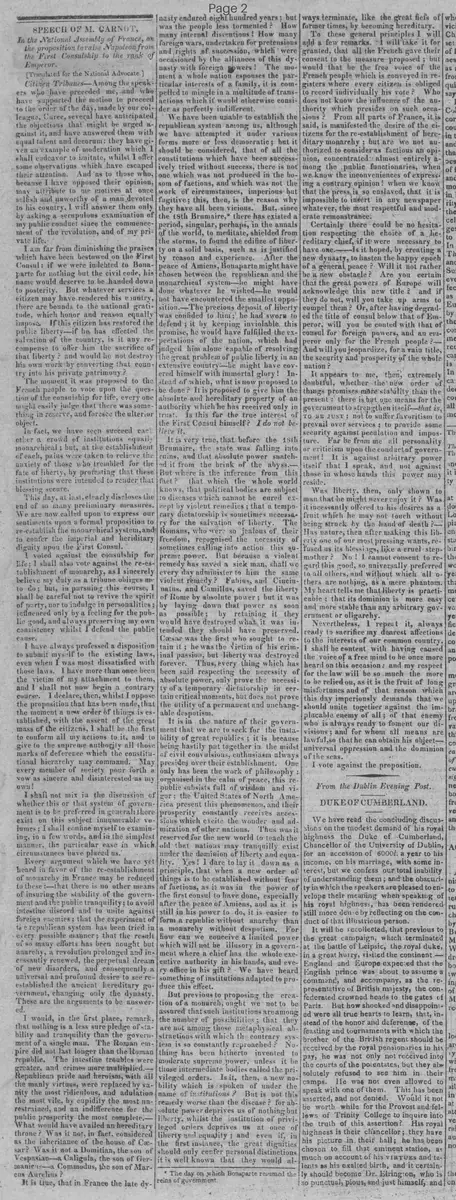
M. Carnot delivers a speech in the French National Assembly opposing the proposition to elevate Napoleon Bonaparte from First Consul to Emperor, arguing it would sacrifice liberty for monarchy and hereditary rule, while pledging to respect any new order established by majority consent.
Clipping
OCR Quality
Full Text
In the National Assembly of France, on
the proposition to raise Napoleon from
the First Consulship to the rank of
Emperor.
[Translated for the National Advocate.]
Citizen Tribunes—Among the speakers
who have preceded me, and who
have supported the motion to proceed
to the order of the day, made by our col-
league, Curee, several have anticipated
the objections that might be urged a-
gainst it, and have answered them with
equal talent and decorum: they have gi-
ven an example of moderation which I
shall endeavor to imitate, whilst I offer
some observations which have escaped
their attention. And as to those who,
because I have opposed their opinion,
may attribute to me motives at once
selfish and unworthy of a man devoted
to his country, I will answer them only
by asking a scrupulous examination of
my public conduct since the commence-
ment of the revolution, and of my pri-
vate life.
I am far from diminishing the praises
which have been bestowed on the First
Consul: if we were indebted to Bona-
parte for nothing but the civil code, his
name would deserve to be handed down
to posterity. But whatever services a
citizen may have rendered his country,
there are bounds to the national grati-
tude, which honor and reason equally
impose. If this citizen has restored the
public liberty—if he has effected the
salvation of the country, is it any re-
compense to offer him the sacrifice of
that liberty? and would he not destroy
his own work by converting that coun-
try into his private patrimony?
The moment it was proposed to the
French people to vote upon the ques-
tion of the consulship for life, every one
might easily judge that there was some-
thing in reserve, and foresee the ulterior
object.
In fact, we have seen succeed each
other a crowd of institutions equally
monarchical; but, at the establishment
of each, pains were taken to relieve the
anxiety of those who trembled for the
fate of liberty, by protesting that these
institutions were intended to render that
blessing secure.
This day, at last, clearly discloses the
end of so many preliminary measures.
We are now called upon to express our
sentiments upon a formal proposition to
re-establish the monarchical system, and
to confer the imperial and hereditary
dignity upon the First Consul.
I voted against the consulship for
life: I shall also vote against the re-es-
tablishment of monarchy, as I sincerely
believe my duty as a tribune obliges me
to do; but, in pursuing this course, I
shall be careful not to revive the spirit
of party, nor to indulge in personalities;
influenced only by a feeling for the pub-
lic good, and always preserving my own
consistency whilst I defend the public
cause.
I have always professed a disposition
to submit myself to the existing laws,
even when I was most dissatisfied with
those laws. I have more than once been
the victim of my attachment to them,
and I shall not now begin a contrary
course. I declare, then, whilst I oppose
the proposition that has been made, that
the moment a new order of things is es-
tablished, with the assent of the great
mass of the citizens, I shall be the first
to conform all my actions to it, and to
give to the supreme authority all those
marks of deference which the constita-
tional hierarchy may command. May
every member of society pour forth a
vow as sincere and disinterested as my
own!
I shall not mix in the discussion of
whether this or that system of govern-
ment is to be preferred in general; there
exist on this subject innumerable vo-
lumes: I shall confine myself to examin-
ing, in a few words, and in the simplest
manner, the particular case in which
circumstances have placed us.
Every argument which we have yes-
terday heard in favor of the re-establishment
of monarchy in France may be reduced
to these:—that there is no other means
of insuring the stability of the govern-
ment and the public tranquility; to avoid
intestine discord and to unite against
foreign enemies; that the experiment of
the republican system has been tried in
every possible manner; that the result
of so many efforts has been naught but
anarchy, a revolution prolonged and in-
cessantly renewed, the perpetual dream
of new disorders, and consequently a
universal and profound desire to see re-
established the ancient hereditary go-
vernment, changing only the dynasty.
These are the arguments to be answered.
I would, in the first place, remark,
that nothing is a less sure pledge of sta-
bility and tranquility than the govern-
ment of a single man. The Roman em-
pire did not last longer than the Roman
republic. The intestine troubles were
greater, and crimes more multiplied.
Republican pride and heroism, with all
the manly virtues, were replaced by va-
nity the most ridiculous, and adulation
the most vile, by cupidity the most un-
restrained, and an indifference for the
public prosperity the most complete.
What would have availed an hereditary
throne? Was it not, in fact, considered
as the inheritance of the house of Cæ-
sar? Was it not a Domitian, the son of
Vespasian—a Caligula, the son of Ger-
manicus—a Commodus, the son of Mar-
cus Aurelius?
It is true, that in France the late dy-
nasty endured eight hundred years; but
was the people less tormented? How
many internal dissentions! How many
foreign wars, undertaken for pretensions
and rights of succession, which were
occasioned by the alliances of this dy-
nasty with foreign powers! The mo-
ment a whole nation espouses the par-
particular interests of a family, it is com-
pelled to mingle in a multitude of trans-
actions which it would otherwise consi-
der as perfectly indifferent.
We have been unable to establish the
republican system among us, although
we have attempted it under various
forms more or less democratic; but it
should be considered, that of all the
constitutions which have been success-
ively tried without success, there is not
one which was not produced in the bo-
som of factions, and which was not the
work of circumstances, imperious—but
fugitive; this, then, is the reason why
they have all been vicious. But, since
the 18th Brumaire,* there has existed a
period, singular, perhaps, in the annals
of the world, to meditate, shielded from
the storms, to found the edifice of liber-
ty on a solid basis, such as is justified
by reason and experience. After the
peace of Amiens, Bonaparte might have
chosen between the republican and the
monarchical system—he might have
done whatever he wished—he would
not have encountered the smallest oppo-
sition.—The precious deposit of liberty
was confided to him; he had sworn to
defend it by keeping inviolable. this
promise, he would have fulfilled the ex-
pectations of the nation, which had
judged him alone capable of resolving
the great problem of public liberty in an
extensive country—he might have cov-
ered himself with immortal glory! In-
stead of which, what is now proposed to
be done? It is proposed to give him the
absolute and hereditary property of an
authority which he has received only in
trust. Is this for the true interest of
the First Consul himself? I do not be-
lieve it.
It is very true, that before the 18th
Brumaire, the state was falling into
ruins, and that absolute power snatched
it from the brink of the abyss.—
But where is the inference from this
fact? that which the whole world
knows, that political bodies are subject
to diseases which cannot be cured ex-
cept by violent remedies; that a tempo-
rary dictatorship is sometimes necessa-
ry for the salvation of liberty. The
Romans, who were so jealous of their
freedom, recognised the necessity of
sometimes calling into action this su-
preme power. But because a violent
remedy has saved a sick man, shall we
every day administer to him the same
violent remedy? Fabius, and Cincinn-
natus, and Camillus, saved the liberty
of Rome by absolute power; but it was
by laying down that power as soon
as possible; by retaining it they
would have destroyed what it was in-
tended they should have preserved.
Cæsar was the first who sought to re-
tain it; he was the victim of his crim-
inal passion, but liberty was destroyed
forever. Thus, every thing which has
been said respecting the necessity of
absolute power, only prove the necessi-
ty of a temporary dictatorship in cer-
tain critical moments, but does not prove
the utility of a permanent and unchang-
able despotism.
It is in the nature of their government
that we are to seek for the insta-
bility of great republics; it is because
being hastily put together in the midst
of civil convulsions, enthusiasm always
preside over their establishment. One
only has been the work of philosophy:
organised in the calm of peace, this re-
public subsists full of wisdom and vi-
gor; the United States of North Ame-
rica present this phenomenon, and their
prosperity constantly receives acces-
sions which excite the wonder and ad-
miration of other nations. Thus was it
reserved for the new world to teach the
old that nations may tranquilly exist
under the dominion of liberty and equa-
lity. Yes! I dare to lay it down as a
principle, that when a new order of
things is to be established without fear
of factions, as it was in the power of
the first consul to have done, especially
after the peace of Amiens, and as it is
still in his power to do, it is easier to
form a republic without anarchy than
a monarchy without despotism. For
how can we conceive a limited power
which will not be illusory in a govern-
ment where a chief has the whole exe-
cutive authority in his hands, and every
office in his gift? We have heard
something of institutions adapted to pro-
duce this effect.
But previous to proposing the crea-
tion of a monarch, ought we not to be
assured that such institutions are among
the number of possibilities; that they
are not among those metaphysical ab-
stractions with which the contrary sys-
tem is so constantly reproached? No-
thing has been hitherto invented to
moderate supreme power, unless it be
those intermediate bodies called the pri-
vileged orders. Is it, then, a new no-
bility which is spoken of under the
name of institutions? But is not this
remedy worse than the disease? for ab-
solute power deprives us of nothing but
liberty, whilst the institution of privi-
leged orders deprives us at once of
liberty and equality; and even if, in
the first instance, the great dignities
should only confer personal distinctions
ways terminate, like the great fiefs of
former times, by becoming hereditary.
To these general principles I will
add a few remarks. I will take it for
granted, that all the French gave their
consent to the measure proposed; but
would that be the free voice of the
French people which is conveyed in re-
gisters where every citizen is obliged
to record individually his vote? Who
does not know the influence of the au-
thority which presides on such occa-
sions? From all parts of France, it is
said, is manifested the desire of the ci-
tizens for the re-establishment of here-
ditary monarchy; but are we not au-
thorized to consider as factious an opi-
nion, concentrated almost entirely a-
mong the public functionaries, when
we know the inconveniences of express-
ing a contrary opinion! when we know
that the press is so enslaved, that it is
impossible to insert in any newspaper
whatever, the most respectful and mod-
erate remonstrance.
Certainly there could be no hesita-
tion respecting the choice of a lie-
red itary chief, if it were necessary to
have one.—Is it hoped, by creating a
new dynasty, to hasten the happy epoch
of a general peace? Will it not rather
be a new obstacle? Are you certain
that the great powers of Europe will
acknowledge this new title? and if
they do not, will you take up arms to
compel them? Or, after having degrad-
ed the title of consul below that of Em-
peror, will you be content with that of
consul for foreign powers, and an em-
peror only for the French people?—
And will you jeopardize, for a vain title,
the security and prosperity of the whole
nation?
It appears to me, then, extremely
doubtful, whether the new order of
things promises more stability than the
present: there is but one means for the
government to strengthen itself—that is,
To BE JUST; not to suffer favoritism to
prevail over services; to provide some
security against peculation and impos-
ture. Far be from me all personality
or criticism upon the conduct of govern-
ment! It is against arbitrary power
itself that I speak, and, not against
those in whose hands this power may
reside.
Was liberty, then, only shown to
man that he might never enjoy it? Was
it incessantly offered to his desires as a
fruit which he may not touch without
being struck by the hands of death?
Has nature, then after making this lib-
erty one of our most pressing wants, re-
fused us its blessings, like a cruel step-
mother? No! I cannot consent to re-
gard this good, so universally preferred
to all others, and without which all o-
thers are nothing, as a mere phantom.
My heart tells me that liberty is practi-
cable; that its dominion is more easy
and more stable than any arbitrary gov-
ernment or oligarchy.
Nevertheless, I repeat it, always
ready to sacrifice my dearest affections
to the interests of our common country.
I shall be content with having caused
the voice of a free mind to be once more
heard on this occasion: and my respect
for the law will be so much the more
to be relied on, as it is the fruit of long
misfortunes and of that reason which
this day imperiously demands that we
should unite together against the im-
placable enemy of all; of that enemy
who is always ready to foment our di-
visions; and for whom all means are
lawful, so that he can obtain his object—
universal oppression and the dominion
of the seas.
I vote against the proposition.
What sub-type of article is it?
What keywords are associated?
What entities or persons were involved?
Where did it happen?
Foreign News Details
Primary Location
France
Key Persons
Outcome
carnot votes against the proposition to elevate napoleon to emperor, arguing it threatens liberty despite pledging future compliance if approved by majority.
Event Details
In a speech to the National Assembly, M. Carnot opposes the motion to raise Napoleon from First Consul to Emperor, praising Bonaparte's services but warning that hereditary monarchy would sacrifice public liberty. He critiques historical monarchies, defends republican possibilities citing the U.S., and questions the stability and international recognition of the proposed change, while committing to obey any new constitutional order.