Thank you for visiting SNEWPapers!
Sign up free
National Opinion
Bradford, Orange County, Vermont
What is this article about?
Ferdinand Kohl and Charles H. Gardner sued Brooklyn Postmaster James Semler for $5,000 over retained letters, but the court ruled in Semler's favor after evidence showed the plaintiffs were swindlers operating under multiple names and failing to deliver goods after receiving payments.
Clipping
OCR Quality
Full Text
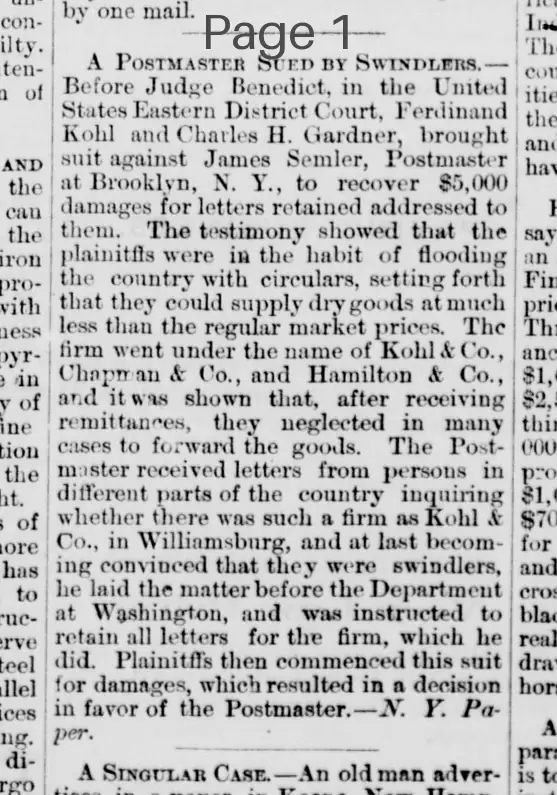
Before Judge Benedict, in the United States Eastern District Court, Ferdinand Kohl and Charles H. Gardner, brought suit against James Semler, Postmaster at Brooklyn, N. Y., to recover $5,000 damages for letters retained addressed to them. The testimony showed that the plaintiffs were in the habit of flooding the country with circulars, setting forth that they could supply dry goods at much less than the regular market prices. The firm went under the name of Kohl & Co., Chapman & Co., and Hamilton & Co., and it was shown that, after receiving remittances, they neglected in many cases to forward the goods. The Postmaster received letters from persons in different parts of the country inquiring whether there was such a firm as Kohl & Co., in Williamsburg, and at last becoming convinced that they were swindlers he laid the matter before the Department at Washington, and was instructed to retain all letters for the firm, which he did. Plaintiffs then commenced this suit for damages, which resulted in a decision in favor of the Postmaster. - N. Y. Paper.
What sub-type of article is it?
What keywords are associated?
What entities or persons were involved?
Where did it happen?
Domestic News Details
Primary Location
Brooklyn, N. Y.
Key Persons
Outcome
decision in favor of the postmaster.
Event Details
Ferdinand Kohl and Charles H. Gardner sued Brooklyn Postmaster James Semler for $5,000 damages due to retained letters addressed to their firm. Testimony revealed they operated as swindlers under names like Kohl & Co., sending circulars for cheap dry goods, receiving payments but often not delivering. Semler, after inquiries and instructions from Washington, retained the letters, leading to the suit's dismissal in his favor.