Thank you for visiting SNEWPapers!
Sign up free
The Rhode Island American, And General Advertiser
Providence, Providence County, Rhode Island
What is this article about?
Excerpt from Thornton's work offering critical observations on Turkish history, national character marked by contradictions, government by caprice, limited education and science, self-sufficient economy and manufactures, geographical ignorance, military weaknesses, and debates on their expulsion from Europe due to religion, title, or despotism.
Merged-components note: Continuation of the article 'Notes on the Turks' from Thornton's work, spanning multiple components and pages.
Clippings
1 of 2
OCR Quality
Full Text
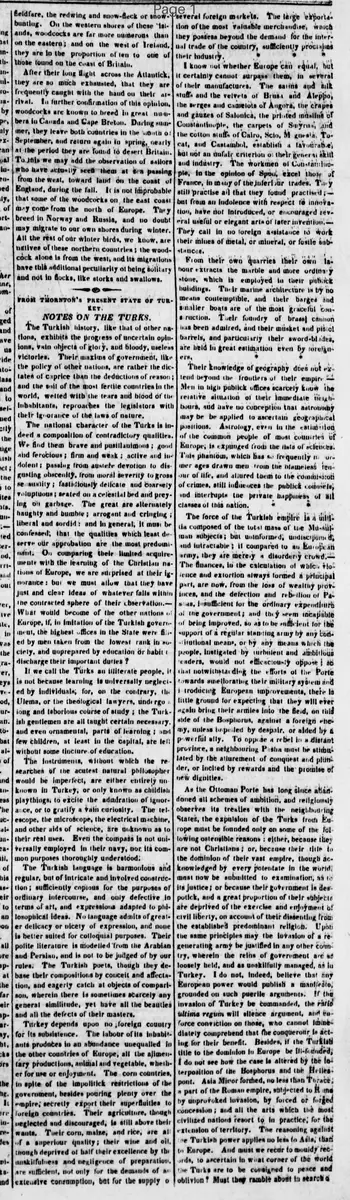
NOTES ON THE TURKS.
The Turkish history, like that of other nations, exhibits the progress of uncertain opinions, vain objects of glory, and bloody, useless victories. Their maxims of government, like the policy of other nations, are rather the dictated of caprice than the deductions of reason; and the soil of the most fertile countries in the world, weltered with the tears and blood of the inhabitants, reproaches the legislators with their ignorance of the laws of nature.
The national character of the Turks is indeed a composition of contradictory qualities. We find them brave and pusillanimous; good and ferocious; firm and weak; active and indolent; passing from austere devotion to disgusting obscenity, from moral severity to gross sensuality; fastidiously delicate and coarsely voluptuous; seated on a celestial bed and preying on garbage. The great are alternately haughty and humble; arrogant and cringing; liberal and sordid: and in general, it must be confessed, that the qualities which least deserve our approbation are the most predominant: On comparing their limited acquirements with the learning of the Christian nations of Europe, we are surprised at their ignorance: but we must allow that they have just and clear ideas of whatever falls within the contracted sphere of their observation.
What would become of the other nations of Europe, if, in imitation of the Turkish government, the highest offices in the State were filled by men taken from the lowest rank in society, and unprepared by education or habit to discharge their important duties?
If we call the Turks an illiterate people, it is not because learning is universally neglected by individuals; for, on the contrary, the Ulema, or the theological lawyers, undergo a long and laborious course of study; the Turkish gentlemen are all taught certain necessary and even ornamental, parts of learning: and few children, at least in the capital, are left without some tincture of education.
The instruments, without which the researches of the acutest natural philosopher would be imperfect, are either entirely unknown in Turkey; or only known as childish playthings, to excite the admiration of ignorance, or to gratify a vain curiosity. The telescope, the microscope, the electrical machine, and other aids of science, are unknown as to their real uses. Even the compass is not generally employed in their navy, nor its common purposes thoroughly understood:
The Turkish language is harmonious and regular, but of intricate and involved construction; sufficiently copious for the purposes of ordinary intercourse, and only defective in terms of art, and expressions adapted to philosophical ideas. No language admits of greater delicacy or variety of expression, and none is better suited for colloquial purposes. Their polite literature is modelled from the Arabian and Persian, and is not to be judged of by our rules: The Turkish poets, though they descend to conceit and affectation, and eagerly catch at objects of comparison, wherein there is sometimes scarcely any general similitude, yet have all the beauties and all the defects of their masters.
Turkey depends upon no foreign country for its subsistence. The labour of its inhabitants produces in an abundance unequalled in the other countries of Europe, all the alimentary productions, animal and vegetable, whether for use or enjoyment. The corn countries, in spite of the impolitic restrictions of the government, besides pouring plenty over the empire; secretly export their superfluities to foreign countries. Their agriculture, though neglected and discouraged; is still above their wants. Their corn, maize; and rice, are all of a superior quality; their wine and oil, though deprived of half their excellence by the unskilfulness and negligence of preparation, are sufficient, not only for the demands of an extensive consumption, but for the supply of several foreign markets. The large exportation of the most valuable merchandise, which they possess beyond the demand for the internal trade of the country, sufficiently proclaims their industry.
I know not whether Europe can equal, but it certainly cannot surpass them, in several of their manufactures. The satins and silk stuffs and the velvets of Brusa and Aleppo; the Berges and camelots of Angora, the craped and gauzes of Salonica, the printed muslins of Constantinople, the carpets of Smyrna, and the cotton stuffs of Cairo, Scio, Magnesia, Toccat, and Castambol, establish a favourable but not an unfair criterion of their general skill and industry. The workmen of Constantinople, in the opinion of Spone, excel those of France, in many of the inferior trades. They still practise all that they found practised; but from an indolence with respect to innovation, have not introduced, or encouraged several useful or elegant arts of later invention. They call in no foreign assistance to work their mines of metal, or mineral, or fossil substances.
From their own quarries their own labour extracts the marble and more ordinary stone, which is employed in their publick buildings. Their marine architecture is by no means contemptible, and their barges and smaller boats are of the most graceful construction. Their foundry of brass cannot has been admired, and their musket and pistol barrels, and particularly their sword-blades, are held in great estimation even by foreigners.
Their knowledge of geography does not extend beyond the frontiers of their empire. Men in high publick offices scarcely know the relative situation of their immediate neighbours, and have no conception that astronomy may be applied to ascertain geographical positions. Astrology, even in the enlightened period of the common people of most countries of Europe; is expunged from the lists of sciences! This phantom, which has so frequently in former ages drawn men from the blameless tenor of life, and allured them to the commission of crimes, still influences the publick counsels and interrupts the private happiness of all classes of this nation.
The force of the Turkish empire is principally composed of the total mass of the Musulman subjects; but uninformed, undisciplined and intractable; if compared to an European army, they are merely a disorderly crowd; The finances, in the calculation of which violence and extortion always formed a principal part, are now, from the loss of wealthy provinces, and the defection and rebellion of Pashas, insufficient for the ordinary expenditure of the government; and these seem incapable of being improved, so as to be sufficient for the support of a regular standing army by any constitutional means, or by any means which the people, instigated by turbulent and ambitious leaders, would not efficaciously oppose.
That notwithstanding the efforts of the Porte towards ameliorating their military system and introducing European improvements, there is little ground for expecting that they will ever again bring their armies into the field. on this side of the Bosphorus, against a foreign enemy, unless impelled by despair, or aided by a powerful ally. To oppose a rebel in a distant province, a neighbouring Pasha must be stimulated by the allurement of conquest and plunder, or incited by rewards and the promise of new dignities.
As the Ottoman Porte has long since abandoned all schemes of ambition, and religiously observes its treaties with the neighbouring States, the expulsion of the Turks from Europe must be founded only on some of the following ostensible reasons : either, because they are not Christians; or, because their title to the dominion of their vast empire, though acknowledged by every potentate in the world! must now be submitted to examination; as to its justice; or because their government is despotick, and a great proportion of their subjects are deprived of the exercise and enjoyment of civil liberty, on account of their dissenting from the established predominant religion. Upon the same principles may the invasion of a regenerating army be justified in any other country, wherein the reins of government are so loosely held, and as unskilfully managed, as in Turkey. I do not, indeed, believe that any European power would publish a manifesto, grounded on such puerile arguments. if the invasion of Turkey be commanded, the real ultima ratio will silence argument, and enforce conviction on those, who cannot immediately comprehend that the conquerors in acting for their benefit. Besides, if the Turkish title to the dominion in Europe be ill-founded: I do not see how the case is altered by the interposition of the Bosphorus and the Hellespont. Asia Minor forded, no less than Thrace: a part of the Roman empire, subjected to the by unprovoked invasion, by forced or forged concession; and all the arts which the most civilized nations resort to in practice; for the extension of territory. The reasoning against the Turkish power applies no less to Asia; than to Europe. And must we recur to mouldy records, to ascertain in what corner of the world the Turks are to be consigned to peace and oblivion? Must they ramble about in search of Eden, the first seat of the common ancestors of mankind? or retrace their steps to Selingrad, whence M. Baillie deduces the origin of human learning? or must the summary Roman method be resorted to, and peace be proclaimed, only when their country is reduced to a solitude?
What sub-type of article is it?
What themes does it cover?
What keywords are associated?
What entities or persons were involved?
Literary Details
Title
Notes On The Turks.
Author
From Thornton's Present State Of Turkey
Form / Style
Prose Observations On Turkish Society And Governance
Key Lines