Thank you for visiting SNEWPapers!
Sign up free
The New Hampshire Gazette And General Advertiser
Portsmouth, Exeter, Rockingham County, New Hampshire
What is this article about?
This letter responds to 'A Citizen of New Hampshire's' defense of the proposed New Hampshire constitution, elaborating on objections to candidate estate qualifications, representation methods, gubernatorial powers over fortifications, age requirements, and rotation in office, advocating caution in political innovations.
Merged-components note: This is a continuation of the same letter to the editor across pages 1 and 2, as the text flows directly from one component to the next.
Clippings
1 of 2
OCR Quality
Full Text
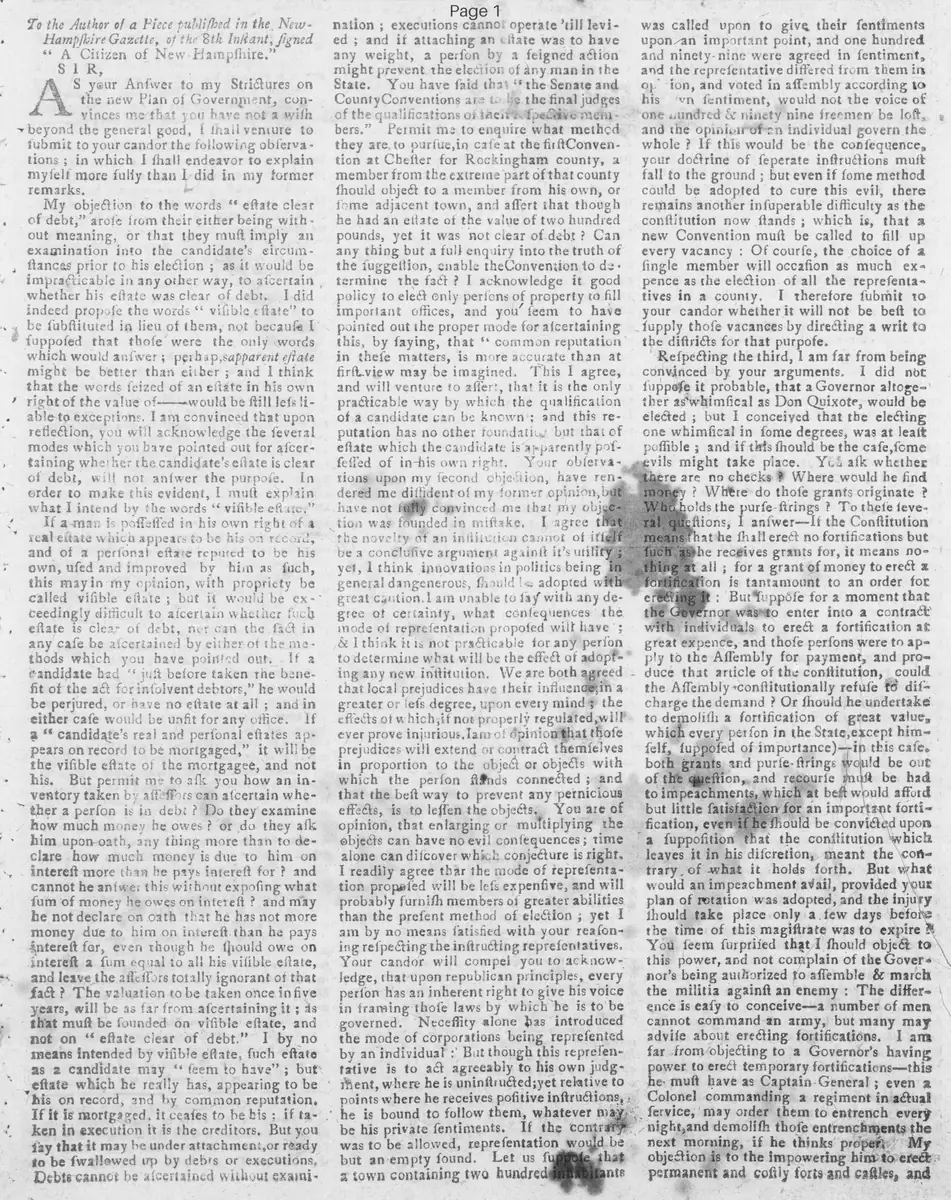
SIR,
As your Answer to my Strictures on the new Plan of Government, convinces me that you have not a wish beyond the general good. I shall venture to submit to your candor the following observations : in which I shall endeavor to explain myself more fully than I did in my former remarks.
My objection to the words "estate clear of debt," arose from their either being without meaning. or that they must imply an examination into the candidate's circumstances prior to his election : as it would be impracticable in any other way, to ascertain whether his estate was clear of debt. I did indeed propose the words "visible estate" to be substituted in lieu of them. not because I supposed that those were the only words which would answer; perhaps apparent estate might be better than either ; and I think that the words seized of an estate in his own right of the value of—would be still less liable to exceptions. I am convinced that upon reflection. you will acknowledge the several modes which you have pointed out for ascertaining whether the candidate's estate is clear of debt, will not answer the purpose.
In order to make this evident. I must explain what I intend by the words "visible estate." If a man is possessed in his own right of a real estate which appears to be his on record, and of a personal estate reputed to be his own, used and improved by him as such, this may in my opinion, with propriety be called visible estate : but it would be exceedingly difficult to ascertain whether such estate is clear of debt. nor can the fact in any case be ascertained by either of the methods which you have pointed out. If a candidate had just before taken the benefit of the act for insolvent debtors. he would be perjured. or have no estate at all : and in either case would be unfit for any office. If a candidate's real and personal estates appears on record to be mortgaged. it will be the visible estate of the mortgagee. and not his. But permit me to ask you how an inventory taken by assessors can ascertain whether a person is in debt ? Do they examine how much money he owes ? or do they ask him upon oath. any thing more than to declare how much money is due to him on interest more than he pays interest for ? and cannot he answer this without exposing what sum of money he owes on interest ? and may not declare on oath that he has not more money due to him on interest than he pays interest for, even though he should owe on interest a sum equal to all his visible estate. and leave the assessors totally ignorant of that fact ? The valuation to be taken once in five years, will be as far from ascertaining it ; as that must be founded on visible estate. and not on "estate clear of debt." I by no means intended by visible estate. such estate as a candidate may "seem to have" ; but estate which he really has, appearing to be his on record, and by common reputation. If it is mortgaged. it ceases to be his : if taken in execution it is the creditors. But you say that it may be under attachment,or ready to be swallowed up by debts or executions. Debts cannot be ascertained without examination : executions cannot operate 'till levied ; and if attaching an estate was to have any weight, a person by a feigned action might prevent the election of any man in the State. You have said that " the Senate and County Conventions are to be the final judges of the qualifications of their respective members." Permit me to enquire what method they are to pursue,in case at the first Convention at Chester for Rockingham county, a member from the extreme part of that county should object to a member from his own. or some adjacent town, and assert that though he had an estate of the value of two hundred pounds, yet it was not clear of debt ? Can any thing but a full enquiry into the truth of the suggestion. enable the Convention to determine the fact ? I acknowledge it good policy to elect only persons of property to fill important offices. and you seem to have pointed out the proper mode for ascertaining this, by saying. that " common reputation in these matters. is more accurate than at first view may be imagined. This I agree, and will venture to assert. that it is the only practicable way by which the qualification of a candidate can be known : and this reputation has no other foundation but that of estate which the candidate is apparently possessed of in-his own right. Your observations upon my second objection, have rendered me diffident of my former opinion,but have not fully convinced me that my objection was founded in mistake. I agree that the novelty of an institution cannot of itself be a conclusive argument against it's utility ; yet, I think innovations in politics being in general dangerous, should be adopted with great caution. I am unable to say with any degree of certainty. what consequences the mode of representation proposed will have : & I think it is not practicable for any person to determine what will be the effect of adopting any new institution. We are both agreed that local prejudices have their influence.in a greater or less degree, upon every mind ; the effects of which,if not properly regulated,will ever prove injurious. I am of opinion that those prejudices will extend or contract themselves in proportion to the object or objects with which the person stands connected : and that the best way to prevent any pernicious effects, is to lessen the objects. You are of opinion, that enlarging or multiplying the objects can have no evil consequences; time alone can discover which conjecture is right. I readily agree that the mode of representation proposed will be less expensive. and will probably furnish members of greater abilities than the present method of election : yet I am by no means satisfied with your reasoning respecting the instructing representatives. Your candor will compel you to acknowledge, that upon republican principles, every person has an inherent right to give his voice in framing those laws by which he is to be governed. Necessity alone has introduced the mode of corporations being represented by an individual : But though this representative is to act agreeably to his own judgment. where he is un-instructed;yet relative to points where he receives positive instructions, he is bound to follow them, whatever may be his private sentiments. If the contrary was to be allowed. representation would be but an empty sound. Let us suppose that a town containing two hundred inhabitants was called upon to give their sentiments upon an important point, and one hundred and ninety-nine were agreed in sentiment. and the representative differed from them in opinion, and voted in assembly according to his own sentiment. would not the voice of one hundred & ninety nine freemen be lost. and the opinion of an individual govern the whole ? If this would be the consequence, your doctrine of separate instructions must fall to the ground ; but even if some method could be adopted to cure this evil, there remains another insuperable difficulty as the constitution now stands ; which is, that a new Convention must be called to fill up every vacancy : Of course, the choice of a single member will occasion as much expense as the election of all the representatives in a county. I therefore submit to your candor whether it will not be better to supply those vacancies by directing a writ to the districts for that purpose. Respecting the third, I am far from being convinced by your arguments. I did not suppose it probable. that a Governor altogether as whimsical as Don Quixote. would be elected ; but I conceived that the electing one whimsical in some degrees, was at least possible : and if this should be the case.some evils might take place. Yet ask whether there are no checks ? Where would he find money ? Where do those grants originate ? Who holds the purse-strings ? To these several questions, I answer--If the Constitution means that he shall erect no fortifications but such as he receives grants for, it means nothing at all ; for a grant of money to erect a fortification is tantamount to an order for erecting it : But suppose for a moment that the Governor was to enter into a contract with individuals to erect a fortification at great expense, and those persons were to apply to the Assembly for payment, and produce that article of the constitution. could the Assembly constitutionally refuse to discharge the demand ? Or should he undertake to demolish a fortification of great value. which every person in the State,except himself. supposed of importance)--in this case. both grants and purse-strings would be out of the question, and recourse must be had to impeachments, which at best would afford but little satisfaction for an important fortification, even if he should be convicted upon a supposition that the constitution which leaves it in his discretion, meant the contrary.of what it holds forth. But what would an impeachment avail, provided your plan of rotation was adopted, and the injury should take place only a,few days before the time of this magistrate was to expire You seem surprised that A should object to this power, and not complain of the Governor's being authorized to assemble & march the militia against an enemy : The difference is easy to conceive--a number of men cannot command an army, but many may advise about erecting fortifications. I am far from objecting to a Governor's having power to erect temporary fortifications--this he- must have as Captain-General ; even a Colonel commanding a regiment in actual service, ' may order them to entrench every night,and demolish those entrenchments the next morning, if he thinks proper My objection is to the impowering him to erect permanent and costly forts and castles, and
to demolish all pleasure every species of fortifications erected within the State.
Your remarks upon my fourth objection, are still less satisfactory. The cases put by you, of a bankrupt, and one under thirty years of age, offering themselves as candidates, in my opinion, proves nothing. We are both agreed that some estate is necessary, and therefore the case of the bankrupt is totally out of the question. But you take it for granted that a candidate under thirty years of age, though universally approved by the people, ought not to be elected; this is begging the question. Are you perfectly convinced that the Convention are right in this article, even to a single day; is there any magic in the number thirty; may not thirty five be as necessary, and may not twenty-nine answer as good a purpose? In order to point out the difference between the effects of popularity in ancient and modern times. I observed, that "the danger of popularity arose in Greece and Rome from the people's being judges in the last resort;" you rejoice that they are so in every resort; but I must ask you, are they so at this day in any well regulated government? They can indeed at any time assume the reins of government; but when they do this, it is either because the Constitution is defective, or because the principles of it have been departed from by those in power. The people in Greece and Rome sat in a judicial capacity for the trial of important causes in the last resort, which is unknown in modern republics. I said at this day "judges uninfluenced by the blaze of popularity, and guided by fixed and permanent laws, try and pass sentence upon every subject accused; and that the people are taught to acquiesce in their determination": Of this, the instance of Arnold, instead of being unfortunately cited, is a striking proof; his conduct in Canada, rendered him so exceedingly unpopular in the year 1776, that he was detested by the whole army; having no opportunity in 1777, to exercise his speculative faculties, and behaving bravely in the field, he began to regain his popularity; but upon his taking command at Philadelphia, in 1778, he began to swerve from the line of rectitude, and immediately became unpopular; was impeached by the Council of Pennsylvania; brought to trial, and was with difficulty acquitted; but his popularity, which had long before began to diminish, had almost ceased to exist, before he absconded. You suppose that General Lee never deviated from the line of virtue: if this is the case, it furnishes a striking example of the people's acquiescence in the determination of their judicatories. He was condemned, and with all his former popularity immediately sunk into oblivion. I observed that "if a man renders himself popular by his virtues, no danger can arise to the State." You acknowledge that this observation would be just, if the people could always see the deviation; but that owing to particular causes they cannot; if this conjecture is right you can best explain why you thanked God that they were the judges in every resort.--In order to confute my arguments against the rotation, and to support the reasons assigned for it by the convention; You ask, whether there are not as many as three men of superior abilities in this State? this question I am not able to answer; but I can easily conceive that some future period, New Hampshire may be fortunate enough, to elect as the first magistrate a person whose abilities may shine with unrivalled lustre. This is not impossible. Rome produced but one Cato, and one Scipio. France has produced, but one Turgene and one duke de Sully. England, but one Pitt, and one Marlborough. Prussia, but one Frederic, and America, but one Washington: And should New Hampshire ever be fortunate enough, to elect a person of equal qualifications, I should lament, if an arbitrary, and anti-republican constitution, should deprive the public of his services.-- I observed, that by this plan, "every incitement to acts of fidelity, and public virtue, is
What sub-type of article is it?
What themes does it cover?
What keywords are associated?
What entities or persons were involved?
Letter to Editor Details
Recipient
Author Of A Piece Published In The New Hampshire Gazette, Signed A Citizen Of New Hampshire
Main Argument
the writer elaborates on prior objections to the proposed new hampshire constitution, arguing for 'visible estate' over 'estate clear of debt' for qualifications, caution in representational innovations, limits on gubernatorial fortification powers, flexible age requirements, and opposition to rotation in office to retain exceptional leaders.
Notable Details