Thank you for visiting SNEWPapers!
Sign up free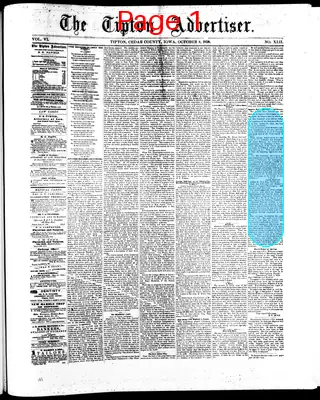
Editorial
October 8, 1859
The Tipton Advertiser
Tipton, Cedar County, Iowa
What is this article about?
Editorial critiques the 'Squatter Sovereignty' doctrine advocated by Douglas and Democrats, tracing its origins to Gen. Arthur St. Clair's 1802 address, his dismissal by Jefferson and Madison, rejection in 1848 Democratic convention, and revival during Wilmot Proviso debates.
Clipping
OCR Quality
95%
Excellent
Full Text
No Matter Sovereignty—an Item of History:
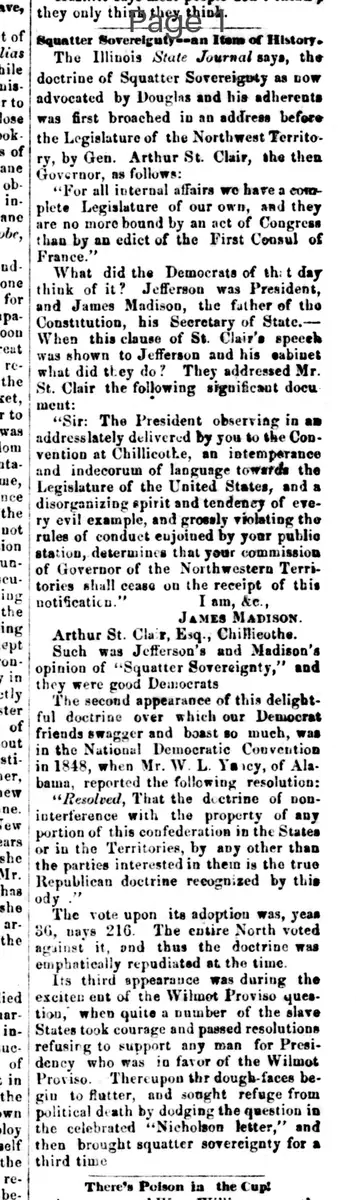
The Illinois State Journal says, the doctrine of Squatter Sovereignty as now advocated by Douglas and his adherents was first broached in an address before the Legislature of the Northwest Territory, by Gen. Arthur St. Clair, the then Governor, as follows:
"For all internal affairs we have a complete Legislature of our own, and they are no more bound by an act of Congress than by an edict of the First Consul of France."
What did the Democrats of the day think of it? Jefferson was President, and James Madison, the father of the Constitution, his Secretary of State. When this clause of St. Clair's speech was shown to Jefferson and his cabinet what did they do? They addressed Mr. St. Clair the following significant document:
"Sir: The President observing in an address lately delivered by you to the Convention at Chillicothe, an intemperance and indecorum of language towards the Legislature of the United States, and a disorganizing spirit and tendency of every evil example, and grossly violating the rules of conduct enjoined by your public station, determines that your commission of Governor of the Northwestern Territories shall cease on the receipt of this notification.'
I am, &c.,
James Madison.
Arthur St. Clair, Esq., Chillicothe.
Such was Jefferson's and Madison's opinion of "Squatter Sovereignty," and they were good Democrats
The second appearance of this delightful doctrine over which our Democrat friends swagger and boast so much, was in the National Democratic Convention in 1848, when Mr. W. L. Yancey, of Alabama, reported the following resolution:
"Resolved, That the doctrine of non-interference with the property of any portion of this confederation in the States or in the Territories, by any other than the parties interested in them is the true Republican doctrine recognized by this body"
The vote upon its adoption was, yeas 36, nays 216. The entire North voted against it, and thus the doctrine was emphatically repudiated at the time.
Its third appearance was during the excitement of the Wilmot Proviso question, when quite a number of the slave States took courage and passed resolutions refusing to support any man for Presidency who was in favor of the Wilmot Proviso. Thereupon the dough-faces began to flutter, and sought refuge from political death by dodging the question in the celebrated "Nicholson letter," and then brought squatter sovereignty for a third time
The Illinois State Journal says, the doctrine of Squatter Sovereignty as now advocated by Douglas and his adherents was first broached in an address before the Legislature of the Northwest Territory, by Gen. Arthur St. Clair, the then Governor, as follows:
"For all internal affairs we have a complete Legislature of our own, and they are no more bound by an act of Congress than by an edict of the First Consul of France."
What did the Democrats of the day think of it? Jefferson was President, and James Madison, the father of the Constitution, his Secretary of State. When this clause of St. Clair's speech was shown to Jefferson and his cabinet what did they do? They addressed Mr. St. Clair the following significant document:
"Sir: The President observing in an address lately delivered by you to the Convention at Chillicothe, an intemperance and indecorum of language towards the Legislature of the United States, and a disorganizing spirit and tendency of every evil example, and grossly violating the rules of conduct enjoined by your public station, determines that your commission of Governor of the Northwestern Territories shall cease on the receipt of this notification.'
I am, &c.,
James Madison.
Arthur St. Clair, Esq., Chillicothe.
Such was Jefferson's and Madison's opinion of "Squatter Sovereignty," and they were good Democrats
The second appearance of this delightful doctrine over which our Democrat friends swagger and boast so much, was in the National Democratic Convention in 1848, when Mr. W. L. Yancey, of Alabama, reported the following resolution:
"Resolved, That the doctrine of non-interference with the property of any portion of this confederation in the States or in the Territories, by any other than the parties interested in them is the true Republican doctrine recognized by this body"
The vote upon its adoption was, yeas 36, nays 216. The entire North voted against it, and thus the doctrine was emphatically repudiated at the time.
Its third appearance was during the excitement of the Wilmot Proviso question, when quite a number of the slave States took courage and passed resolutions refusing to support any man for Presidency who was in favor of the Wilmot Proviso. Thereupon the dough-faces began to flutter, and sought refuge from political death by dodging the question in the celebrated "Nicholson letter," and then brought squatter sovereignty for a third time
What sub-type of article is it?
Partisan Politics
Constitutional
Slavery Abolition
What keywords are associated?
Squatter Sovereignty
Arthur St Clair
Thomas Jefferson
James Madison
W L Yancey
Wilmot Proviso
Democratic Convention 1848
What entities or persons were involved?
Douglas
Arthur St. Clair
Thomas Jefferson
James Madison
W. L. Yancey
Democrats
Editorial Details
Primary Topic
Historical Origins And Rejection Of Squatter Sovereignty Doctrine
Stance / Tone
Strongly Anti Democratic Critique
Key Figures
Douglas
Arthur St. Clair
Thomas Jefferson
James Madison
W. L. Yancey
Democrats
Key Arguments
Squatter Sovereignty First Broached By St. Clair In Northwest Territory Address
St. Clair Dismissed By Jefferson And Madison For Disorganizing Language
Jefferson And Madison, As Democrats, Opposed The Doctrine
Rejected In 1848 Democratic Convention With 36 Yeas, 216 Nays
Revived During Wilmot Proviso Debates Via Nicholson Letter