Thank you for visiting SNEWPapers!
Sign up free
Editorial
February 11, 1884
The Indianapolis Journal
Indianapolis, Marion County, Indiana
What is this article about?
The editorial praises General Sherman's quiet retirement from command as exemplifying American republican simplicity and the nation's enduring strength, contrasting it with Old World autocracies and highlighting historical leaders' selflessness amid wars and crises.
Clipping
OCR Quality
98%
Excellent
Full Text
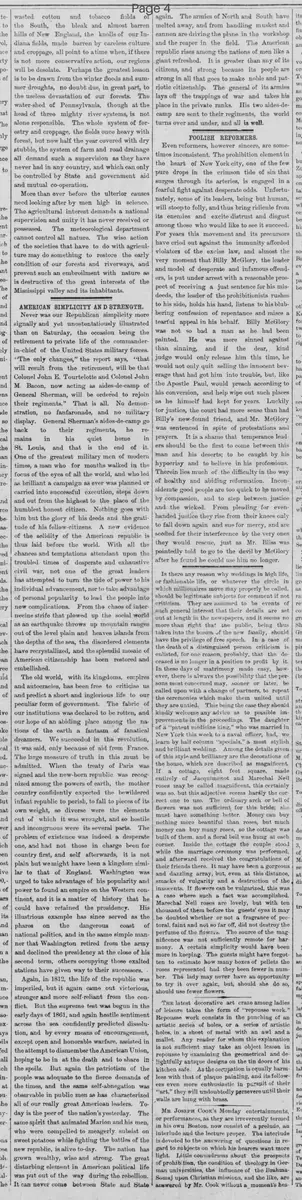
AMERICAN SIMPLICITY AND STRENGTH.
Never was our Republican simplicity more signally and yet unostentatiously illustrated than on Saturday, the occasion being the retirement to private life of the commander-in-chief of the United States military forces. "The only changes," the report says, "that will result from the retirement, will be that Colonel John E. Tourtelotte and Colonel John M. Bacon, now acting as aides-de-camp of General Sherman, will be ordered to rejoin their regiments." That is all. No demonstration, no fanfaronade, and no military display. General Sherman's aides-de-camp go back to their regiments, he remains in his quiet home in St. Louis, and that is the end of it.
One of the greatest military men of modern times, a man who for months walked in the focus of the eyes of all the world, and who led as brilliant a campaign as ever was planned or carried into successful execution, steps down and out from the highest to the place of the humblest honest citizen. Nothing goes with him but the glory of his deeds and the gratitude of his fellow-citizens. A new evidence of the solidity of the American republic is thus laid before the world. With all the chances and temptations attendant upon the troubled times of desperate and exhaustive civil war, not one of the great leaders has attempted to turn the tide of power to his individual advancement, nor to take advantage of personal popularity to lead the people into new complications. From the chaos of internecine strife that plowed up the social world as an earthquake throws up mountain ranges out of the level plain and heaves islands from the depths of the sea, the disordered elements have recrystallized, and the splendid mosaic of American citizenship has been restored and embellished.
The old world, with its kingdoms, empires and autocracies, has been free to criticise us and predict a short and inglorious life to our peculiar form of government. The fabric of our institutions was declared to be rotten, and our hope of an abiding place among the nations of the earth a fantasm of fanatical dreamers. We succeeded in the revolution, it was said, only because of aid from France. The large measure of truth in this must be admitted. When the treaty of Paris was signed and the new-born republic was recognized among the powers of earth, the mother country confidently expected the bewildered infant republic to perish, to fall to pieces of its own weight, so diverse were the elements out of which it was wrought, and so hostile and incongruous were its several parts. The problem of existence was indeed a desperate one, and had not those in charge been for country first, and self afterwards, it is not plain but we might have been a kingdom similar to that of England. Washington was urged to take advantage of his popularity and power to found an empire on the Western continent, and it is a matter of history that he could have retained the presidency. His illustrious example has since served as the pharos on the dangerous coast of national politics, and in the same simple manner that Washington retired from the army and declined the presidency at the close of his second term, others occupying those exalted stations have given way to their successors.
Again, in 1812, the life of the republic was imperiled, but it again came out victorious, stronger and more self-reliant from the conflict. But the supreme test was begun in the early days of 1861, and again hostile sentiment across the sea confidently predicted dissolution, and by every means of encouragement, except open and honorable warfare, assisted in the attempt to dismember the American Union, hoping to be in at the death and to share in the spoils. But again the patriotism of the people was adequate to the fierce demands of the times, and the same self-abnegation was observable in public men as has characterized all of our really great American leaders. Today is the peer of the nation's yesterday. The same spirit that animated Marion and his men, who were compelled to meagerly subsist on sweet potatoes while fighting the battles of the new republic, is alive to-day. The nation has grown wealthy, wise and strong. The great disturbing element in American political life was put out of the way during the rebellion. It can never come between State and State again. The armies of North and South have melted away, and from handling musket and cannon are driving the plane in the workshop and the reaper in the field. The American republic rises among the nations of men like a giant refreshed. It is greater than any of its citizens, and strong because its people are strong in all that goes to make noble and patriotic citizenship. The general of its armies lays off the trappings of war and takes his place in the private ranks. His two aides-de-camp are sent to their regiments, the world turns over and under, and all is well.
Never was our Republican simplicity more signally and yet unostentatiously illustrated than on Saturday, the occasion being the retirement to private life of the commander-in-chief of the United States military forces. "The only changes," the report says, "that will result from the retirement, will be that Colonel John E. Tourtelotte and Colonel John M. Bacon, now acting as aides-de-camp of General Sherman, will be ordered to rejoin their regiments." That is all. No demonstration, no fanfaronade, and no military display. General Sherman's aides-de-camp go back to their regiments, he remains in his quiet home in St. Louis, and that is the end of it.
One of the greatest military men of modern times, a man who for months walked in the focus of the eyes of all the world, and who led as brilliant a campaign as ever was planned or carried into successful execution, steps down and out from the highest to the place of the humblest honest citizen. Nothing goes with him but the glory of his deeds and the gratitude of his fellow-citizens. A new evidence of the solidity of the American republic is thus laid before the world. With all the chances and temptations attendant upon the troubled times of desperate and exhaustive civil war, not one of the great leaders has attempted to turn the tide of power to his individual advancement, nor to take advantage of personal popularity to lead the people into new complications. From the chaos of internecine strife that plowed up the social world as an earthquake throws up mountain ranges out of the level plain and heaves islands from the depths of the sea, the disordered elements have recrystallized, and the splendid mosaic of American citizenship has been restored and embellished.
The old world, with its kingdoms, empires and autocracies, has been free to criticise us and predict a short and inglorious life to our peculiar form of government. The fabric of our institutions was declared to be rotten, and our hope of an abiding place among the nations of the earth a fantasm of fanatical dreamers. We succeeded in the revolution, it was said, only because of aid from France. The large measure of truth in this must be admitted. When the treaty of Paris was signed and the new-born republic was recognized among the powers of earth, the mother country confidently expected the bewildered infant republic to perish, to fall to pieces of its own weight, so diverse were the elements out of which it was wrought, and so hostile and incongruous were its several parts. The problem of existence was indeed a desperate one, and had not those in charge been for country first, and self afterwards, it is not plain but we might have been a kingdom similar to that of England. Washington was urged to take advantage of his popularity and power to found an empire on the Western continent, and it is a matter of history that he could have retained the presidency. His illustrious example has since served as the pharos on the dangerous coast of national politics, and in the same simple manner that Washington retired from the army and declined the presidency at the close of his second term, others occupying those exalted stations have given way to their successors.
Again, in 1812, the life of the republic was imperiled, but it again came out victorious, stronger and more self-reliant from the conflict. But the supreme test was begun in the early days of 1861, and again hostile sentiment across the sea confidently predicted dissolution, and by every means of encouragement, except open and honorable warfare, assisted in the attempt to dismember the American Union, hoping to be in at the death and to share in the spoils. But again the patriotism of the people was adequate to the fierce demands of the times, and the same self-abnegation was observable in public men as has characterized all of our really great American leaders. Today is the peer of the nation's yesterday. The same spirit that animated Marion and his men, who were compelled to meagerly subsist on sweet potatoes while fighting the battles of the new republic, is alive to-day. The nation has grown wealthy, wise and strong. The great disturbing element in American political life was put out of the way during the rebellion. It can never come between State and State again. The armies of North and South have melted away, and from handling musket and cannon are driving the plane in the workshop and the reaper in the field. The American republic rises among the nations of men like a giant refreshed. It is greater than any of its citizens, and strong because its people are strong in all that goes to make noble and patriotic citizenship. The general of its armies lays off the trappings of war and takes his place in the private ranks. His two aides-de-camp are sent to their regiments, the world turns over and under, and all is well.
What sub-type of article is it?
Constitutional
Military Affairs
War Or Peace
What keywords are associated?
Republican Simplicity
General Sherman Retirement
American Republic Strength
Military Leadership
Patriotic Self Abnegation
What entities or persons were involved?
General Sherman
Colonel John E. Tourtelotte
Colonel John M. Bacon
Washington
Marion
Editorial Details
Primary Topic
General Sherman's Retirement Illustrating American Republican Simplicity And Strength
Stance / Tone
Praiseworthy Of American Republican Virtues And Institutional Solidity
Key Figures
General Sherman
Colonel John E. Tourtelotte
Colonel John M. Bacon
Washington
Marion
Key Arguments
Republican Simplicity Shown In Sherman's Unostentatious Retirement
American Military Leaders Prioritize Country Over Personal Power
Historical Examples Like Washington Demonstrate Self Abnegation
Republic Survived Revolutions, War Of 1812, And Civil War Through Patriotism
Civil War Resolved Major Political Disturbances, Strengthening The Union