Thank you for visiting SNEWPapers!
Sign up free
The Silver State
Winnemucca, Humboldt County, Nevada
What is this article about?
F. H. Taylor in Mancos, Colorado, successfully used a coyote-proof fence to enclose 500 acres, saving 100% of lambs from 1,000 ewes with one man, compared to 95% outside with three men and hounds. The method, inspired by U.S. Department of Agriculture experiment in Oregon, improves forage use and sheep condition.
Merged-components note: Image follows immediately in reading order and thematically matches the article on sheep fencing.
Clipping
OCR Quality
Full Text
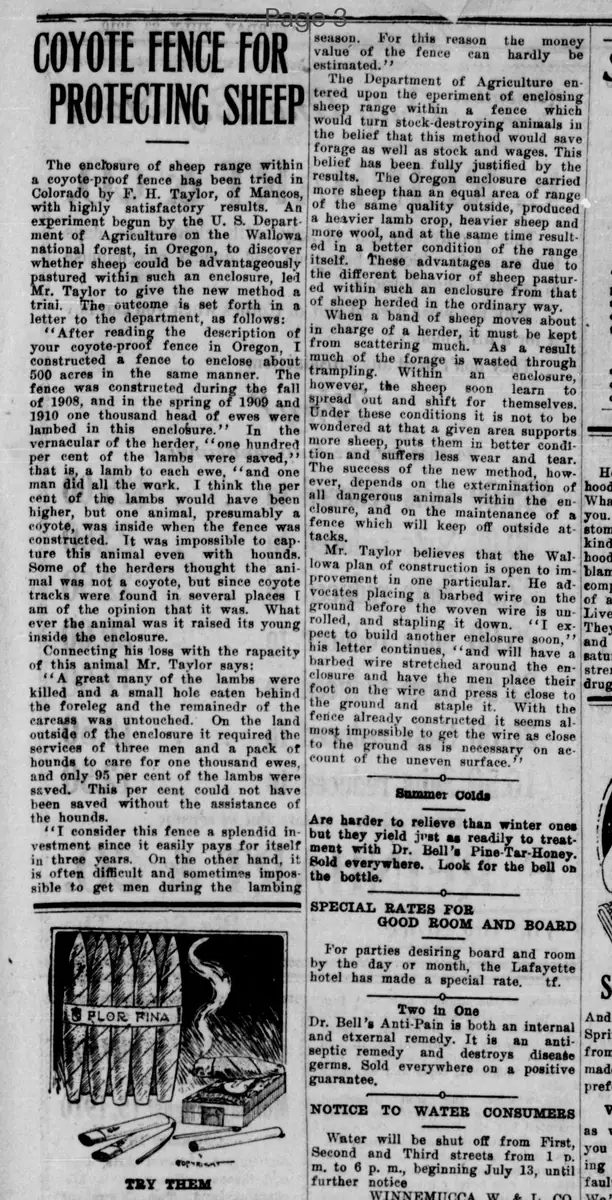
The enclosure of sheep range within a coyote-proof fence has been tried in Colorado by F. H. Taylor, of Mancos, with highly satisfactory results. An experiment begun by the U. S. Department of Agriculture on the Wallowa national forest, in Oregon, to discover whether sheep could be advantageously pastured within such an enclosure, led Mr. Taylor to give the new method a trial. The outcome is set forth in a letter to the department, as follows:
"After reading the description of your coyote-proof fence in Oregon, I constructed a fence to enclose about 500 acres in the same manner. The fence was constructed during the fall of 1908, and in the spring of 1909 and 1910 one thousand head of ewes were lambed in this enclosure." In the vernacular of the herder, "one hundred per cent of the lambs were saved." that is, a lamb to each ewe, "and one man did all the work. I think the per cent of the lambs would have been higher, but one animal, presumably a coyote, was inside when the fence was constructed. It was impossible to capture this animal even with hounds. Some of the herders thought the animal was not a coyote, but since coyote tracks were found in several places I am of the opinion that it was. Whatever the animal was it raised its young inside the enclosure.
Connecting his loss with the rapacity of this animal Mr. Taylor says:
"A great many of the lambs were killed and a small hole eaten behind the foreleg and the remainder of the carcass was untouched. On the land outside of the enclosure it required the services of three men and a pack of hounds to care for one thousand ewes, and only 95 per cent of the lambs were saved. This per cent could not have been saved without the assistance of the hounds.
"I consider this fence a splendid investment since it easily pays for itself in three years. On the other hand, it is often difficult and sometimes impossible to get men during the lambing season. For this reason the money value of the fence can hardly be estimated."
The Department of Agriculture entered upon the experiment of enclosing sheep range within a fence which would turn stock-destroying animals in the belief that this method would save forage as well as stock and wages. This belief has been fully justified by the results. The Oregon enclosure carried more sheep than an equal area of range of the same quality outside, produced a heavier lamb crop, heavier sheep and more wool, and at the same time resulted in a better condition of the range itself. These advantages are due to the different behavior of sheep pastured within such an enclosure from that of sheep herded in the ordinary way.
When a band of sheep moves about in charge of a herder, it must be kept from scattering much. As a result much of the forage is wasted through trampling. Within an enclosure, however, the sheep soon learn to spread out and shift for themselves. Under these conditions it is not to be wondered at that a given area supports more sheep, puts them in better condition and suffers less wear and tear.
The success of the new method, however, depends on the extermination of all dangerous animals within the enclosure, and on the maintenance of a fence which will keep off outside attacks.
Mr. Taylor believes that the Wallowa plan of construction is open to improvement in one particular. He advocates placing a barbed wire on the ground before the woven wire is unrolled, and stapling it down. "I expect to build another enclosure soon," his letter continues, "and will have a barbed wire stretched around the enclosure and have the men place their foot on the wire and press it close to the ground and staple it. With the fence already constructed it seems almost impossible to get the wire as close to the ground as is necessary on account of the uneven surface."
What sub-type of article is it?
What themes does it cover?
What keywords are associated?
What entities or persons were involved?
Where did it happen?
Story Details
Key Persons
Location
Mancos, Colorado; Wallowa National Forest, Oregon
Event Date
1908 1910
Story Details
F. H. Taylor built a coyote-proof fence enclosing 500 acres in Colorado, inspired by a U.S. Department of Agriculture experiment in Oregon, achieving 100% lamb survival with one herder, versus 95% outside requiring three men and hounds; the method saves labor, improves range condition, and boosts production.