Thank you for visiting SNEWPapers!
Sign up free
Malvern Times=Journal
Malvern, Hot Spring County, Arkansas
What is this article about?
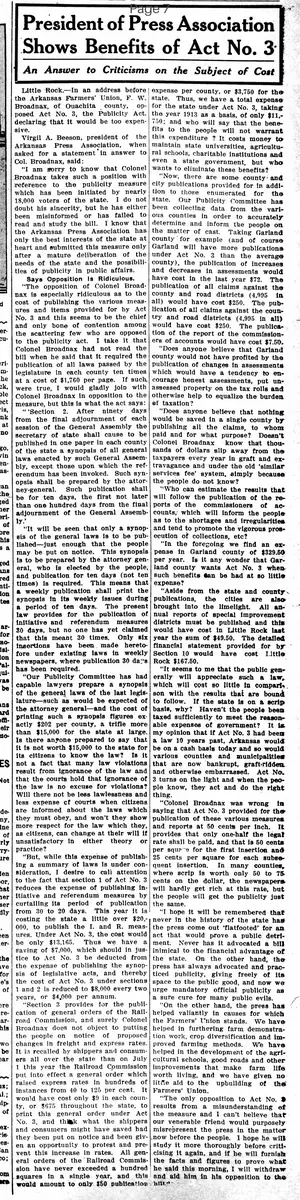
In Little Rock, Arkansas, Virgil A. Beeson, president of the Arkansas Press Association, defends Act No. 3 (Publicity Act) against criticisms by F. W. Broadnax of the Farmers' Union, who claimed it was too expensive. Beeson clarifies costs, benefits, and savings, estimating net state expense at $4,000 annually.
Clipping
OCR Quality
Full Text
Shows
Benefits of Act No. 3
An
Answer
to
Criticisms
on the
Subject of Cost
Little Rock.—In an address before the Arkansas Farmers' Union, F. W. Broadnax, of Ouachita county, opposed Act No. 3, the Publicity Act, declaring that it would be too expensive.
Virgil A. Beeson, president of the Arkansas Press Association, when asked for a statement in answer to Col. Broadnax, said:
"I am sorry to know that Colonel Broadnax takes such a position with reference to the publicity measure which has been initiated by nearly 18,000 voters of the state. I do not doubt his sincerity, but he has either been misinformed or has failed to read and study the bill. I know that the Arkansas Press Association has only the best interests of the state at heart and submitted this measure only after a mature deliberation of the needs of the state and the possibilities of publicity in public affairs.
Says Opposition Is Ridiculous.
"The opposition of Colonel Broadnax is especially ridiculous as to the cost of publishing the various measures and items provided for by Act No. 3 and this seems to be the chief and only bone of contention among the scattering few who are opposed to the publicity act. I take it that Colonel Broadnax had not read the bill when he said that it required the publication of all laws passed by the legislature in each county ten times at a cost of $1,760 per page. If such were true, I would gladly join with Colonel Broadnax in opposition to the measure, but this is what the act says:
" 'Section 2. After ninety days from the final adjournment of each session of the General Assembly the secretary of state shall cause to be published in one paper in each county of the state a synopsis of all general laws enacted by such General Assembly, except those upon which the referendum has been invoked. Such synopsis shall be prepared by the attorney-general.
Such publication shall be for ten days, the first not later than one hundred days from the final adjournment of the General Assembly.'
"It will be seen that only a synopsis of the general laws is to be published—just enough that the people may be put on notice. This synopsis is to be prepared by the attorney general, who is elected by the people, and publication for ten days (not ten times) is required. This means that a weekly publication shall print the synopsis in its weekly issues during a period of ten days. The present law provides for the publication of initiative and referendum measures 30 days, but no one has yet claimed that this meant 30 times. Only six insertions have been made heretofore under existing laws in weekly newspapers, where publication 30 days has been required.
"Our Publicity Committee has had capable lawyers prepare a synopsis of the general laws of the last legislature—such as would be expected of the attorney general—and the cost of printing such a synopsis figures exactly $202 per county, a trifle more than $15,000 for the state at large.
Is there anyone prepared to say that it is not worth $15,000 to the state for its citizens to know the law? Is it not a fact that many law violations result from ignorance of the law and that the courts hold that ignorance of the law is no excuse for violations?
Will there not be less lawlessness and less expense of courts when citizens are informed about the laws which they must obey, and won't they show more respect for the law which they as citizens, can change at their will if unsatisfactory in either theory or practice?
"But, while this expense of publishing a summary of laws is under consideration, I desire to call attention to the fact that section 1 of Act No. 3 reduces the expense of publishing initiative and referendum measures by curtailing its period of publication from 30 to 20 days. This year it is costing the state a little over $20,000, to publish the I. and R. measures. Under Act No. 3, the cost would be only $13,165. Thus we have a saving of $7,000, which should in justice to Act No. 3 be deducted from the expense of publishing the synopsis of legislative acts, and thereby the cost of Act No. 3 under sections 1 and 2 is reduced to $8,000 every two years, or $4,000 per annum.
"Section 3 provides for the publication of general orders of the Railroad Commission, and surely Colonel Broadnax does not object to putting the people on notice of proposed changes in freight and express rates. It is recalled by shippers and consumers all over the state than on July 1 this year the Railroad Commission put into effect a general order which raised express rates in hundreds of instances from 40 to 125 per cent. It would have cost only $9 in each county, or $675 throughout the state, to print this general order under Act No. 3, and think what the shippers and consumers might have saved had they been put on notice and been given an opportunity to protest and prevent this increase in rates. All general orders of the Railroad Commission have never exceeded a hundred squares in a single year, and this would amount to only $50 publication expense per county, or $3,750 for the state. Thus, we have a total expense for the state under Act No. 3, taking the year 1913 as a basis, of only $11,750; and who will say that the benefits to the people will not warrant this expenditure? It costs money to maintain state universities, agricultural schools, charitable institutions and even a state government, but who wants to eliminate these benefits?
"Now, there are some county and city publications provided for in addition to those enumerated for the state. Our Publicity Committee has been collecting data from the various counties in order to accurately determine and inform the people on the matter of cost. Taking Garland county for example (and of course Garland will have more publications under Act No. 3 than the average county), the publication of increases and decreases in assessments would have cost in the last year $72. The publication of all claims against the county and road districts (4,995 in all) would have cost $250. The publication of the report of the commissioners of accounts would have cost $7.50.
"Does anyone believe that Garland county would not have profited by the publication of changes in assessments which would have a tendency to encourage honest assessments, put unassessed property on the tax rolls and otherwise help to equalize the burden of taxation?
"Does anyone believe that nothing would be saved in a single county by publishing all the claims, to whom paid and for what purpose? Doesn't Colonel Broadnax know that thousands of dollars slip away from the taxpayers every year in graft and extravagance and under the old 'similar services fee' system, simply because the people do not know?
"Who can estimate the results that will follow the publication of the reports of the commissioners of accounts, which will inform the people as to the shortages and irregularities and tend to promote the vigorous prosecution of collections, etc?
"In the foregoing we find an expense in Garland county of $329.50 per year. Is it any wonder that Garland county wants Act No. 3 when such benefits can be had at so little expense?
"Aside from the state and county publications, the cities are also brought into the limelight. All annual reports of special improvement districts must be published and this would have cost in Little Rock last year the sum of $49.50. The detailed financial statement provided for by Section 10 would have cost Little Rock $167.50.
"It seems to me that the public generally will appreciate such a law, which will cost so little in comparison with the results that are bound to follow. If the state is on a scrip basis, why? Haven't the people been taxed sufficiently to meet the reasonable expenses of government? It is my opinion that if Act No. 3 had been a law 10 years past, Arkansas would be on a cash basis today and so would various counties and municipalities that are now bankrupt, graft-ridden and otherwise embarrassed. Act No. 3 turns on the light and when the people know, they act and do the right thing.
"Colonel Broadnax was wrong in saying that Act No. 3 provided for the publication of these various measures and reports at 50 cents per inch. It provides that only one-half the legal rate shall be paid, and that is 50 cents per square for the first insertion and 25 cents per square for each subsequent insertion. In many counties, where scrip is worth only 50 to 75 cents on the dollar, the newspapers will hardly get rich at this rate, but the people will get the publicity just the same.
"I hope it will be remembered that never in the history of the state has the press come out 'flatfooted' for an act that would prove a public detriment. Never has it advocated a bill inimical to the financial advantage of the state. On the other hand, the press has always advocated and practiced publicity, giving freely of its space to the public good, and now we urge mandatory official publicity as a sure cure for many public evils.
"On the other hand, the press has helped valiantly in causes for which the Farmers' Union stands. We have helped in furthering farm demonstration work, crop diversification and improved farming methods. We have helped in the development of the agricultural schools, good roads and other improvements that make farm life worth living, and we have given no little aid to the upbuilding of the Farmers' Union.
"The only opposition to Act No. 3 results from a misunderstanding of the measure and I can't believe that our venerable friend would purposely misrepresent the press in the matter now before the people. I hope he will study it more thoroughly before criticizing it again, and if he will furnish the facts and figures to prove what he said this morning, I will withdraw and aid him in his opposition to the hilt."
What sub-type of article is it?
What keywords are associated?
What entities or persons were involved?
Where did it happen?
Domestic News Details
Primary Location
Little Rock, Arkansas
Key Persons
Outcome
beeson defends the act, estimating net annual cost at $4,000 with benefits including reduced lawlessness, savings on publications, and increased transparency in government finances.
Event Details
F. W. Broadnax opposes Act No. 3 before the Arkansas Farmers' Union, citing high costs. Virgil A. Beeson responds, clarifying that the act requires publishing synopses of laws, railroad orders, and local reports at low cost, promoting public awareness and accountability.