Thank you for visiting SNEWPapers!
Sign up free
The Rhode Islander
Newport, Newport County, Rhode Island
What is this article about?
The ship Charles, departing New Orleans on November 1 with 26 people aboard, was found abandoned on November 4 near the Lighthouse with signs of violence, leading to suspicions of mutiny, piracy, or murder. Searches were launched, and a later report added confusion about the captain's survival.
Merged-components note: These components continue the story of the murder and piracy on the ship Charles, including additional mystery and details from later reports.
Clipping
OCR Quality
Full Text
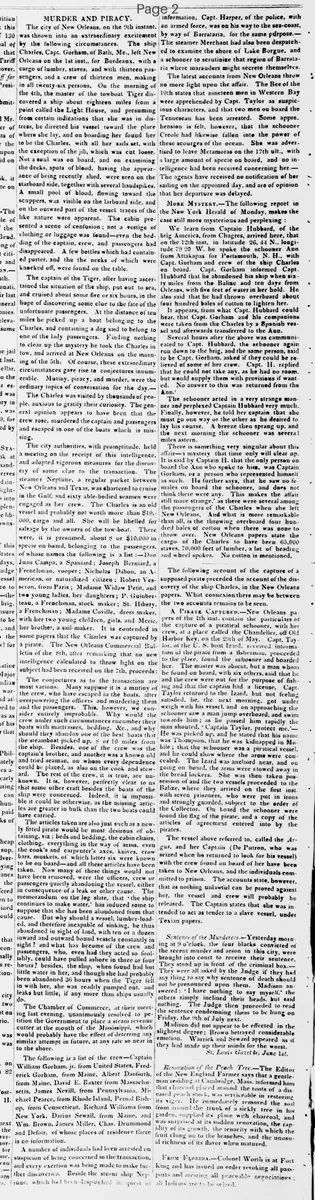
The city of New Orleans, on the 9th instant, was thrown into an extraordinary excitement by the following circumstances. The ship Charles, Capt. Gorham, of Bath, Me., left New Orleans on the 1st inst., for Bordeaux, with cargo of lumber, staves, and with thirteen passengers, and a crew of thirteen men, making in all twenty-six persons. On the morning of the 4th, the master of the towboat Tiger discovered a ship about eighteen miles from a point called the Light House, and presuming from certain indications that she was in distress, he directed his vessel toward the place where she lay, and on boarding her found her to be the Charles, with all her sails set, with the exception of the jib, which was cut loose.
Not a soul was on board, and on examining the decks, spots of blood, having the appearance of being recently shed, were seen on the starboard side, together with several handspikes. A small pool of blood, flowing toward the scuppers, was visible on the larboard side, and on the outward part of the vessel traces of the like nature were apparent. The cabin presented a scene of confusion; not a vestige of clothing or luggage was found—even the bedding of the captain, crew, and passengers had disappeared. A few bottles which had contained porter, and the necks of which were knocked off, were found on the table.
The captain of the Tiger, after having ascertained the situation of the ship, put out to sea, and cruised about some five or six hours, in the hope of discovering some clue to the fate of the unfortunate passengers. At the distance of ten miles he picked up a boat belonging to the Charles, and containing a dog said to belong to one of the lady passengers. Finding nothing to clear up the mystery he took the Charles in tow, and arrived at New Orleans on the morning of the 5th. Of course, these extraordinary circumstances gave rise to conjectures innumerable. Mutiny, piracy, and murder, were the ordinary topics of conversation for the day. The Charles was visited by thousands of people, anxious to gratify their curiosity. The general opinion appears to have been that the crew rose, murdered the captain and passengers and escaped in one of the boats which is missing.
The city authorities, with promptitude, held a meeting on the receipt of this intelligence and adopted vigorous measures for the discovery of some clue to the transaction. The steamer Neptune, a regular packet between New Orleans and Texas, was chartered to cruise in the Gulf, and sixty able-bodied seamen were engaged as her crew. The Charles is an old vessel and probably not worth more than $10,000, cargo and all. She will be libelled for salvage by the owners of the tow-boat. There were, it is presumed, about $8 or $10,000 in specie on board, belonging to the passengers of whose names the following is a list:—Don Juan Campa, a Spaniard; Joseph Berniard, a Frenchman, cooper; Nicholas Dabon, an American, or naturalized citizen; Robert Vesseron, from Paris; Madame Widow Petit, and two young ladies, her daughters; P. Guinberteau, a Frenchman, stock maker; St. Hibery, a Frenchman; Madame Coville, dress maker, with her two young children, girls, and Marie, her brother, a sail-maker. It is contended in some papers that the Charles was captured by a pirate. The New Orleans Commercial Bulletin of the 5th, after remarking that no new intelligence calculated to throw light on the subject had been received on the 7th, proceeds:
The conjectures as to the transaction are most various. Many suppose it is a mutiny of the crew, who have escaped in the boats, after overpowering the officers and murdering them and the passengers. This, however, we consider entirely improbable. Why would the crew under such circumstances encumber their boats with mattrasses, bedding, &c., and why should they abandon one of the best boats that the steamboat picked up, 8 or 10 miles from the ship. Besides, one of the crew was the captain's brother, and another was a known old and tried seaman, on whom every dependence could be placed, as also on the cook and steward. The rest of the crew, it is true, are unknown. It is, however, perfectly clear to us that some other craft besides the boats of the ship were concerned. Indeed, it is impossible it could be otherwise, as the missing articles are greater in bulk than the two boats could have carried.
The articles taken are also just such as a newly fitted pirate would be most desirous of obtaining, viz: beds and bedding, the cabin chairs, clothing, everything in the way of arms, even the cook's and carpenter's axes, knives, crow bars, muskets, of which latter six were known to be on board—and all these articles have been taken. Now many of these things would not have been removed, were the officers, crew or passengers quietly abandoning the vessel, either in consequence of a leak or other cause. The memorandum on the log slate, that 'the ship continues to make water,' has induced some to suppose that she has been abandoned from that cause. But why should a vessel, lumber-loaded, and therefore incapable of sinking, be thus abandoned in sight of land, with ten or a dozen inward and outward bound vessels constantly in sight? and what has become of the crew and passengers, who, even had they acted so foolishly, could have pulled ashore in three or four hours? besides, the ship, when found had but little water in her, and though she had probably been abandoned 36 hours when the Tiger fell in with her, she was readily pumped out, and leaks but little, if any more than ships usually do.
The Chamber of Commerce, at their meeting last evening, unanimously resolved to petition the Government to place a steam revenue cutter at the mouth of the Mississippi, which would probably have the effect of deterring any similar attempt in future, at any rate so near to the shore.
The following is a list of the crew—Captain William Gorham, jr. from United States, Frederick Gorham, from Maine, Albert Danforth, from Maine, David E. Baxter from Massachusetts, James Nevill, from Pennsylvania, Michael Pearce, from Rhode Island, Perpal Bishop, from Connecticut, Richard Williams from New York, Darius Sewall, from Maine, and Wm. Brown, James Miller, Chas. Drummond and Defoir, of whose places of residence there is no information.
A number of individuals had been arrested on suspicion of being concerned in the transaction, and every exertion was being made to make further discoveries. Beside the steam ship Neptune, which had been despatched in quest of information, Capt. Harper, of the police, with an armed force, was on his way to the sea-coast, by way of Barrataria, for the same purpose. The steamer Merchant had also been despatched to examine the shore of Lake Borgne, and a schooner to scrutinize that region of Barrataria where marauders might secrete themselves.
The latest accounts from New Orleans throw no more light upon the affair. The Bee of the 10th states that nineteen men in Western Bay were apprehended by Capt. Taylor as suspicious characters, and that two men on board the Tennessee has been arrested. Some apprehension is felt, however, that the schooner Creole had likewise fallen into the power of these scourges of the ocean. She was advertised to leave Matamoras on the 17th ult., with a large amount of specie on board, and no intelligence had been received concerning her. The agents have received no notification of her sailing on the appointed day, and are of opinion that her departure was delayed.
More Mystery.—The following report in the New York Herald of Monday, makes the case still more mysterious and perplexing:
We learn from Captain Hubbard, of the brig America, from Chagres, arrived here, that on the 12th inst. in latitude 26. 44 N., longitude 79 20 W. he spoke the schooner Ann from Attakapas for Portsmouth, N.H., with Capt. Gorham and crew of the ship Charles on board. Capt. Gorham informed Capt. Hubbard that he abandoned his ship when sixty miles from the Balize and ten days from Orleans, with five feet of water in her hold. He also said that he had thrown overboard about four hundred bales of cotton to lighten her.
It appears, from what Capt. Hubbard could hear, that Capt. Gorham and his companions were taken from the Charles by a Spanish vessel and afterwards transferred to the Ann.
Several hours after the above was communicated to Capt. Hubbard, the schooner again run down to the brig, and the same person, said to be Capt. Gorham, asked if they could be relieved of some of her crew. Capt. H. replied that he could not take any, as he had no room, but would supply them with provisions if wanted. No answer to this was returned from the Ann.
The schooner acted in a very strange manner and perplexed Captain Hubbard very much. Finally, however, he told her captain that she must go one way or the other as he desired to lay his course. A breeze then sprang up, and the next morning the schooner was several miles astern.
There is something very singular about this affair—a mystery that time only will clear up. It is said by Captain H. that the only person on board the Ann who spoke to him, was Captain Gorham, or a person who represented himself as such. He further says, that he saw no females on board the schooner, and does not think there were any. This makes the affair still more strange, as there were several among the passengers of the Charles when she left New Orleans. And what is more remarkable than all, is the throwing overboard four hundred bales of cotton when there was none to throw over. New Orleans papers state the cargo of the Charles to have been 65,000 staves, 70,000 feet of lumber, a lot of heading and wheel spokes. No cotton is mentioned.
What sub-type of article is it?
What keywords are associated?
What entities or persons were involved?
Where did it happen?
Domestic News Details
Primary Location
New Orleans
Event Date
1st To 5th Instant
Key Persons
Outcome
suspected murder of 26 persons (13 crew, 13 passengers); ship abandoned with signs of violence; searches launched, arrests made; mystery deepened by conflicting report of captain's survival without passengers.
Event Details
The ship Charles left New Orleans on the 1st instant for Bordeaux with lumber cargo and 26 aboard. Found abandoned on the 4th near the Lighthouse with bloodstains, missing items suggesting piracy or mutiny. Towed back on the 5th. Authorities dispatched vessels and forces to investigate. Later report claims Capt. Gorham and crew rescued but inconsistencies noted, no female passengers seen.