Thank you for visiting SNEWPapers!
Sign up free
Story
October 16, 1956
Atlanta Daily World
Atlanta, Fulton County, Georgia
What is this article about?
Opinion piece urging Negro voters to support Eisenhower over Stevenson in 1956 election due to civil rights record, highlighting segregation disparities in Georgia schools, sports cancellations, bus arrests, and Stevenson's evasions versus Eisenhower's actions.
Clipping
OCR Quality
97%
Excellent
Full Text
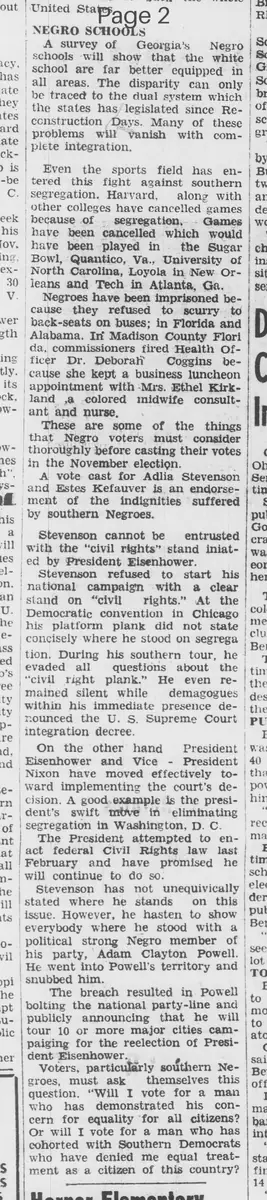
NEGRO SCHOOLS
A survey of Georgia's Negro schools will show that the white schools are far better equipped in all areas. The disparity can only be traced to the dual system which the state has legislated since Reconstruction Days. Many of these problems will vanish with complete integration.
Even the sports field has entered this fight against southern segregation. Harvard, along with other colleges have cancelled games because of segregation. Games have been cancelled which would have been played in the Sugar Bowl, Quantico, Va., University of North Carolina, Loyola in New Orleans and Tech in Atlanta, Ga.
Negroes have been imprisoned because they refused to scurry to back-seats on buses: in Florida and Alabama. In Madison County Florida, commissioners fired Health Officer Dr. Deborah Coggins because she kept a business luncheon appointment with Mrs. Ethel Kirkland a colored midwife consultant and nurse.
These are some of the things that Negro voters must consider thoroughly before casting their votes in the November election.
A vote cast for Adlai Stevenson and Estes Kefauver is an endorsement of the indignities suffered by southern Negroes.
Stevenson cannot be entrusted with the "civil rights" stand initiated by President Eisenhower.
Stevenson refused to start his national campaign with a clear stand on "civil rights." At the Democratic convention in Chicago his platform plank did not state concisely where he stood on segregation. During his southern tour, he evaded all questions about the "civil right plank." He even remained silent while demagogues within his immediate presence denounced the U. S. Supreme Court integration decree.
On the other hand President Eisenhower and Vice-President Nixon have moved effectively toward implementing the court's decision. A good example is the president's swift move in eliminating segregation in Washington, D. C.
The President attempted to enact federal Civil Rights law last February and have promised he will continue to do so.
Stevenson has not unequivocally stated where he stands on this issue. However, he hasten to show everybody where he stood with a political strong Negro member of his party, Adam Clayton Powell.
He went into Powell's territory and snubbed him.
The breach resulted in Powell bolting the national party-line and publicly announcing that he will tour 10 or more major cities campaigning for the reelection of President Eisenhower.
Voters, particularly southern Negroes, must ask themselves this question. Will I vote for a man who has demonstrated his concern for equality for all citizens? Or will I vote for a man who has cohorted with Southern Democrats who have denied me equal treatment as a citizen of this country?
A survey of Georgia's Negro schools will show that the white schools are far better equipped in all areas. The disparity can only be traced to the dual system which the state has legislated since Reconstruction Days. Many of these problems will vanish with complete integration.
Even the sports field has entered this fight against southern segregation. Harvard, along with other colleges have cancelled games because of segregation. Games have been cancelled which would have been played in the Sugar Bowl, Quantico, Va., University of North Carolina, Loyola in New Orleans and Tech in Atlanta, Ga.
Negroes have been imprisoned because they refused to scurry to back-seats on buses: in Florida and Alabama. In Madison County Florida, commissioners fired Health Officer Dr. Deborah Coggins because she kept a business luncheon appointment with Mrs. Ethel Kirkland a colored midwife consultant and nurse.
These are some of the things that Negro voters must consider thoroughly before casting their votes in the November election.
A vote cast for Adlai Stevenson and Estes Kefauver is an endorsement of the indignities suffered by southern Negroes.
Stevenson cannot be entrusted with the "civil rights" stand initiated by President Eisenhower.
Stevenson refused to start his national campaign with a clear stand on "civil rights." At the Democratic convention in Chicago his platform plank did not state concisely where he stood on segregation. During his southern tour, he evaded all questions about the "civil right plank." He even remained silent while demagogues within his immediate presence denounced the U. S. Supreme Court integration decree.
On the other hand President Eisenhower and Vice-President Nixon have moved effectively toward implementing the court's decision. A good example is the president's swift move in eliminating segregation in Washington, D. C.
The President attempted to enact federal Civil Rights law last February and have promised he will continue to do so.
Stevenson has not unequivocally stated where he stands on this issue. However, he hasten to show everybody where he stood with a political strong Negro member of his party, Adam Clayton Powell.
He went into Powell's territory and snubbed him.
The breach resulted in Powell bolting the national party-line and publicly announcing that he will tour 10 or more major cities campaigning for the reelection of President Eisenhower.
Voters, particularly southern Negroes, must ask themselves this question. Will I vote for a man who has demonstrated his concern for equality for all citizens? Or will I vote for a man who has cohorted with Southern Democrats who have denied me equal treatment as a citizen of this country?
What sub-type of article is it?
Political Editorial
Civil Rights Advocacy
What themes does it cover?
Justice
Moral Virtue
What keywords are associated?
Civil Rights
Segregation
1956 Election
Eisenhower
Stevenson
Negro Voters
Integration
What entities or persons were involved?
Adlai Stevenson
Estes Kefauver
President Eisenhower
Vice President Nixon
Dr. Deborah Coggins
Mrs. Ethel Kirkland
Adam Clayton Powell
Where did it happen?
Southern United States, Georgia, Florida, Alabama, Washington D.C.
Story Details
Key Persons
Adlai Stevenson
Estes Kefauver
President Eisenhower
Vice President Nixon
Dr. Deborah Coggins
Mrs. Ethel Kirkland
Adam Clayton Powell
Location
Southern United States, Georgia, Florida, Alabama, Washington D.C.
Event Date
1956
Story Details
The article criticizes segregation in Southern schools and society, highlights civil rights actions and inactions by political candidates, and urges Negro voters to support Eisenhower for his commitment to integration and civil rights over Stevenson's evasiveness.