Thank you for visiting SNEWPapers!
Sign up free
The National Intelligencer And Washington Advertiser
Washington, District Of Columbia
What is this article about?
Mr. Hopkinson's speech in defense of Judge Samuel Chase during his impeachment trial, emphasizing judicial independence and addressing charges related to the 1800 trial of John Fries in Philadelphia for treason, arguing no prejudice or oppression occurred.
Merged-components note: This is a continuation of the article on the Impeachment of Judge Chase across pages 1 and 2, as indicated by the sequential reading order and the text flow.
Clippings
1 of 2
OCR Quality
Full Text
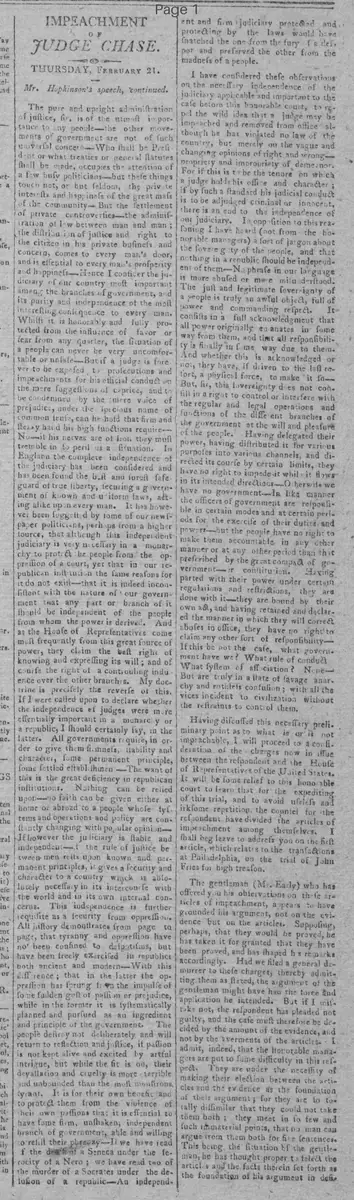
THURSDAY, FEBRUARY 21.
Mr. Hopkinson's speech, continued.
The pure and upright administration of justice, sir, is of the nature of importance to any people—the other movements of government are not of such universal concern---Who shall be President or what treaties or general measures shall be made, occupies the attention of a few but politicians—but these things touch not, or but seldom, the private interests and happiness of the great mass of the community— But the settlement of private controversies—the administration of law between man and man; the distribution of justice and right to the citizen in his private business and concern, comes to every man's door, and is essential to every man's prosperity and happiness—Hence I consider the judiciary of our country most important among the branches of government, and its purity and independence of the most interesting consequence to every man.
Whilst it is honorably and fully protected from the influence of favor or fear from any quarter, the situation of a people can never be very uncomfortable or unsafe But if a judge is forever to be exposed to prosecutions and impeachments for his official conduct by the mere suggestions of caprice, and to be condemned by the mere voice of prejudice, under the specious name of common sense, can he hold that firm and steady hand his high functions require--- No—if his nerves are not of iron they must tremble in so perilous a situation. In England the complete independence of the judiciary has been considered and has been found the best and surest safeguard of true liberty, securing a government of known and uniform laws, acting alike upon every man. It has however been suggested by some of our newspaper politicians, perhaps from a higher source, that although this independent judiciary is very necessary in a monarchy to protect the people from the oppression of a court, yet that in our republican institution the same reasons for it do not exist—that it is indeed inconsistent with the nature of our government that any part or branch of it should be independent of the people from whom the power is derived. And as the House of Representatives come most frequently from this great source of power, they claim the best right of knowing and expressing its will; and of course the right of a controlling influence over the other branches. My doctrine is precisely the reverse of this.
If I were called upon to declare whether the independence of judges were more essentially important in a monarchy or a republic, I should certainly say, in the latter. All governments require, in order to give them firmness, stability and character, some permanent principle, some settled establishment—The want of this is the great deficiency in republican institutions. Nothing can be relied upon—no faith can be given either at home or abroad to a people whose systems and operations and policy are constantly changing with popular opinion— If however the judiciary is stable and independent— if the rule of justice between men rests upon known and permanent principles, it gives a security and character to a country which is absolutely necessary in its intercourse with the world and in its own internal concerns. This independence is further requisite as a security from oppression.
All history demonstrates from page to page, that tyranny and oppression have not been confined to despotisms, but have been freely exercised in republics both ancient and modern—With this difference; that in the latter the oppression has sprung from the impulse of one sudden gust of passion or prejudice, while in the former it is systematically planned and pursued as an ingredient and principle of the government. The people destroy not deliberately and will return to reflection and justice, if passion is not kept alive and excited by artful intrigue, but while the fit is on, their devastation and cruelty is more terrible and unbounded than the most monstrous tyrant. It is for their own benefit and to protect them from the violence of their own passions that it is essential to have some firm, unshaken, independent branch of government, able and willing to resist their phrenzy—If we have read of the death of a Seneca under the ferocity of a Nero ; we have read too of the murder of a Socrates under the delusion of a republic—An independent judiciary protected and protecting by the laws would have snatched the one from the fury of a despot and preserved the other from the madness of a people.
I have considered these observations on the necessary independence of the judiciary applicable and important to the case before this honorable court, to repel the wild idea that a judge may be impeached and removed from office although he has violated no law of the country, but merely on the vague and changing opinions of right and wrong— propriety and impropriety of demeanor. For if this is to be the tenure on which a judge holds his office and character ; if by such a standard his judicial conduct is to be adjudged criminal or innocent, there is an end to the independence of our judiciary. In opposition to this reasoning I have heard (not from the honorable managers) a sort of jargon about the sovereignty of the people, and that nothing in a republic should be independent of them— A phrase in our language is more abused or more misunderstood.
The just and legitimate sovereignty of a people is truly an awful object, full of power and commanding respect. It consists in a full acknowledgment that all power originally emanates in some way from them. and that all responsibility is finally in some way due to them— And whether this is acknowledged or not, they have, if driven to the last resort, a physical force, to make it so— But, sir, this sovereignty does not consist in a right to control or interfere with the regular and legal operations and functions of the different branches of the government at the will and pleasure of the people. Having delegated their power, having distributed it for various purposes into various channels. and directed its course by certain limits, they have no right to impede it while it flows in its intended directions—Otherwise we have no government—In like manner the officers of government are responsible in certain modes and at certain periods for the exercise of their duties and powers—but the people have no right to make them accountable in any other manner or at any other period than that prescribed by the great compact of government—our constitution. Having parted with their power under certain regulations and restrictions, they are done with it—they are bound by their own act, and having retained and declared the manner in which they will correct abuses in office, they have no right to claim any other sort of responsibility— If this be not the case, what government have we? What rule of conduct What system of legislation? None— But are truly in a state of savage anarchy and ruthless confusion; with all the vices incident to civilization without the restraints to control them.
Having discussed this necessary preliminary point as to what is or is not impeachable, I will proceed to a consideration of the charges now in issue between the respondent and the House of Representatives of the United States.
It will be some relief to this honorable court to learn that for the expediting of this trial, and to avoid useless and irksome repetition. the counsel for the respondent have divided the articles of impeachment among themselves. I shall beg leave to address you on the first article, which relates to the transactions at Philadelphia, on the trial of John Fries for high treason.
The gentleman (Mr. Early) who has offered you his observations on the articles of impeachment, appears to have grounded his argument, not on the evidence but on the articles. Supposing, perhaps, that they would be proved, he has taken it for granted that they have been proved, and has shaped his remarks accordingly. Had we filed a general demurrer to these charges, thereby admitting them as stated, the argument of the gentleman might have had the force and application he intended. But if I mistake not, the respondent has pleaded not guilty, and the case must therefore be decided by the amount of the evidence, and not by the averments of the articles. I admit, indeed, that the honorable managers are put to some difficulty in this respect. They are under the necessity of making their election between the articles and the evidence as the foundation of their argument ; or they are so totally dissimilar that they could not take them both : they meet in so few and such immaterial points, that no man can argue from them both for sentences. This being the situation of the gentleman, he has thought proper to select the articles and the facts therein set forth as the foundation of his argument in defiance of the evidence. In the observations I shall have the honor to submit, I propose to take the evidence as my text and leave the articles, to shift for themselves under the care and patronage of our honorable opponents.
Upon reading this first article of impeachment against the respondent, after a due degree of horror and indignation at the monstrous tyranny and oppression portrayed in it, the first question that would strike the mind of the enquirer would naturally be, when did this horrid transaction take place? when and where was it that Judge Chase thus executed an unfortunate wretch to the very brink of the grave, from which he was snatched by the interference of executive mercy. Shocked at the injustice of his countrymen? When were the rights of jurors and the privileges of counsel and the client thus thrown down and prostrated at the feet of a cruel and inexorable judge? What would this enquirer think and believe on being informed that these atrocious outrages upon justice, and humanity were perpetrated five years ago. Why, and where has the voice of the country slumbered so long? What awakens it from this lethargy? Why has this malefactor so long escaped the punishment it so justly deserves? To what region of refuge did he fly? But will he be greatly increased, when it is told that at the time of the trial of John Fries, this injured and oppressed man, at the very time when these crimes of the judge were committed, the Congress of the United States, the guardians of our lives & liberties, were actually in session in the very city where the deeds were said probably viewed the whole transaction.
I cannot suppose our honorable opponents of so much liberality, that at that period the administration must friction of our suffers was in the hands of the political friends of the judge, and therefore he was permitted to escape however atrocious his crimes.--
Whatever, sir, may have been the character of that administration; even if a weak and wicked one, as it has been represented, it could have no object in producing any individual at greater a risk to themselves and their reputation.
I judge Chase had really violated the law and constitution to come at the blood of Fries, and had done this in the face of the public, the administration would have put too much at hazard by endeavoring to shelter him. I hope, however, no such great a will be given for the neglect of the charges. And as we most cheerfully and truly concur in the justice of the present administration, we trust no such difficult will be hoped for the integrity of the former--we feel as safe under trial now as we would have done then, and look without distrust for the same impartial justice from this honorable court, we should have expected and received at any time.
We feel however, sir, a serious inconvenience from the delay of this prosecution. In five years facts fall into oblivion, and we so engaged in their ordinary occupations of life cannot tax their memories with the circumstances of such distant events, It is difficult to discover indeed who were present at the transaction. To guard against injustice of this kind, even in civil cases, and protect us from fraudulent and unreasonable demands, a limitation is put by law upon the claims of every man. The Criminal code of the United States has justly adopted the same principle. By a statute, no person shall be prosecuted or punished for treason or other capital offence, with some exceptions, unless the indictment be found within three years after the offence is committed, and for smaller crimes the prosecution must be instituted within two years. We cannot it is true claim the benefit of the letter of this law, but we may claim nothing from its principle; in expecting from this honorable court every indulgence and allowance for any deficiency in our proof, which should be attributed not to the real weakness of our case, but to the unreasonable lengthiness of the charges. Judge Chase was a stranger in Philadelphia, and recently found extreme difficulty in discovering what persons were in court at the time to which the charges relate, and in selecting those who had the best recollection of the transaction.
This first article, sir, charges, "That unmindful of the solemn duties of his office, and contrary to the sacred obligations by which he stood bound to discharge them faithfully and impartially and without regard to persons, the said Samuel Chase at the trial of John Fries, charged with treason, before the circuit court of the United States, held for the district of Pennsylvania, in the city of Philadelphia, during the months of April and May 1800 whereat the said Samuel Chase presided, did in his judicial capacity, conduct himself in a manner highly arbitrary, oppressive and unjust." This general accusation is followed by three distinct specifications of offence, to wit :
1. In delivering an opinion, in writing, 'on the question of law, on the construction of which the defence of the accused materially depended, tending to prejudice the minds of the jury against the case of the said John Fries, the prisoner, before counsel had been heard in his defence:
2. In restricting the counsel for the said Fries from recurring to such English authorities as they believed apposite or from citing certain statutes of the U. States, which they deemed illustrative of the positions, upon which they intended to rest the defence of their client:
3. In debarring the prisoner from his constitutional privilege of addressing the jury (through his counsel) on the law as well as on the fact, which was to determine his guilt, or innocence, and, at the same time endeavoring to wrest from the jury their indisputable right to hear arguments, and determine upon the question of law, as well as the question of fact, involved in the verdict which they were required to give."
In the whole of these specifications I am able to discover but one truth; the rest is wholly contradicted and disproved by the evidence. It is true, that judge Chase did form and reduce to writing, and, in a limited manner, deliver an opinion on a question of law, on the construction of which the defence of the accused materially depended--but when the article goes on to charge that this opinion tended to prejudice the minds of the jury against the case of John Fries the prisoner, before counsel had been heard in his defence, it is utterly unfounded and untrue. To whom was this opinion delivered? To the counsel for Fries and to the attorney for the United States; and to no other person. The third copy, and but three were made, never was delivered, to the jury or to any other person, and never could produce any prejudice or injury to John Fries. Nor indeed was it ever intended to come to the knowledge of the jury, until they had completely heard the discussion of the case by Counsel, when they were to have taken out with them this opinion of the judge upon the law of the case submitted to them. At that period of the trial when it was not only the right but the duty of the court to state to the jury their opinion of the law arising on the facts, then and not until then was it the intention of the judge to communicate to them this deliberate opinion. Could this be done with any intention to injure or oppress the prisoner; if such was the intention of the act, then and not otherwise, it was criminal.
Inquiring into the nature of this act, I confine myself now to the forming and delivery of this opinion, and to decide innocence or criminality. we should consider it in relation to its motives. its time and manner and its consequences. If nothing partial, oppressive or corrupt is to be found in any of these, I know not in what nor whence the criminality is to be established. In deciding, sir, upon the motive which prompted the judge to this act, we must look for materials in the testimony : by this we should be governed, and not by the imputations, surmises and constructions of our opponents, however eloquent and ingenious The judge and his motives are not only strongly deduced in the article, but have also had the same fate from the mouths of the managers. I take the evidence as my guide, and I know it will be the guide of this honorable court.
What then, sir, did judge Chase declare himself to be the reasons which induced him to form this opinion, to reduce it to writing, and to hand it to the council? And permit me here, sir, to state, that in all criminal prosecutions for an act equivocal in itself, and whose character of guilt or innocence depends upon the intention with which it was done,, the declarations of the party, made at the time, are always received in evidence to ascertain and fix the true character of the act; and the air and legal explanation of the act is taken and derived from such declarations of the party, if not disproved by other evidence.
What then did judge Chase himself say of his intention and motives in relation to this opinion? Mr. Lewis states that on this occasion judge Chase said, that he had understood that at the former trial there had been a great waste of time on topics which had nothing to do with the business or case, and in reading common law decisions on the doctrine of treason, as well as under the statute of Edw. 3d before the revolution ; and also referring to certain acts of Congress for crimes less than treason. That to prevent this in future, he or they had considered the law, made up their minds and reduced it to writing. And in order that the council might govern themselves accordingly, had ordered three copies to be made out, &c. &c.
Here then the judge, at the time of the act now charged to proceed from a corrupt and partial intention, declares in unequivocal language what were his true motives. His object was to prevent an unnecessary waste of time in a court. where a vast deal of criminal and civil business was then depending and waiting for trial. This was the motive, and the only motive declared and avowed by the judge, at the time he delivered this offensive paper, and unless it be disproved by the evidence or the circumstances of the case, it must be taken to be the true one. It is not a subject of enquiry now whether the reason he assigned for this proceeding by a good or a bad one: it is enough to our purpose that it most certainly is not partial or corrupt. As the motive was not partial, so neither was or could be the act oppressive to the prisoner, unless the judge, in executing his design of preventing the waste of time, pursued it to an unreasonable extent. If he obstructed only the introduction of irrelevant matter, and did not exclude any thing that could and ought to have benefitted the prisoner, he was guilty of no injustice or impropriety. If the proper and legal rights of the counsel of the prisoner were curtailed to his injury, there was certainly injustice done ; but if not ignomore than wholesome & reasonable restrictions were imposed, to the manifest advantage of the general business of the court and of other suitors there, without any unjust detriment to John Fries, then not only the motive was correct, but the act was highly laudable. And such was undoubtedly the case. If we go no further than Mr. Lewis's testimony on this subject, every idea of an intention on the part of the judge to injure or oppress John Fries is done away. As far as the judge declared himself his intention was pure and correct, and we cannot say that in the execution of this correct intention, he would have carried it to such excess as to produce oppression and injustice. The design was crushed in embryo; as far as we are acquainted with it, it is fair and clear of oppression, and we are not authorized to presume that if it had proceeded farther, it would have changed its character and become partial and corrupt.
It is well known in Pennsylvania, that the loudest clamours are made against our courts for the delays of justice and the unreasonable time spent in the trial of every cause. These complaints had doubtless reached the ears of the judge; there was an enormous list of civil causes then before him, and he presumed that any expedient fairly to save time, would have been acceptable to every body, to counsel as well as to suitors.
(To be continued)
What sub-type of article is it?
What themes does it cover?
What keywords are associated?
What entities or persons were involved?
Where did it happen?
Story Details
Key Persons
Location
Philadelphia
Event Date
Thursday, February 21
Story Details
Mr. Hopkinson defends Judge Chase against impeachment charges stemming from his conduct in the 1800 treason trial of John Fries, arguing for judicial independence and that Chase's actions aimed to prevent time-wasting without prejudice to the defendant.