Thank you for visiting SNEWPapers!
Sign up free
Literary
April 18, 1831
The New England Weekly Review
Hartford, Hartford County, Connecticut
What is this article about?
In 18th-century New Hampshire, tavern keeper Nehemiah and his wife, facing ruin, have their young daughter impersonate fairies speaking from hiding to lure superstitious locals and travelers. The hoax revives their business until a quarrel exposes the trick, drawing crowds and profit through gullibility and a credulous minister's endorsement.
Merged-components note: Continuation of the story 'The Fairies of the Inn' within page 2.
Clipping
OCR Quality
95%
Excellent
Full Text
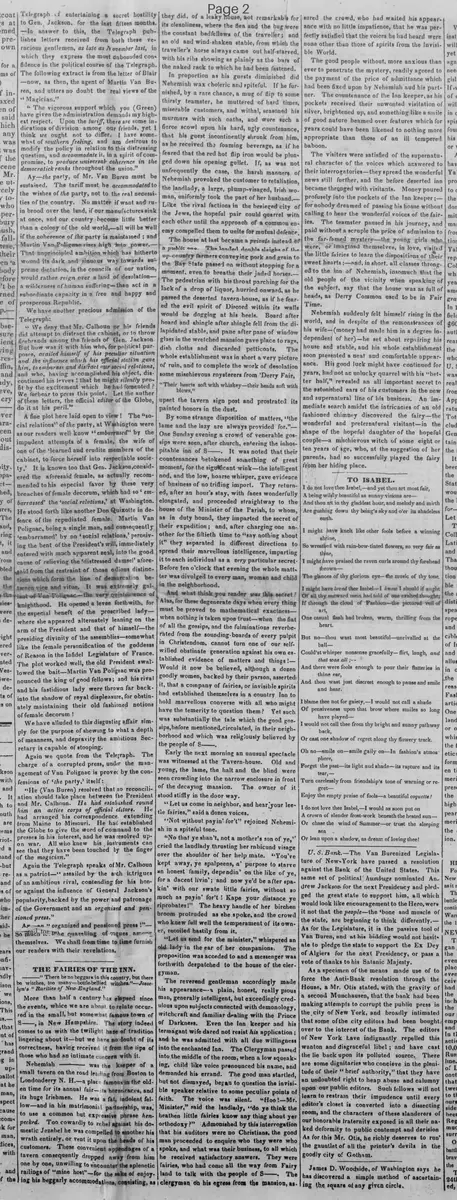
THE FAIRIES OF THE INN.
" There be no beggars in this country, but there
be witches, too many—bottle-bellied witches."—Joselyn's " Rarities of New-England."
More than half a century has elapsed since
the events, which we are about to relate occurred in the small, but somewhat famous town of
S—, in New Hampshire. The story indeed
comes to us with the twilight haze of tradition
lingering about it—but we have no doubt of its
correctness, having received it from the lips of
those who had an intimate concern with it.
Nehemiah — was the keeper of a
small tavern on the road leading from Boston to
Londonderry N. H.—a place famous in the olden time for its annual fair—its horse races, and
its huge Irishmen. He was a fat, indolent fellow—and in his matrimonial partnership, was,
to use a common but expressive phrase henpecked. Too cowardly to rebel against his domestic Jezebel he was compelled to smother his
wrath entirely, or vent it upon the heads of his
customers. These convenient appendages of a
tavern consequently dropped away from him
one by one, unwilling to encounter the splenetic
railings of "mine host"—for the sake of enjoying his beggarly accommodations, consisting, as
they did, of a leaky house, not remarkable for
its cleanliness, where the flea and the bug were
the constant bedfellows of the traveller; and
an old and wind-shaken stable, from which the
traveller's horse always came out half-starved,
with his ribs showing as plainly as the bars of
the naked rack to which he had been fastened.
In proportion as his guests diminished did
Nehemiah wax choleric and spiteful. If he furnished, by a rare chance, a mug of flip to some
thirsty teamster, he muttered of hard times,
miserable customers, and withal, seasoned his
murmurs with such oaths, and wore such a
fierce scowl upon his hard, ugly countenance,
that his guest incontinently shrunk from him,
as he received the foaming beverage, as if he
feared that the red hot flip iron would be plunged down his opening gullet. If, as was not
unfrequently the case, the harsh manners of
Nehemiah provoked the customer to retaliation,
the landlady, a large, plump-visaged, Irish woman, uniformly took the part of her husband.—
Like the rival factions in the besieged city of
the Jews, the hopeful pair could quarrel with
each other until the approach of a common enemy compelled them to unite for mutual defence.
The house at last became a private instead of
a public one. The loaded double sleighs of the
up-country farmers conveying pork and grain to
the Bay State passed on without stopping for a
moment, even to breathe their jaded horses.—
The pedestrian with his throat parching for the
lack of a drop of liquor, hurried onward, as he
passed the deserted tavern-house, as if he feared the evil spirit of Discord within its walls
would be dogging at his heels. Board after
board and shingle after shingle fell from the dilapidated stable, and pane after pane of window
glass in the wretched mansion gave place to rags,
dish cloths and discarded petticoats. The
whole establishment was in short a very picture
of ruin, and to complete the work of desolation
some mischievous roysterers from Derry Fair,
"Their hearts soft with whiskey—their heads soft with blows,"
upset the tavern sign post and prostrated its
painted honors in the dust.
By some strange disposition of matters, "the
lame and the lazy are always provided for."—
One Sunday evening a crowd of venerable gossips were seen, after church, entering the inhospitable inn of S—. It was noted that their
countenances betokened something of great
moment, for the significant wink—the intelligent nod, and the low, hoarse whisper, gave evidence of business of no trifling import. They returned, after an hour's stay, with faces wonderfully elongated, and proceeded straightway to the house of the Minister of the Parish, to whom,
as in duty bound, they imparted the secret of
their expedition; and, after charging one another for the fiftieth time to "say nothing about
it" they separated in different directions to
spread their marvellous intelligence, imparting
it to each individual as a very particular secret
Before ten o'clock that evening the whole matter was divulged to every man, woman and child
in the neighborhood.
And what think you reader was this secret?
Alas, for these degenerate days when every thing must be proved to mathematical exactness—
when nothing is taken upon trust—when the fiat of all the gossips, and the fulminations reverberated from the sounding-boards of every pulpit in Christendom, cannot turn one of our self-willed obstinate generation against his own established evidence of matters and things!—
Would it now be believed, although a dozen
goodly women, backed by their parson, asserted
it, that a company of fairies, or invisible spirits
had established themselves in a country inn to
hold marvellous converse with all who might
have the temerity to question them? Yet such
was substantially the tale which the good gossips, before mentioned, circulated, in their neighborhood and which was religiously believed by
the people of S—.
Early the next morning an unusual spectacle
was witnessed at the Tavern-house. Old and
young, the lame, the halt and the blind were
seen crowding into the narrow enclosure in front
of the decaying mansion. The owner of it
stood stiffly in the door way.
"Let us come in neighbor, and hear your little fairies," said a dozen voices.
"Not without paying 'for't" rejoined Nehemiah in a spiteful tone.
"No that you shan't, not a mother's son of you,"
cried the landlady thrusting her rubicund visage over the shoulder of her help mate. "You've
kept away, you spalpeens, a' purpose to starve
an honest family, depending on the like of you,
for a decent living'; and now you'd be after speaking with our sweet little fairies, without so
much as paying 'for't! Keep your distance you
reprobates!" The heavy handle of her birchen
broom protruded as she spoke, and the crowd
who knew full well the temperament of its owner, recoiled hastily from it.
"Let us send for the minister," whispered an
old lady in the ear of her companions. The
proposition was acceded to and a messenger was
forthwith despatched to the house of the clergyman.
The reverend gentleman accordingly made
his appearance—a plain, honest, really pious
man, generally intelligent, but exceedingly credulous upon subjects connected with demonology,
witchcraft and familiar dealing with the Prince
of Darkness. Even the inn keeper and his
termagant wife dared not resist his application;
and he was admitted with all due willingness
into the enchanted inn. The Clergyman passed
into the middle of the room, when a low squeaking, child like voice pronounced his name, and
demanded his errand. The good man startled,
but not dismayed, began to question the invisible speaker relative to some peculiar points of
faith. The voice was silent. "Hoo! Mr.
Minister," said the landlady, "do you think the
heathen little fairies know any thing about your
orthodoxy?" Admonished by this interrogation that his auditors were no Christians, the good
man proceeded to enquire who they were who
spoke, and what was their business, to all which
he received satisfactory answers. They were
fairies, who had come all the way from Fairy
land to talk with the people of S—. The
clergyman on his egress from the mansion, assured the crowd, who had waited his appearance with no little impatience, that he was perfectly satisfied that the voices he had heard were
none other than those of spirits from the Invisible World.
The good people without, more anxious than
ever to penetrate the mystery, readily agreed to
the payment of the price of admittance which
had been fixed upon by Nehemiah and his partner. The countenance of the inn keeper, as his
pockets received their unwonted visitation of
silver, brightened up, and something like a smile of good nature beamed over features which for
years could have been likened to nothing more
appropriate than those of an ill tempered
baboon.
The visitors were satisfied of the supernatural character of the voices which answered to
their interrogatories—they spread the wonderful news still further, and the before deserted inn
became thronged with visitants. Money poured
profusely into the pockets of the inn keeper;—
for nobody dreamed of passing his house without calling to hear the wonderful voices of the fairies. The teamster paused in his journey, and
paid without a scruple the price of admission to
the far-famed mystery—the young girls who
were, or imagined themselves, in love, visited
the little fairies to learn the dispositions of their
sweet hearts;—and, in short, all classes thronged to the inn of Nehemiah, insomuch that the
old people of the vicinity when speaking of
the subject, say that the house was as full of
heads, as Derry Common used to be in Fair
Time.
Nehemiah suddenly felt himself rising in the
world, and in despite of the remonstrances of
his wife—(money had made him in a degree independent of her)—he set about repairing his
house and stable, and his whole establishment
soon presented a neat and comfortable appearance. His good luck might have continued for
years, had not an unlucky quarrel with his "better half," revealed an all important secret to
the astonished ears of his customers in the new
and supernatural line of his business. An immediate search amidst the intricacies of an old
fashioned chimney discovered the fairy—the
wonderful and preternatural visitant—in the
shape of the hopeful daughter of the hopeful
couple—a mischievous witch of some eight or
ten years of age, who, at the suggestion of her
parents, had so successfully played the fairy
from her hiding place.
" There be no beggars in this country, but there
be witches, too many—bottle-bellied witches."—Joselyn's " Rarities of New-England."
More than half a century has elapsed since
the events, which we are about to relate occurred in the small, but somewhat famous town of
S—, in New Hampshire. The story indeed
comes to us with the twilight haze of tradition
lingering about it—but we have no doubt of its
correctness, having received it from the lips of
those who had an intimate concern with it.
Nehemiah — was the keeper of a
small tavern on the road leading from Boston to
Londonderry N. H.—a place famous in the olden time for its annual fair—its horse races, and
its huge Irishmen. He was a fat, indolent fellow—and in his matrimonial partnership, was,
to use a common but expressive phrase henpecked. Too cowardly to rebel against his domestic Jezebel he was compelled to smother his
wrath entirely, or vent it upon the heads of his
customers. These convenient appendages of a
tavern consequently dropped away from him
one by one, unwilling to encounter the splenetic
railings of "mine host"—for the sake of enjoying his beggarly accommodations, consisting, as
they did, of a leaky house, not remarkable for
its cleanliness, where the flea and the bug were
the constant bedfellows of the traveller; and
an old and wind-shaken stable, from which the
traveller's horse always came out half-starved,
with his ribs showing as plainly as the bars of
the naked rack to which he had been fastened.
In proportion as his guests diminished did
Nehemiah wax choleric and spiteful. If he furnished, by a rare chance, a mug of flip to some
thirsty teamster, he muttered of hard times,
miserable customers, and withal, seasoned his
murmurs with such oaths, and wore such a
fierce scowl upon his hard, ugly countenance,
that his guest incontinently shrunk from him,
as he received the foaming beverage, as if he
feared that the red hot flip iron would be plunged down his opening gullet. If, as was not
unfrequently the case, the harsh manners of
Nehemiah provoked the customer to retaliation,
the landlady, a large, plump-visaged, Irish woman, uniformly took the part of her husband.—
Like the rival factions in the besieged city of
the Jews, the hopeful pair could quarrel with
each other until the approach of a common enemy compelled them to unite for mutual defence.
The house at last became a private instead of
a public one. The loaded double sleighs of the
up-country farmers conveying pork and grain to
the Bay State passed on without stopping for a
moment, even to breathe their jaded horses.—
The pedestrian with his throat parching for the
lack of a drop of liquor, hurried onward, as he
passed the deserted tavern-house, as if he feared the evil spirit of Discord within its walls
would be dogging at his heels. Board after
board and shingle after shingle fell from the dilapidated stable, and pane after pane of window
glass in the wretched mansion gave place to rags,
dish cloths and discarded petticoats. The
whole establishment was in short a very picture
of ruin, and to complete the work of desolation
some mischievous roysterers from Derry Fair,
"Their hearts soft with whiskey—their heads soft with blows,"
upset the tavern sign post and prostrated its
painted honors in the dust.
By some strange disposition of matters, "the
lame and the lazy are always provided for."—
One Sunday evening a crowd of venerable gossips were seen, after church, entering the inhospitable inn of S—. It was noted that their
countenances betokened something of great
moment, for the significant wink—the intelligent nod, and the low, hoarse whisper, gave evidence of business of no trifling import. They returned, after an hour's stay, with faces wonderfully elongated, and proceeded straightway to the house of the Minister of the Parish, to whom,
as in duty bound, they imparted the secret of
their expedition; and, after charging one another for the fiftieth time to "say nothing about
it" they separated in different directions to
spread their marvellous intelligence, imparting
it to each individual as a very particular secret
Before ten o'clock that evening the whole matter was divulged to every man, woman and child
in the neighborhood.
And what think you reader was this secret?
Alas, for these degenerate days when every thing must be proved to mathematical exactness—
when nothing is taken upon trust—when the fiat of all the gossips, and the fulminations reverberated from the sounding-boards of every pulpit in Christendom, cannot turn one of our self-willed obstinate generation against his own established evidence of matters and things!—
Would it now be believed, although a dozen
goodly women, backed by their parson, asserted
it, that a company of fairies, or invisible spirits
had established themselves in a country inn to
hold marvellous converse with all who might
have the temerity to question them? Yet such
was substantially the tale which the good gossips, before mentioned, circulated, in their neighborhood and which was religiously believed by
the people of S—.
Early the next morning an unusual spectacle
was witnessed at the Tavern-house. Old and
young, the lame, the halt and the blind were
seen crowding into the narrow enclosure in front
of the decaying mansion. The owner of it
stood stiffly in the door way.
"Let us come in neighbor, and hear your little fairies," said a dozen voices.
"Not without paying 'for't" rejoined Nehemiah in a spiteful tone.
"No that you shan't, not a mother's son of you,"
cried the landlady thrusting her rubicund visage over the shoulder of her help mate. "You've
kept away, you spalpeens, a' purpose to starve
an honest family, depending on the like of you,
for a decent living'; and now you'd be after speaking with our sweet little fairies, without so
much as paying 'for't! Keep your distance you
reprobates!" The heavy handle of her birchen
broom protruded as she spoke, and the crowd
who knew full well the temperament of its owner, recoiled hastily from it.
"Let us send for the minister," whispered an
old lady in the ear of her companions. The
proposition was acceded to and a messenger was
forthwith despatched to the house of the clergyman.
The reverend gentleman accordingly made
his appearance—a plain, honest, really pious
man, generally intelligent, but exceedingly credulous upon subjects connected with demonology,
witchcraft and familiar dealing with the Prince
of Darkness. Even the inn keeper and his
termagant wife dared not resist his application;
and he was admitted with all due willingness
into the enchanted inn. The Clergyman passed
into the middle of the room, when a low squeaking, child like voice pronounced his name, and
demanded his errand. The good man startled,
but not dismayed, began to question the invisible speaker relative to some peculiar points of
faith. The voice was silent. "Hoo! Mr.
Minister," said the landlady, "do you think the
heathen little fairies know any thing about your
orthodoxy?" Admonished by this interrogation that his auditors were no Christians, the good
man proceeded to enquire who they were who
spoke, and what was their business, to all which
he received satisfactory answers. They were
fairies, who had come all the way from Fairy
land to talk with the people of S—. The
clergyman on his egress from the mansion, assured the crowd, who had waited his appearance with no little impatience, that he was perfectly satisfied that the voices he had heard were
none other than those of spirits from the Invisible World.
The good people without, more anxious than
ever to penetrate the mystery, readily agreed to
the payment of the price of admittance which
had been fixed upon by Nehemiah and his partner. The countenance of the inn keeper, as his
pockets received their unwonted visitation of
silver, brightened up, and something like a smile of good nature beamed over features which for
years could have been likened to nothing more
appropriate than those of an ill tempered
baboon.
The visitors were satisfied of the supernatural character of the voices which answered to
their interrogatories—they spread the wonderful news still further, and the before deserted inn
became thronged with visitants. Money poured
profusely into the pockets of the inn keeper;—
for nobody dreamed of passing his house without calling to hear the wonderful voices of the fairies. The teamster paused in his journey, and
paid without a scruple the price of admission to
the far-famed mystery—the young girls who
were, or imagined themselves, in love, visited
the little fairies to learn the dispositions of their
sweet hearts;—and, in short, all classes thronged to the inn of Nehemiah, insomuch that the
old people of the vicinity when speaking of
the subject, say that the house was as full of
heads, as Derry Common used to be in Fair
Time.
Nehemiah suddenly felt himself rising in the
world, and in despite of the remonstrances of
his wife—(money had made him in a degree independent of her)—he set about repairing his
house and stable, and his whole establishment
soon presented a neat and comfortable appearance. His good luck might have continued for
years, had not an unlucky quarrel with his "better half," revealed an all important secret to
the astonished ears of his customers in the new
and supernatural line of his business. An immediate search amidst the intricacies of an old
fashioned chimney discovered the fairy—the
wonderful and preternatural visitant—in the
shape of the hopeful daughter of the hopeful
couple—a mischievous witch of some eight or
ten years of age, who, at the suggestion of her
parents, had so successfully played the fairy
from her hiding place.
What sub-type of article is it?
Prose Fiction
Satire
What themes does it cover?
Moral Virtue
Social Manners
Religious
What keywords are associated?
Fairies
Inn
Hoax
Superstition
Tavern
New Hampshire
Gossip
Clergyman
Deception
Literary Details
Title
The Fairies Of The Inn.
Key Lines
" There Be No Beggars In This Country, But There
Be Witches, Too Many—Bottle Bellied Witches."—Joselyn's " Rarities Of New England."
"Let Us Come In Neighbor, And Hear Your Little Fairies," Said A Dozen Voices.
"Not Without Paying 'For't" Rejoined Nehemiah In A Spiteful Tone.
They Were
Fairies, Who Had Come All The Way From Fairy
Land To Talk With The People Of S—.
A Mischievous Witch Of Some Eight Or
Ten Years Of Age, Who, At The Suggestion Of Her
Parents, Had So Successfully Played The Fairy
From Her Hiding Place.