Thank you for visiting SNEWPapers!
Sign up free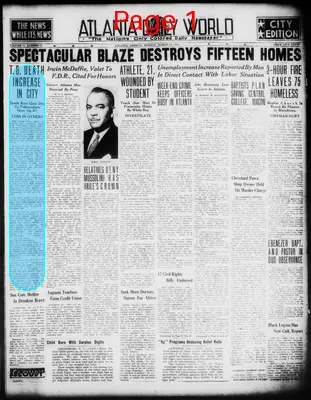
Atlanta Daily World
Atlanta, Fulton County, Georgia
What is this article about?
1936 report by G.J. Drolet on tuberculosis death rates among Black Americans in 46 U.S. cities vs. 1935, noting sharp increases in places like Portland (198%) and decreases in St. Paul, Minneapolis, Omaha. Top cities mostly saw rises except Memphis, Detroit. Urges improved health measures.
Clipping

OCR Quality
Full Text
Death Rate Gain Due to Tuberculosis Here Up 5%
LOSS IN OTHERS
NEW YORK CITY-(ANP)-Interesting facts concerning deaths from tuberculosis among Negroes in 46 American cities is revealed in a recently released report compiled by G. J. Drolet of the New York Tuberculosis and Health Association, the survey being made by courtesy of the Health Commissioners of each city included in the survey.
Covering the year 1930 the report contrasts the mortality rate with that of 1935, all increases or declines being made on that basis.
The greatest increase (198 per cent) was recorded in Portland, Oregon, with a Negro population of 1,645, where in 1935, there was only one death, in 1936, three.
Next in increase is Worcester, Mass., population 1,345, two deaths in 1935, four in 1936.
Omaha, Nebr., St. Paul, Minn. and the twin city, Minneapolis, lead the cities of the nation in Negro mortality decrease. St. Paul with 4,507 Negroes, had 8 deaths in 1935, only 4 in 1936; Minneapolis, with 4,424, had 7 deaths in 1935, only 4 in 1936; Omaha, with 11,436 Negroes had 25 deaths from consumption in 1935 only 13 in 1936.
Two cities among the 46, Syracuse, N. Y., 2,000 Negroes and Cleveland, Ohio, 74,628 Negroes, had the same number of deaths in 1936 as the previous year, viz, Syracuse 1, Cleveland 243.
The ten cities in America leading in Negro population are New York City, 348,152; Chicago, 241,801; Philadelphia, 228,329; Washington, D. C., 167,910; Baltimore, 149,757; New Orleans, 143,828; Detroit, 126,138; Birmingham, 108,968; Memphis, 105,002, and Atlanta, 104,051. Of these ten, Chicago, Washington and Baltimore showed a 2 percent increase in the tuberculosis death rate. Atlanta has a 5 per cent increase death rate due to tuberculosis, New Orleans, 4 per cent. New York 1 per cent and Philadelphia 9 per cent, all increases in the death rate. It is significant that among the 10 leading cities, only two-Memphis and Detroit showed decreases: Memphis 8 per cent and Detroit 3 per cent.
The report of the New York Association and the recommendations from the Health Commissioners of the various cities stressed the need for continuing unabated the fight against tuberculosis. Better living conditions, better hospitalization facilities, the need for periodic examinations by those exposed to the disease, and protection of children against tuberculosis were some of the measures recommended to halt the death rate among Negroes.
What sub-type of article is it?
What themes does it cover?
What keywords are associated?
What entities or persons were involved?
Where did it happen?
Story Details
Key Persons
Location
46 American Cities Including New York City, Portland Oregon, Worcester Mass., Omaha Nebr., St. Paul Minn., Minneapolis, Syracuse N.Y., Cleveland Ohio, Chicago, Philadelphia, Washington D.C., Baltimore, New Orleans, Detroit, Birmingham, Memphis, Atlanta
Event Date
1935 1936
Story Details
Report contrasts tuberculosis mortality rates among Negroes in 46 U.S. cities from 1935 to 1936, showing increases like 198% in Portland Oregon (1 to 3 deaths), 100% in Worcester Mass. (2 to 4), and decreases in St. Paul (8 to 4), Minneapolis (7 to 4), Omaha (25 to 13). Syracuse and Cleveland unchanged (1 and 243). Among top 10 cities by Negro population, increases in Chicago Washington Baltimore (2%), Atlanta (5%), New Orleans (4%), New York (1%), Philadelphia (9%); decreases in Memphis (8%), Detroit (3%). Recommends better living conditions, hospitalization, examinations, child protection to combat tuberculosis.