Thank you for visiting SNEWPapers!
Sign up free
Story
June 15, 1840
Lynchburg Virginian
Lynchburg, Virginia
What is this article about?
Political defense of Gen. Harrison against Federalist accusations, citing his 1800 speech opposing repeal of the 1798 Provisional Army act amid French threats. Contrasts with Jackson administration's larger peacetime military proposals, highlighting supporters like Gen. Samuel Smith.
Clipping
OCR Quality
95%
Excellent
Full Text
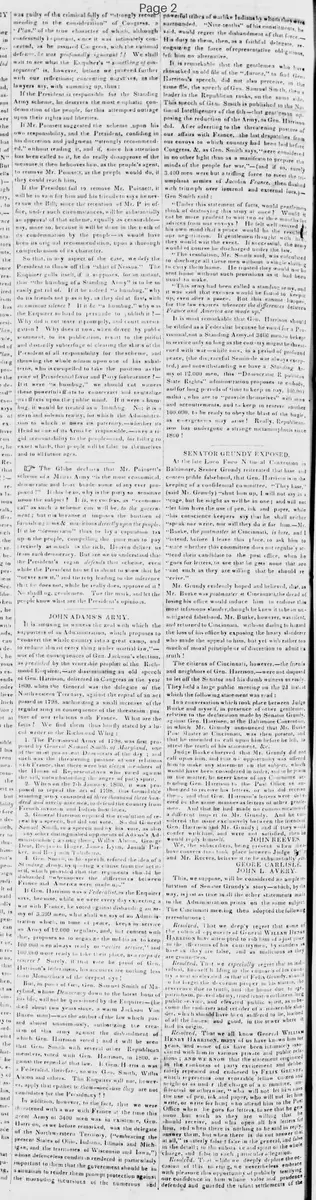
JOHN ADAMS'S ARMY.
It is amusing to witness the zeal with which the supporters of an Administration, which proposes to "convert the whole country into a great camp, and to reduce almost every thing under martial law,"—one of the consequences of Gen. Jackson's election, as predicted by the venerable prophet of the Richmond Enquirer,—are disseminating an old speech of Gen. Harrison, delivered in Congress in the year 1800, when the General was the delegate of the Northwestern Territory, against the repeal of an act passed in 1798, authorizing a small increase of the regular army in consequence of the threatening posture of our relations with France. What are the facts? We find them thus briefly stated by a lucid writer in the Richmond Whig:
1. The Provisional Army of 1798, was first proposed by General Samuel Smith, of Maryland, one of the most prominent Democrats of the day; and such was the threatening posture of our relations with France, that there were but eleven members of the House of Representatives who voted against the bill, notwithstanding the anger of party spirit.
2. When on the 7th January, 1800, it was proposed to repeal the act of 1798, this formidable standing army consisted of three thousand three hundred and ninety-nine men, to defend the country from French invasion and Indian hostilities.
3. General Harrison opposed the resolution of repeal by a speech, but did not vote. So did General Samuel Smith, in a speech and by his vote, as also did many other distinguished opponents of Adams's Administration; among them, Willis Alston, George Dent, Benjamin Huger, James Bayard, Josiah Parker, and Benjamin Taliaferro.
4. Gen. Smith, in his speech, refuted the idea of a Standing Army, by quoting a clause from the act itself, which provided that the regiments should be disbanded "whensoever the differences between France and America were made up."
If Gen. Harrison was a Federalist, as the Enquirer says, because, while we were every day expecting a war with France, he voted against disbanding an army of 3,399 men, what shall we say of an Administration which, in time of peace, keeps in service an Army of 12,000 regulars, and, not content with that, proposes so to organize the militia as to keep 100,000 men always ready for "active service," and 100,000 more ready to take their place, as a corps de reserve? Surely, if that vote be proof of Gen. Harrison's federalism, his accusers are nothing less than Monarchists of the deepest dye!
But, in point of fact, Gen. Samuel Smith of Maryland, whose Democracy down to the latest hour of his life, will not be questioned by the Enquirer—he died about two years since, a warm Jackson Van Buren man—was the author of the law which passed almost unanimously, authorizing the creation of this army against the disbandment of which Gen. Harrison voted: and it will be seen that Gen. Smith with several other Republican members, voted with Gen. Harrison, in 1800, against the repeal of that law. If Gen. Harrison was a Federalist, therefore, so was Gen. Smith, Willis Alston and others. The Enquirer will not, however, apply that epithet to them—because they are not candidates for the Presidency!!
In addition, however, to the fact, that we were threatened with a war with France at the time this great Army of 3,400 men was in existence, Gen. Harrison, as we before remarked, was the delegate of the Northwestern Territory, ("embracing the present States of Ohio, Indiana, Illinois and Michigan, and the territories of Wisconsin and Iowa,") whose defenceless condition rendered it peculiarly important to them that the government should be in a situation to render them prompt protection against the marauding incursions of the numerous and powerful tribes of warlike Indians by whom they were surrounded. "Nine-tenths" of his constituents, he said, would regret the disbandment of that force.—His duty to them, then, as a faithful delegate, recognizing the force of representative obligations, left him no alternative.
It is remarkable that the gentlemen who have ransacked an old file of the "Aurora," to find Gen. Harrison's speech, did not also perceive, in the same file, the speech of Gen. Samuel Smith, then a leader in the Republican ranks, on the same side. This speech of Gen. Smith is published in the National Intelligencer of the 6th—that gentleman opposing the reduction of the Army, as Gen. Harrison did. After adverting to the threatening posture of our affairs with France, the last despatches from our envoys to which country had been laid before Congress, &, as Gen. Smith says, "were considered in no other light than as a manifesto to prepare the minds of the people for war,"—(and if so, surely 3,400 men were but a trifling force to meet the triumphant armies of Jacobin France, then flushed with triumph over internal and external foes.)—Gen. Smith said:
"Under this statement of facts, would gentlemen think of destroying this army at once? Would it not be more prudent to wait two or three months for advices from our envoys? He felt well assured in his own mind that a peace would be the result of our negotiation. If gentlemen thought with him, they would wait the event. If successful, the army would of course be discharged under the law. The resolution, Mr. Smith said, was calculated to discharge all these men without a single shilling to carry them home. He trusted they would not be sent home without such provisions as it had been usual to make.
"This army had been called a standing army, and it was said that excuses would be found to keep it up, even after a peace. But this cannot happen, for the law expires whenever the differences between France and America are made up."
It is most remarkable that Gen. Harrison should be vilified as a Federalist because he voted for a Provisional, not a Standing Army, of 3,400 men, to be kept in service only so long as the country might be threatened with war—while now, in a period of profound peace, (the disgraceful Seminole war always excepted,) and notwithstanding we have a Standing Army of 12,000 men, this "Democratic Republican State Rights" administration proposes to embody, and for long periods of time to keep in pay, 100,000 militia, who are to "provide themselves" with arms and accoutrements, and to keep in reserve another 100,000, to be ready to obey the blast of the bugle, as emergencies may arise! Really, Republicanism has undergone a strange metamorphosis since 1800!
It is amusing to witness the zeal with which the supporters of an Administration, which proposes to "convert the whole country into a great camp, and to reduce almost every thing under martial law,"—one of the consequences of Gen. Jackson's election, as predicted by the venerable prophet of the Richmond Enquirer,—are disseminating an old speech of Gen. Harrison, delivered in Congress in the year 1800, when the General was the delegate of the Northwestern Territory, against the repeal of an act passed in 1798, authorizing a small increase of the regular army in consequence of the threatening posture of our relations with France. What are the facts? We find them thus briefly stated by a lucid writer in the Richmond Whig:
1. The Provisional Army of 1798, was first proposed by General Samuel Smith, of Maryland, one of the most prominent Democrats of the day; and such was the threatening posture of our relations with France, that there were but eleven members of the House of Representatives who voted against the bill, notwithstanding the anger of party spirit.
2. When on the 7th January, 1800, it was proposed to repeal the act of 1798, this formidable standing army consisted of three thousand three hundred and ninety-nine men, to defend the country from French invasion and Indian hostilities.
3. General Harrison opposed the resolution of repeal by a speech, but did not vote. So did General Samuel Smith, in a speech and by his vote, as also did many other distinguished opponents of Adams's Administration; among them, Willis Alston, George Dent, Benjamin Huger, James Bayard, Josiah Parker, and Benjamin Taliaferro.
4. Gen. Smith, in his speech, refuted the idea of a Standing Army, by quoting a clause from the act itself, which provided that the regiments should be disbanded "whensoever the differences between France and America were made up."
If Gen. Harrison was a Federalist, as the Enquirer says, because, while we were every day expecting a war with France, he voted against disbanding an army of 3,399 men, what shall we say of an Administration which, in time of peace, keeps in service an Army of 12,000 regulars, and, not content with that, proposes so to organize the militia as to keep 100,000 men always ready for "active service," and 100,000 more ready to take their place, as a corps de reserve? Surely, if that vote be proof of Gen. Harrison's federalism, his accusers are nothing less than Monarchists of the deepest dye!
But, in point of fact, Gen. Samuel Smith of Maryland, whose Democracy down to the latest hour of his life, will not be questioned by the Enquirer—he died about two years since, a warm Jackson Van Buren man—was the author of the law which passed almost unanimously, authorizing the creation of this army against the disbandment of which Gen. Harrison voted: and it will be seen that Gen. Smith with several other Republican members, voted with Gen. Harrison, in 1800, against the repeal of that law. If Gen. Harrison was a Federalist, therefore, so was Gen. Smith, Willis Alston and others. The Enquirer will not, however, apply that epithet to them—because they are not candidates for the Presidency!!
In addition, however, to the fact, that we were threatened with a war with France at the time this great Army of 3,400 men was in existence, Gen. Harrison, as we before remarked, was the delegate of the Northwestern Territory, ("embracing the present States of Ohio, Indiana, Illinois and Michigan, and the territories of Wisconsin and Iowa,") whose defenceless condition rendered it peculiarly important to them that the government should be in a situation to render them prompt protection against the marauding incursions of the numerous and powerful tribes of warlike Indians by whom they were surrounded. "Nine-tenths" of his constituents, he said, would regret the disbandment of that force.—His duty to them, then, as a faithful delegate, recognizing the force of representative obligations, left him no alternative.
It is remarkable that the gentlemen who have ransacked an old file of the "Aurora," to find Gen. Harrison's speech, did not also perceive, in the same file, the speech of Gen. Samuel Smith, then a leader in the Republican ranks, on the same side. This speech of Gen. Smith is published in the National Intelligencer of the 6th—that gentleman opposing the reduction of the Army, as Gen. Harrison did. After adverting to the threatening posture of our affairs with France, the last despatches from our envoys to which country had been laid before Congress, &, as Gen. Smith says, "were considered in no other light than as a manifesto to prepare the minds of the people for war,"—(and if so, surely 3,400 men were but a trifling force to meet the triumphant armies of Jacobin France, then flushed with triumph over internal and external foes.)—Gen. Smith said:
"Under this statement of facts, would gentlemen think of destroying this army at once? Would it not be more prudent to wait two or three months for advices from our envoys? He felt well assured in his own mind that a peace would be the result of our negotiation. If gentlemen thought with him, they would wait the event. If successful, the army would of course be discharged under the law. The resolution, Mr. Smith said, was calculated to discharge all these men without a single shilling to carry them home. He trusted they would not be sent home without such provisions as it had been usual to make.
"This army had been called a standing army, and it was said that excuses would be found to keep it up, even after a peace. But this cannot happen, for the law expires whenever the differences between France and America are made up."
It is most remarkable that Gen. Harrison should be vilified as a Federalist because he voted for a Provisional, not a Standing Army, of 3,400 men, to be kept in service only so long as the country might be threatened with war—while now, in a period of profound peace, (the disgraceful Seminole war always excepted,) and notwithstanding we have a Standing Army of 12,000 men, this "Democratic Republican State Rights" administration proposes to embody, and for long periods of time to keep in pay, 100,000 militia, who are to "provide themselves" with arms and accoutrements, and to keep in reserve another 100,000, to be ready to obey the blast of the bugle, as emergencies may arise! Really, Republicanism has undergone a strange metamorphosis since 1800!
What sub-type of article is it?
Historical Event
Biography
What themes does it cover?
Deception
Justice
What keywords are associated?
Harrison Speech
Provisional Army
French Threats
Political Defense
Military Expansion
Federalist Accusation
What entities or persons were involved?
Gen. Harrison
Gen. Samuel Smith
John Adams
Gen. Jackson
Where did it happen?
Northwestern Territory
Story Details
Key Persons
Gen. Harrison
Gen. Samuel Smith
John Adams
Gen. Jackson
Location
Northwestern Territory
Event Date
Year 1800
Story Details
Article defends Gen. Harrison's opposition to repealing the 1798 Provisional Army act during French threats, noting support from Democrats like Gen. Smith; contrasts with larger peacetime military under Jackson administration.