Thank you for visiting SNEWPapers!
Sign up free
Editorial
March 9, 1869
Owyhee Semi Weekly Tidal Wave
Silver City, Owyhee County, Idaho
What is this article about?
Editorial advocates for uniform use of U.S. legal tender notes and national bank currency nationwide until specie resumption, criticizing California and Nevada's gold coin policy for undermining San Francisco's interior trade amid Pacific Railroad connections. Highlights currency fluctuations harming Idaho miners.
Clipping
OCR Quality
95%
Excellent
Full Text
CURRENCY.
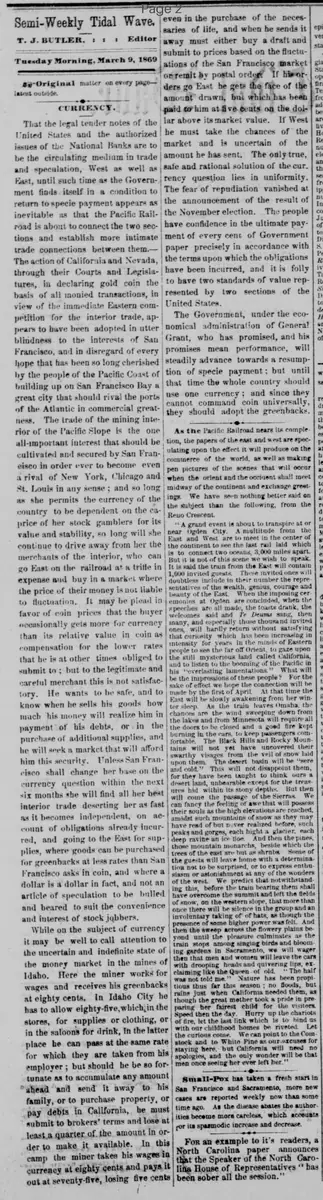
That the legal tender notes of the United States and the authorized issues of the National Banks are to be the circulating medium in trade and speculation, West as well as East, until such time as the Government finds itself in a condition to return to specie payment appears as inevitable as that the Pacific Railroad is about to connect the two sections and establish more intimate trade connections between them. The action of California and Nevada, through their Courts and Legislatures, in declaring gold coin the basis of all monied transactions, in view of the immediate Eastern competition for the interior trade, appears to have been adopted in utter blindness to the interests of San Francisco, and in disregard of every hope that has been so long cherished by the people of the Pacific Coast of building up on San Francisco Bay a great city that should rival the ports of the Atlantic in commercial greatness. The trade of the mining interior of the Pacific Slope is the one all-important interest that should be cultivated and secured by San Francisco in order ever to become even a rival of New York, Chicago and St. Louis in any sense; and so long as she permits the currency of the country to be dependent on the caprice of her stock gamblers for its value and stability, so long will she continue to drive away from her the merchants of the interior, who can go East on the railroad at a trifle in expense and buy in a market where the price of their money is not liable to fluctuation. It may be plead in favor of coin prices that the buyer occasionally gets more for currency than its relative value in coin as compensation for the lower rates that he is at other times obliged to submit to; but to the legitimate and careful merchant this is not satisfactory. He wants to be safe, and to know when he sells his goods how much his money will realize him in payment of his debts, or in the purchase of additional supplies, and he will seek a market that will afford him this security. Unless San Francisco shall change her base on the currency question within the next six months she will find all her best interior trade deserting her as fast as it becomes independent, on account of obligations already incurred, and going to the East for supplies, where goods can be purchased for greenbacks at less rates than San Francisco asks in coin, and where a dollar is a dollar in fact, and not an article of speculation to be bull'ed and bear'ed to suit the convenience and interest of stock jobbers.
While on the subject of currency it may be well to call attention to the uncertain and indefinite state of the money market in the mines of Idaho. Here the miner works for wages and receives his greenbacks at eighty cents. In Idaho City he has to allow eighty-five, which in the stores, for supplies or clothing, or in the saloons for drink, in the latter place he can pass at the same rate for which they are taken from his employer; but should he be so fortunate as to accumulate any amount of head and send it away to his family, or to purchase property, or pay debts in California, he must submit to brokers' terms and lose at least a quarter of the amount in order to make it available. In this camp the miner takes his wages in currency at eighty cents and pays it out at seventy-five, losing five cents even in the purchase of the necessaries of life, and when he sends it away must either buy a draft and submit to prices based on the fluctuations of the San Francisco market or remit by postal order. If his orders go East he gets the face of the amount drawn, but which has been paid to him at five cents on the dollar above its market value. If West he must take the chances of the market and is uncertain of the amount he has sent. The only true, safe and rational solution of the currency question lies in uniformity. The fear of repudiation vanished at the announcement of the result of the November election. The people have confidence in the ultimate payment of every cent of Government paper precisely in accordance with the terms upon which the obligations have been incurred, and it is folly to have two standards of value represented by two sections of the United States.
The Government, under the economical administration of General Grant, who has promised, and his promises mean performance, will steadily advance towards a resumption of specie payment; but until that time the whole country should use one currency; and since they cannot command coin universally, they should adopt the greenbacks.
That the legal tender notes of the United States and the authorized issues of the National Banks are to be the circulating medium in trade and speculation, West as well as East, until such time as the Government finds itself in a condition to return to specie payment appears as inevitable as that the Pacific Railroad is about to connect the two sections and establish more intimate trade connections between them. The action of California and Nevada, through their Courts and Legislatures, in declaring gold coin the basis of all monied transactions, in view of the immediate Eastern competition for the interior trade, appears to have been adopted in utter blindness to the interests of San Francisco, and in disregard of every hope that has been so long cherished by the people of the Pacific Coast of building up on San Francisco Bay a great city that should rival the ports of the Atlantic in commercial greatness. The trade of the mining interior of the Pacific Slope is the one all-important interest that should be cultivated and secured by San Francisco in order ever to become even a rival of New York, Chicago and St. Louis in any sense; and so long as she permits the currency of the country to be dependent on the caprice of her stock gamblers for its value and stability, so long will she continue to drive away from her the merchants of the interior, who can go East on the railroad at a trifle in expense and buy in a market where the price of their money is not liable to fluctuation. It may be plead in favor of coin prices that the buyer occasionally gets more for currency than its relative value in coin as compensation for the lower rates that he is at other times obliged to submit to; but to the legitimate and careful merchant this is not satisfactory. He wants to be safe, and to know when he sells his goods how much his money will realize him in payment of his debts, or in the purchase of additional supplies, and he will seek a market that will afford him this security. Unless San Francisco shall change her base on the currency question within the next six months she will find all her best interior trade deserting her as fast as it becomes independent, on account of obligations already incurred, and going to the East for supplies, where goods can be purchased for greenbacks at less rates than San Francisco asks in coin, and where a dollar is a dollar in fact, and not an article of speculation to be bull'ed and bear'ed to suit the convenience and interest of stock jobbers.
While on the subject of currency it may be well to call attention to the uncertain and indefinite state of the money market in the mines of Idaho. Here the miner works for wages and receives his greenbacks at eighty cents. In Idaho City he has to allow eighty-five, which in the stores, for supplies or clothing, or in the saloons for drink, in the latter place he can pass at the same rate for which they are taken from his employer; but should he be so fortunate as to accumulate any amount of head and send it away to his family, or to purchase property, or pay debts in California, he must submit to brokers' terms and lose at least a quarter of the amount in order to make it available. In this camp the miner takes his wages in currency at eighty cents and pays it out at seventy-five, losing five cents even in the purchase of the necessaries of life, and when he sends it away must either buy a draft and submit to prices based on the fluctuations of the San Francisco market or remit by postal order. If his orders go East he gets the face of the amount drawn, but which has been paid to him at five cents on the dollar above its market value. If West he must take the chances of the market and is uncertain of the amount he has sent. The only true, safe and rational solution of the currency question lies in uniformity. The fear of repudiation vanished at the announcement of the result of the November election. The people have confidence in the ultimate payment of every cent of Government paper precisely in accordance with the terms upon which the obligations have been incurred, and it is folly to have two standards of value represented by two sections of the United States.
The Government, under the economical administration of General Grant, who has promised, and his promises mean performance, will steadily advance towards a resumption of specie payment; but until that time the whole country should use one currency; and since they cannot command coin universally, they should adopt the greenbacks.
What sub-type of article is it?
Economic Policy
Trade Or Commerce
What keywords are associated?
Currency Uniformity
Greenbacks
Gold Coin
San Francisco Trade
Idaho Mines
Specie Payment
Pacific Railroad
What entities or persons were involved?
United States Government
California
Nevada
San Francisco
General Grant
Idaho Miners
Stock Gamblers
Editorial Details
Primary Topic
Uniform Adoption Of National Currency Over Regional Gold Coin Standards
Stance / Tone
Strong Advocacy For Currency Uniformity To Protect Western Trade
Key Figures
United States Government
California
Nevada
San Francisco
General Grant
Idaho Miners
Stock Gamblers
Key Arguments
Legal Tender Notes And National Bank Issues Should Be Circulating Medium Nationwide Until Specie Resumption
California And Nevada's Gold Coin Policy Blinds Them To San Francisco's Interests And Drives Away Interior Trade
Pacific Railroad Will Enable Eastern Competition, Making Uniform Currency Essential
Idaho Miners Suffer Losses From Currency Fluctuations In Daily Transactions And Remittances
Uniformity Is The Safe Solution; Repudiation Fears Ended With November Election
Government Under Grant Will Resume Specie Payments, But Greenbacks Should Be Used Uniformly Until Then